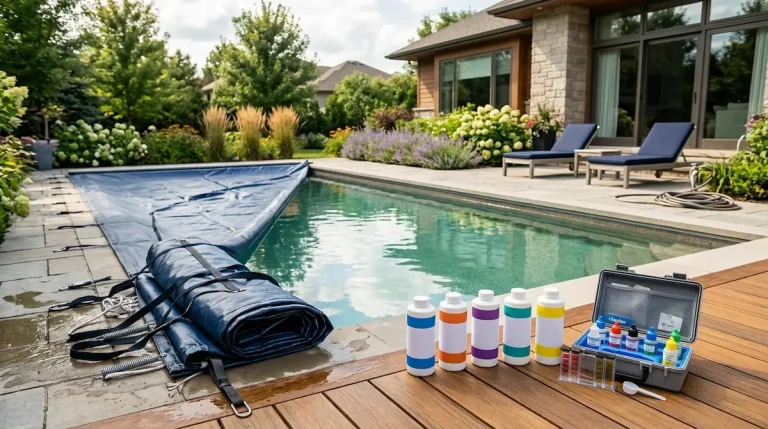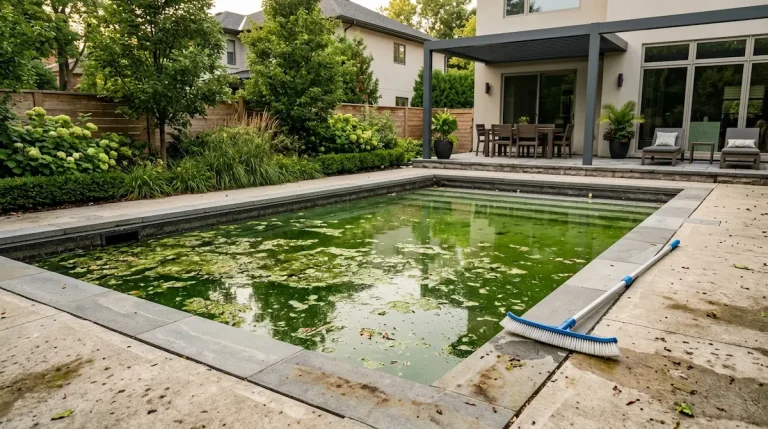
You bought the house. The pool came with it. Now there’s a green tint creeping across the shallow end, a shelf of jugs you can’t pronounce, and a quiet fear that you’re about to ruin something expensive. Breathe. Pool water chemistry looks intimidating from the outside, but it really comes down to five numbers and the order you fix them in.
This is pool chemistry for beginners, written the way I wish someone had explained it to me the first summer I owned a pool. No jargon dumps. Just what each number does, where it should sit, and what to do when it drifts off.
What balanced pool water actually looks like
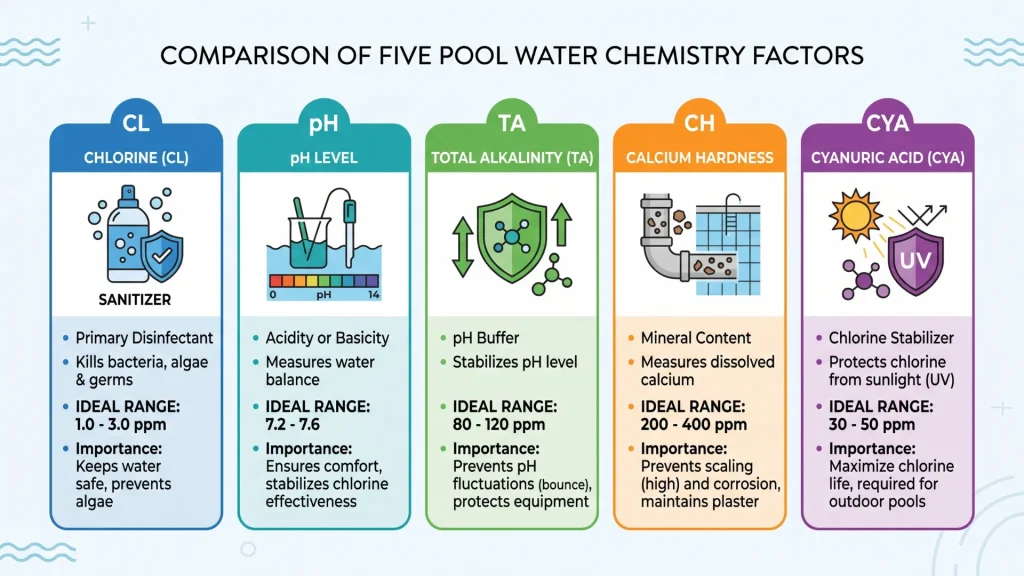
Balanced water really just means five readings all land where they should: free chlorine sitting at 2 to 4 ppm, pH between 7.4 and 7.6, total alkalinity from 80 to 120 ppm, calcium hardness anywhere in the 200 to 400 ppm band, and cyanuric acid around 30 to 50 ppm. Hold those five steadies and the water stays clear, safe for swimmers, and easy on your gear.
Print this table. Stick it on the pump shed. It’s the whole game on one screen.
| What you test | Ideal range | What it controls | If it’s off |
|---|---|---|---|
| Free chlorine | 2–4 ppm | Your germ and algae killer | Water turns cloudy, unsafe, or green |
| pH | 7.4–7.6 | Sets acidity, and whether chlorine can even work | Stinging eyes, lazy chlorine, scale |
| Total alkalinity | 80–120 ppm | Keeps pH from bouncing around | pH swings all over the place |
| Calcium hardness | 200–400 ppm | Guards plaster and surfaces | Etching when low, scale when high |
| Cyanuric acid (CYA) | 30–50 ppm | Shields chlorine from sunlight | Chlorine burns off fast, or gets locked up |
Where do these ranges come from? A mix of the CDC’s healthy swimming guidance and the test ranges the pool industry has settled on (full sources are listed at the bottom). Worth noting: the CDC actually allows a wider pH band, 7.0 to 7.8, and free chlorine as low as 1 ppm, bumped to 2 ppm once stabilizer is in the water. (CDC: Home Pool Water Treatment and Testing)
Why balance matters more than any single chemical
When water falls out of balance, it drifts one of two directions, and your wallet feels both.
Let it turn too acidic and the water gets hungry. It strips metal off ladders, eats into plaster, and works away at the inside of your heater. Swing too far the other way, too alkaline, and the reverse happens. Calcium drops out of solution and cakes onto tile, jets, and the waterline as chalky scale.
What you’re aiming for is the calm middle: clear, comfortable, and quietly doing its job. Cloudy or green water almost always traces back to chemistry. If murky water is what you’re looking at right now, cloudy pool water can be traced step by step to its cause. If the problem has already turned green, pool algae needs its own treatment path.
The five numbers, explained one at a time
No chemistry degree required here. What you do need is a feel for what each dial does and which way to turn it.
pH: the one that runs the whole show
Picture pH as a 0-to-14 dial for acidity, and your water wants to sit just past the middle. It runs the show because it decides whether your chlorine pulls its weight at all. Let pH drift above 7.6 and the chlorine turns lazy, showing up on your test yet doing little in the water. Let it slip under 7.2 and swimmers get red eyes while your surfaces quietly wear down.
Need it higher? Add soda ash. Need it lower? Reach for muriatic acid or dry acid. Work in small doses, keep the pump running, and come back to retest a few hours later. For the deeper mechanics and dosing math, it’s worth getting to know pool pH on its own.
Total alkalinity: the shock absorber
Alkalinity is pH’s bodyguard. It buffers the water so pH stops bouncing every time it rains or a crowd jumps in. Get alkalinity right first, and pH becomes far easier to hold steady.
Running low? Baking soda (sodium bicarbonate) brings it back up. Sitting too high? Add acid, then aerate to finish the job. For the full ideal range, symptoms, and correction steps, read pool alkalinity before you start chasing pH.</p>
Free chlorine: the sanitizer doing the dirty work
Free chlorine is whatever sanitizer is still unused and on patrol, ready to take out bacteria and algae. In most backyard pools you want it between 2 and 4 ppm. Come a hot, sunny, crowded weekend, it burns off quicker, so you’ll be testing and topping up more often.
Here’s the catch: chlorine isn’t one single thing. Tablets, granules, liquid, and salt-generated chlorine all behave differently, and a few arrive with stabilizer already baked in. Before you commit to a bucket of anything, get familiar with the different types of pool chlorine. And when free chlorine bottoms out or algae moves in, you shock the pool, a heavy reset dose, which has its own timing and dosing to get right.
Calcium hardness: the surface protector
Calcium hardness just tracks how much dissolved calcium is riding around in your water. Run it too low and the soft water goes looking for calcium, pulling it straight out of your plaster and grout. Run it too high and the surplus settles out as scale. Park it between 200 and 400 ppm and your surfaces hold up far longer.
Cyanuric acid: sunscreen for your chlorine
Cyanuric acid, CYA for short, is the stabilizer that shields your chlorine from UV. Leave chlorine unstabilized under full sun and it can shed up to half its punch inside an hour. A touch of CYA solves that. Keep it in the 30 to 50 ppm range.
The trap? Overdoing it. Push CYA past 50 and the extra shielding does almost nothing, and once it clears 75 ppm it starts choking your chlorine instead. For the full breakdown, cyanuric acid deserves a closer look. Salt pools wrestle with CYA as well, so if a salt generator runs your water, saltwater pool care comes with its own salt-specific quirks. One more troublemaker deserves a spot on your radar: phosphates, which feed algae and quietly drain your chlorine. Look into phosphates if your chlorine keeps vanishing for no clear reason.
The number most charts skip: chlorine and CYA work as a pair
This is the part that trips up almost every new owner, and most beginner charts never mention it. Your chlorine reading is meaningless on its own. It only makes sense next to your CYA.
Think of CYA as a leash on your chlorine. A short leash protects it from the sun. Make the leash too long and the chlorine can’t reach far enough to sanitize, even while your test strip proudly shows 3 ppm. That’s the classic “my chlorine looks fine but my pool’s still green” trap. Two things cause it: pH sitting above 7.6, which neutralizes chlorine without burning it off, or CYA above 75 ppm, which ties it up. Dumping in more chlorine fixes neither. (CDC on chlorine and pH)
So your target chlorine actually shifts with your setup. Use this quick reference by chlorine type.
| Chlorine type | Free chlorine target | Best pH window | Best for |
|---|---|---|---|
| Unstabilized (liquid, cal-hypo) | around 0.5 to 1.5 ppm active | 7.2–7.4 | Owners who dose by hand and want tight control |
| Stabilized (trichlor tabs, dichlor) | 2 to 3 ppm | 7.2–7.5 | Set-and-forget owners on a floater or feeder |
| Saltwater generator | roughly 0.5 to 1.5 ppm | 7.2–7.4 | Less daily effort, more upfront cost |
And if CYA ever drifts past 75 ppm, no bottle on the shelf brings it down. Your only real move is draining and refilling somewhere between 30 and 50 percent of the water. Annoying, sure. But it’s the one honest answer.
Balancing pool water in the right order
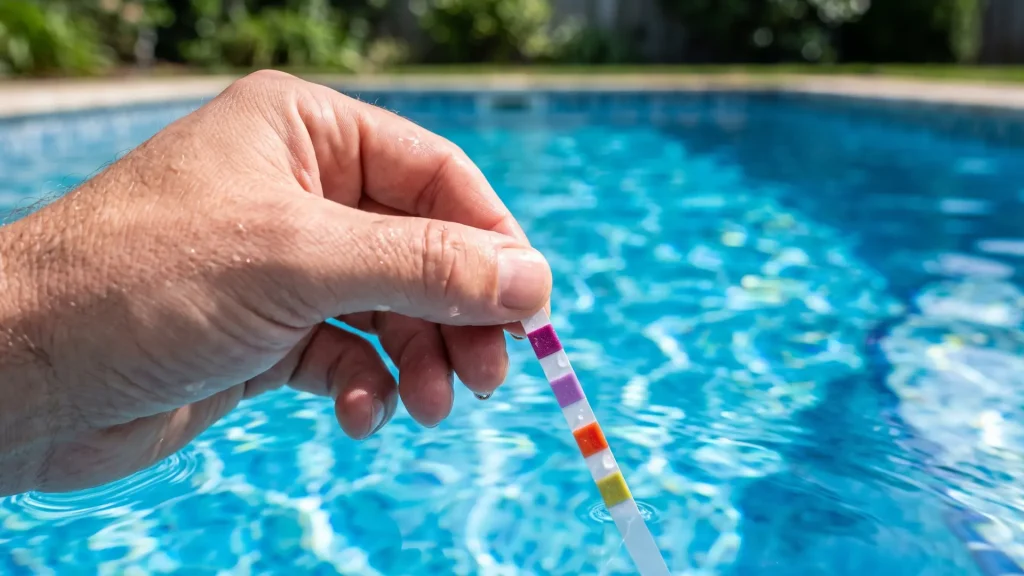
Sequence matters more than most people expect. Tackle things out of order and you’ll end up chasing your tail, nudging one reading only to knock two others loose. Work this flow instead.
- Test everything up front, so you actually know what you’re dealing with.
- If CYA or calcium hardness is sitting too high, dilute with fresh water before touching anything else.
- Lock in total alkalinity. It steadies the step that follows.
- Dial pH into the 7.4 to 7.6 window.
- Bring calcium hardness into range.
- Sanitize last of all: chlorine, plus stabilizer if you need it.
Dose in small amounts with the pump running, and let the water rest between additions before you retest. Skip the bucket-mixing entirely, and remember the direction rule: chemical goes into water, never water into chemical. For a plain-language rundown of what each bottle actually does, it helps to know your pool chemicals.
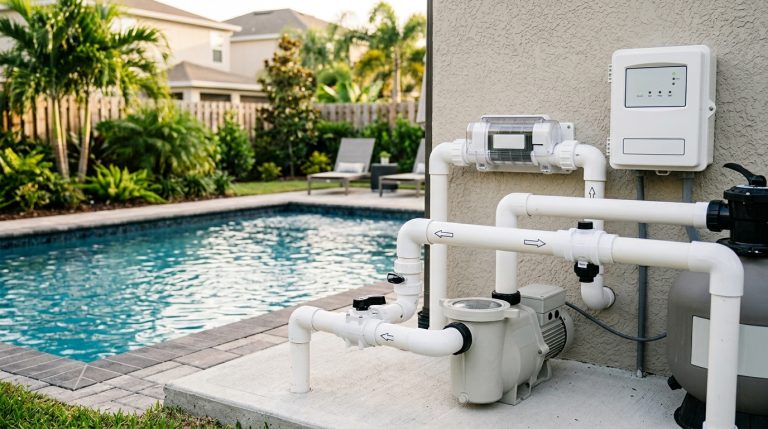
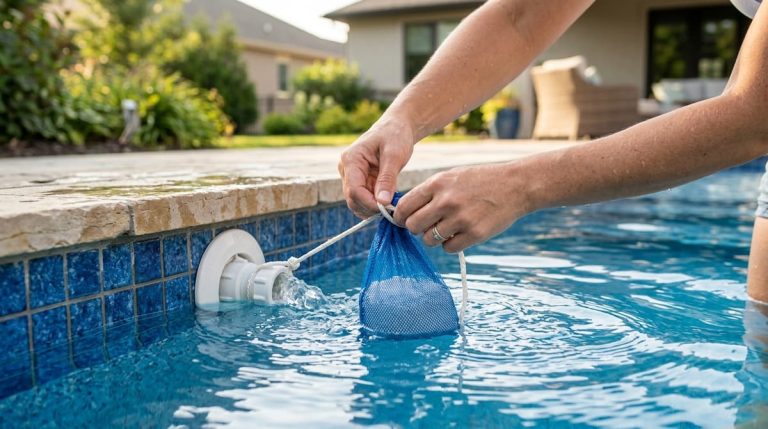
Circulation is the silent partner in all of this. A rough field rule: divide your water temperature in Fahrenheit by two and run the filter that many hours. At 84°F that’s about 42 hours spread across the day, which is basically nonstop in peak summer. Still water is exactly where algae hide, and a solid automatic pool cleaner keeps debris from feeding the problem.
How to test, and how often
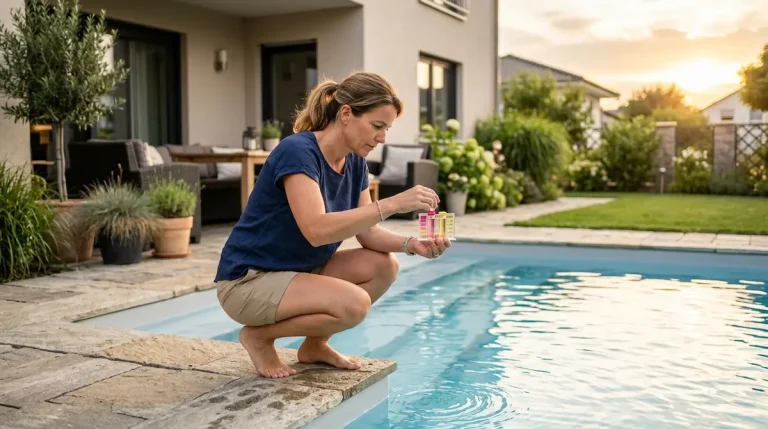
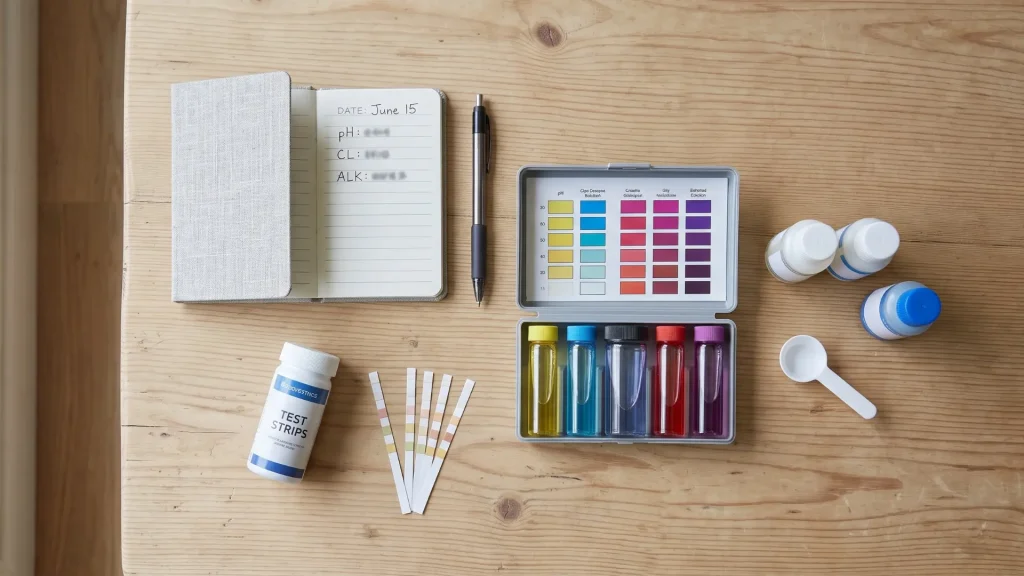
You can’t manage what you never measure. Good news: once it’s a habit, testing takes about two minutes. Draw your sample elbow-deep, well away from jets and returns, for the most honest reading.
Three testing methods are common, and each fits a different kind of owner.
| Method | Best for | Pros | Cons |
|---|---|---|---|
| Test strips | Quick weekly checks | Cheap, fast, easy | Least precise; strips expire |
| Liquid test kit | Owners who want accuracy | More reliable, detailed | Slower; small learning curve |
| Digital tester | Data-minded owners | Precise, repeatable, easy to read | Costs more; needs calibration |
Frequency comes down to what moves fast. pH and free chlorine shift quickly, so check them two or three times a week in season, daily during a heat wave or heavy use. Alkalinity, calcium, and CYA drift slowly, which makes weekly or even monthly plenty. Test extra after a storm, a pool party, or a big fresh-water top-up. The full sampling routine is worth learning for how to test pool water properly. And when the season winds down, square away your chemistry before you close up, because balanced water protects surfaces all winter when you winterize the pool.
| Test | Swim season | Heavy use / after storms |
|---|---|---|
| Free chlorine & pH | 2–3x per week | Daily |
| Total alkalinity | Weekly | After big water changes |
| Calcium hardness | Monthly | Seasonally |
| Cyanuric acid | Monthly | After adding stabilized chlorine |
Common beginner mistakes that wreck your water
I’ve watched new owners make the same handful of errors, over and over. A few worth avoiding:
- Chasing chlorine when the real problem is pH or CYA. Test those first.
- Dumping a week’s worth of chemicals in one go. Small doses, then wait.
- Adding stabilized tablets all season without ever testing CYA, until it’s locked at 90 ppm.
- Skipping the filter to save on electricity. Cheap now, green later.
- Ignoring alkalinity and wondering why pH won’t hold.
Most green pools I’ve seen trace back to one of those five. None of them are hard to avoid once you know they exist.
When chemistry problems turn into surface problems
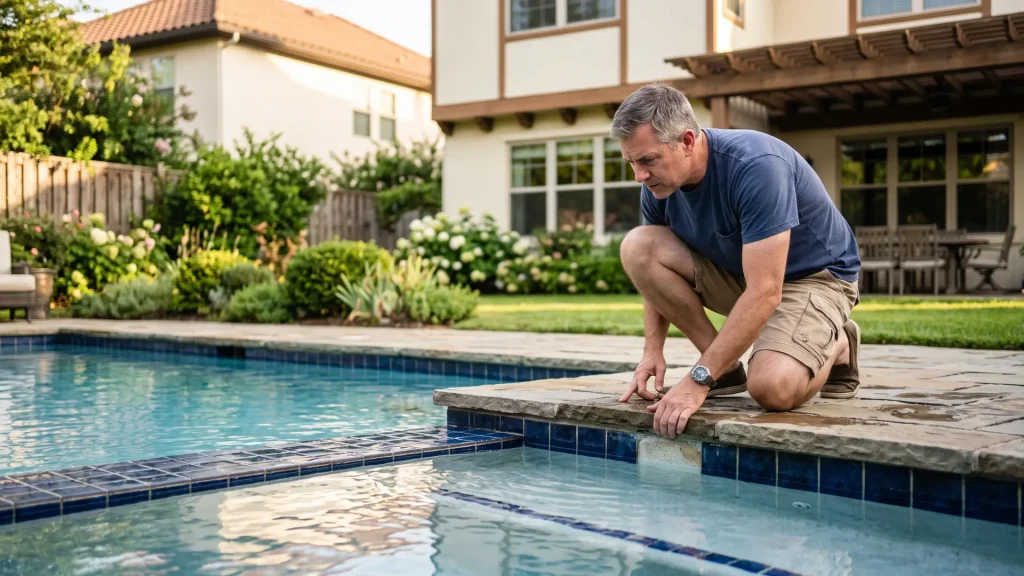
Neglected chemistry does more than cloud the water. Month after month, it goes to work on the shell of your pool itself, and those repairs cost far more than a jug of acid ever would.
Soft, low-pH water etches and softens plaster. Scale and staining grind away at tile and grout. Aggressive water can even crack and spall the concrete around and beneath your finish. Once it reaches that stage, you’re facing real work: pool plaster repair, pool coping repair, and in the worst cases pool concrete repair.
Cracked or missing tiles carry their own bill in pool tile replacement cost. A worn, etched surface may need a full refinish through pool resurfacing, and the budget side comes down to overall pool renovation cost. Some owners eventually decide the pool isn’t worth the trouble at all, and pool removal cost maps out that route. Good chemistry is how you stay out of every one of those situations.
What pool water chemistry costs to keep up
Chemistry is the cheapest slice of pool ownership, which is exactly why skipping it stings so much later. As a rough benchmark, a typical backyard pool runs somewhere around $20 to $60 a month in chemicals through swim season. Treat that as a ballpark, not a quote. Prices shift with brand, region, and the time of year you buy, so check current local pricing before you set a budget. And expect that figure to climb the moment you’re correcting a problem instead of heading one off. For the full monthly and yearly picture, cleaning and service included, a pool maintenance cost breakdown lays it out.
A few dollars a week on stable water, or a few thousand later on a resurface. That’s the real trade you’re weighing.
Frequently asked questions
What are the ideal pool water chemistry levels?
For most residential pools: free chlorine 2 to 4 ppm, pH 7.4 to 7.6, total alkalinity 80 to 120 ppm, calcium hardness 200 to 400 ppm, and cyanuric acid 30 to 50 ppm. The CDC allows pH up to 7.8 and free chlorine as low as 1 ppm, or 2 ppm when stabilizer is used.
In what order should I add pool chemicals?
Start by testing. If CYA or calcium is high, dilute with fresh water first. From there, set alkalinity, adjust pH, correct calcium hardness, and save chlorine for last. Keep doses small with the pump running, and wait between them before you retest.
Why is my pool green even though the chlorine reads normal?
Usually one of two things. Either your pH is above 7.6, leaving chlorine present but inactive, or your CYA is above 75 ppm, tying the chlorine up. Test pH and CYA before you add more chlorine, since more chlorine solves neither one.
How often should I test my pool water?
Check pH and free chlorine two to three times a week in season, and daily through heat waves or heavy use. Alkalinity, calcium, and CYA only need weekly-to-monthly checks. Always retest after storms, parties, or big water top-ups.
Is a saltwater pool easier on chemistry?
A little. Because a salt generator makes chlorine for you, the daily dosing eases off. You still test and balance pH, alkalinity, calcium, and CYA exactly the same way, plus you keep an eye on salt level and the cell. Less daily fuss, not zero maintenance.
The bottom line for a new pool owner
Start with the five numbers. Get alkalinity steady, hold pH between 7.4 and 7.6, keep CYA under 50, and let those set the stage so your chlorine can do its job. Test twice a week, add chemicals in small doses in the right order, and run your filter longer than feels necessary. Do that, and you’ll spend your summer swimming instead of scrubbing. Bookmark this page, keep the five-number chart near the pump, and check your water before every weekend. That habit alone prevents most of the expensive problems this guide warns about.