Your pool can look crystal clear and still be quietly working against you. The number that decides most of it is pool pH. Get it right and your chlorine actually does its job, the water stays comfortable, and your equipment lasts for years. Let it drift and you’ll fight cloudy water, itchy skin, and slow damage you won’t notice until it’s expensive.
So let’s sort out the ideal pool pH, why it never sits still, and how to pull it back without turning your backyard into a lab.
What’s the ideal pool pH?
For everyday pool care, treat 7.4 to 7.6 as the sweet spot. Many health departments use 7.2 to 7.8 as the practical operating range. The CDC’s home pool water treatment guidance allows 7.0 to 7.8 as long as sanitizer stays in range. Still, don’t aim for the edges. Below 7.2, the water starts acting rough on metal, plaster, and liners. Above 7.8, chlorine has to work harder for less result. Aim for 7.5.
Quick reference: pool pH at a glance
| pH reading | Status | What it means for your water |
|---|---|---|
| Below 7.0 | Too acidic | Corrodes metal, etches plaster, stings eyes |
| 7.0 to 7.1 | Low | Swimmable but hard on liners and equipment |
| 7.4 to 7.6 | Ideal | Chlorine works well, water feels good |
| 7.7 to 7.8 | High side | Acceptable, but watch for cloudiness |
| Above 7.8 | Too alkaline | Weak chlorine, scale, cloudy water |
Why pool pH matters more than most owners think
That pH number decides how much of your chlorine is actually available to sanitize, not just show up on a test strip. The higher pH climbs, the more your sanitizer shifts into a less useful form. You can have plenty of chlorine on your test kit and still have water that isn’t cleaning itself well. That’s the part that catches people off guard.
It also decides comfort. Water close to your body’s own pH feels fine. Push it too far in either direction and you get the red eyes, the tight skin, the “why does my hair feel like straw” complaints. Then there’s your wallet. Acidic water eats ladders, rails, heaters, and plaster. Alkaline water leaves chalky scale on tile and inside your filter.
What high pH actually does
- Chlorine loses strength, so algae and bacteria get a foothold
- Calcium drops out of solution and clouds the water
- Scale crusts on tile, heaters, and salt cells
- Skin and eyes dry out
What low pH actually does
- Metal parts corrode, sometimes staining the water
- Plaster and grout get etched and rough
- Vinyl liners fade, wrinkle, and age early
- Eyes sting the moment you open them underwater
A simple decision table: read your pH, then act
This is the part most guides skip. You don’t need to memorize chemistry. You need to know what to do the moment you see a number.
| Your reading | What’s happening | What to do |
|---|---|---|
| 7.8 or higher | Chlorine fading, scale risk | Add acid in small doses, retest in 6 hours |
| 7.6 to 7.8 | Slightly high | Watch it. Fix if it keeps climbing |
| 7.4 to 7.6 | Dialed in | Nothing. Keep testing |
| 7.2 to 7.4 | Low but usable | Nudge up with soda ash if trending down |
| Below 7.2 | Corrosive | Raise pH now, check alkalinity too |
What makes pool pH drift in the first place
Pool pH usually wants to rise. Water slowly gives off carbon dioxide, and as that happens, pH creeps upward. Anything that stirs the surface speeds it up: waterfalls, jets, aeration, even a busy afternoon of cannonballs.
A few other usual suspects:
- Salt chlorine generators nudge pH up as a byproduct of how they work
- Fresh plaster or gunite leaches for months and drives pH high
- Trichlor tablets are acidic and pull pH down, while cal-hypo and liquid chlorine push it up
- Heavy rain, top-off water, swimmer sweat, and sunscreen all move the needle
Total alkalinity is the quiet controller behind all of this. Think of it as the shock absorber for pH. Keep it in the 80 to 120 ppm range and your pH stops bouncing around. If you want the full picture of how these levels work together, that’s covered in our pool water chemistry guide.
How to test pool pH the right way
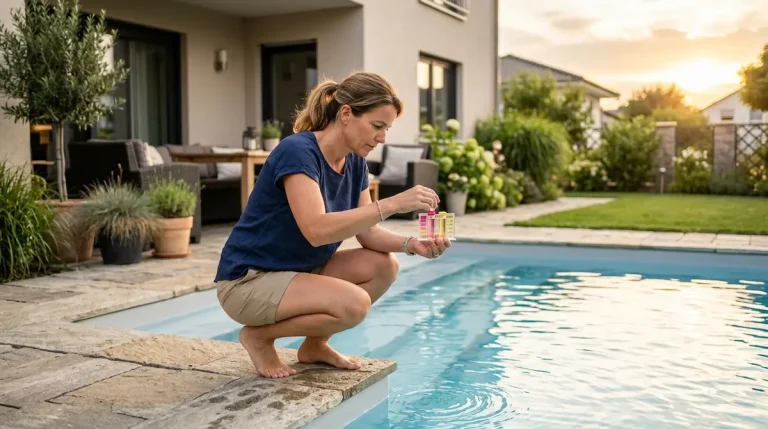
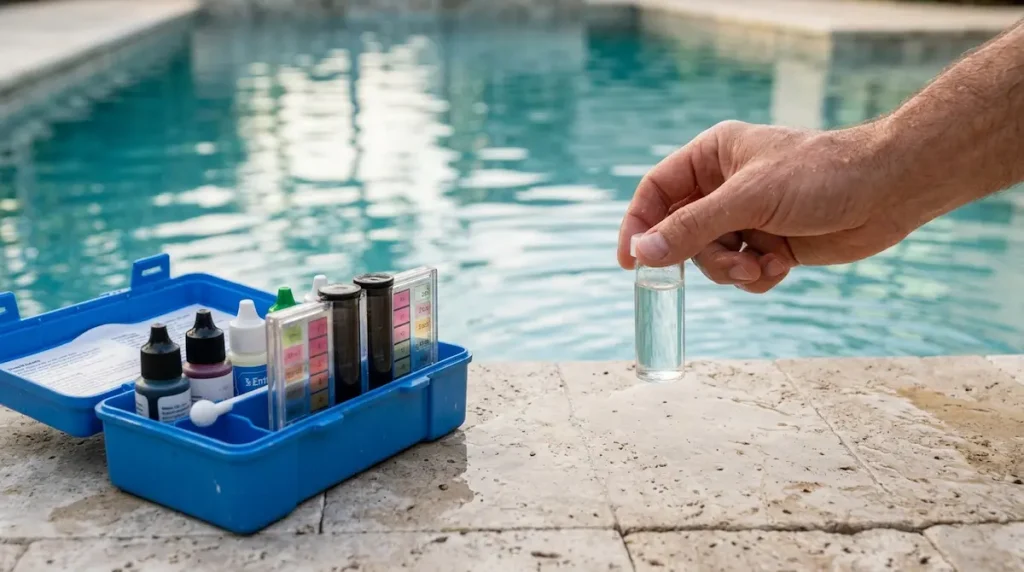
Test two to three times a week in summer, and always after rain, a big pool party, or a fresh dose of chemicals. A liquid drop test kit beats strips for accuracy. Strips are fine for a fast gut-check, but they drift and fade, and they’ll send you chasing problems that aren’t there.
Test at elbow depth, away from return jets, and read in good light. For the full set of target numbers to test against, see ideal pool chemical levels so you’re not guessing what “balanced” looks like.
How to bring pool pH back into range
One rule before you touch anything. Check total alkalinity first. If alkalinity is way off, your pH won’t hold no matter how much you dose. Fix the buffer, then fine-tune pH.
Lowering a high pH
For lowering pH, muriatic acid is usually the blunt, reliable tool. It’s cheap, it works on contact, and pros reach for it constantly. As a rough local price check, a gallon often lands around $8 to $12 at many hardware stores, but brand, region, and timing can change that. Check current local prices before buying. Dry acid (sodium bisulfate) usually costs more, but it gives off fewer fumes and is easier to handle.
Dosing depends on your pool size and starting point. As a real-world reference, a 10,000-gallon pool sitting at pH 8.0 may need roughly 2.5 cups of muriatic acid to come down near 7.6, based on published dosing charts. Treat that as a starting point, not a blind rule. Add it slowly, pour it over a wide area with the pump running, and wait before retesting. For the full walkthrough, check our how to lower ph in pool guide. Prefer to skip the acid entirely? There’s how to lower pH without chemicals too.
Raising a low pH
When pH is low and you need a clean lift, soda ash (sodium carbonate) is the quick option. It dissolves fast and raises pH with only a small bump to alkalinity. Borax is another option when you want to raise pH without moving alkalinity much. And the free trick nobody advertises: aeration. Run a fountain, aim your returns up, or turn on the spa spillover, and pH climbs on its own with zero product added. It’s slow, but it costs nothing. Full steps live in more on how to raise pH in pool.
Which product for which job
| Product | What it does | Best for | Rough cost |
|---|---|---|---|
| Muriatic acid | Lowers pH and alkalinity | Cheapest, fastest fix for high pH | About $8 to $12 / gal |
| Dry acid (sodium bisulfate) | Lowers pH and alkalinity | Owners who hate fumes | Roughly $15 to $25 / bag |
| Soda ash | Raises pH fast | Bringing up a low pH quickly | Around $10 to $20 |
| Borax | Raises pH, minimal alkalinity change | Nudging pH without touching TA | About $6 to $12 |
| Aeration | Raises pH, no chemicals | Patient, budget-minded owners | Free |
These costs are only shopping-range estimates. Pool chemical prices vary by brand, store, package size, region, and season, so check current local prices before treating them as a budget. Small doses win. It’s tempting to dump in a big scoop and be done, but overshooting means you’ll be correcting the correction all week. Chemicals add up, and so does the hassle. If you’re tracking what all this costs over a season, read about pool maintenance cost for realistic numbers.
Frequently asked questions
Does high pH really stop chlorine from working?
Yes. As pH rises, less of your chlorine stays in its active form. At 8.0 your sanitizer can be working at a fraction of its strength, even when the test says you have “enough.” Keeping pH near 7.5 is how you get your money’s worth from chlorine.
Why does my pool pH keep rising?
Usually carbon dioxide escaping the water, and surface movement speeds it up. Salt cells, fresh plaster, waterfalls, and certain chlorine types all push it higher too. If it climbs daily, check whether your total alkalinity is running high, since that keeps feeding the rise.
Can I swim if the pH is a little off?
If your test lands from 7.2 through 7.8 and sanitizer is in range, swimming is generally okay. Outside that, you risk stinging eyes on the low end or cloudy, poorly sanitized water on the high end. If pH is under 7.0 or over 8.0, adjust and retest before anyone gets in.
Should I fix pH or alkalinity first?
Alkalinity first, in most cases. It buffers pH and keeps it stable. Correct alkalinity into the 80 to 120 ppm range, then fine-tune pH. Skip that order and your pH won’t stay put.
Does baking soda raise pool pH?
Mainly it raises alkalinity, with a mild lift to pH. If you specifically need pH up and not much else, soda ash or borax is the better pick. Baking soda is your tool when alkalinity is the real problem.
What I’d actually do
Keep it simple. Test a few times a week, hold alkalinity between 80 and 120 ppm, and steer pH toward 7.5. When it creeps up, add acid in small amounts and retest before adding more. When it dips, reach for soda ash or just aerate the water and let physics do the work. Do that, and pH stops being the thing you dread and becomes a two-minute habit. Your chlorine, your liner, and your skin will all thank you.
For authoritative safety ranges, see the CDC’s home pool water treatment guidance.