By mid-afternoon your chlorine is gone. You shock after dark, test at sunrise, and the free chlorine already reads flat. Nine times out of ten the real problem is low cyanuric acid. Here’s how to raise it safely, how much to add for your exact pool size, and the single slip that makes people drain half the pool.
The short version: how to raise cyanuric acid
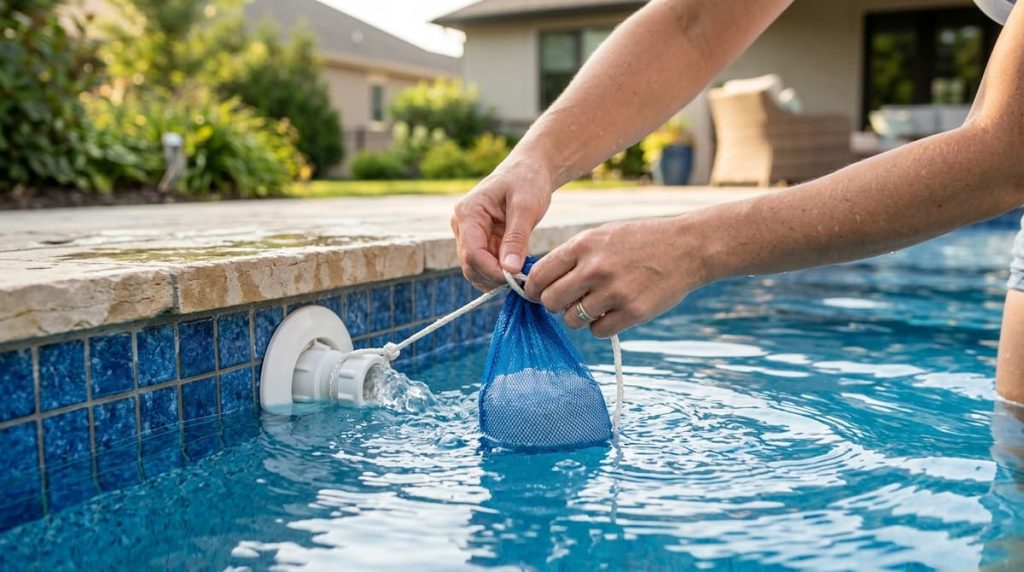
Add granular pool stabilizer through a sock. Figure on about 13 ounces per 10,000 gallons to lift CYA by roughly 10 ppm. Let it dissolve slowly, keep the pump running, and give it one to seven days before you retest. Most outdoor chlorine pools sit happy between 30 and 50 ppm.
- Test first, then dose only for the gap you actually have. Guessing backfires.
- Fastest option: liquid CYA shows up in about 24 hours; granular needs 5 to 7 days.
- Stabilized chlorine (dichlor or trichlor tabs) nudges CYA up too, just slowly and with little control.
- Nothing removes CYA chemically, so start low and sneak up on your target.
First, know your target before you add anything
Different pools want different numbers. A generic “opening dose” is exactly how people blow past their target. Match the number to how your pool gets its chlorine.
| Pool type | Ideal CYA (ppm) | Why |
|---|---|---|
| Outdoor chlorine pool | 30 to 50 | Enough sun protection without weakening chlorine |
| Saltwater pool | 60 to 80 | Hayward and Pentair recommend more to shield generator chlorine |
| Indoor pool | 0 to 20 | Little UV, so little stabilizer needed |
| Commercial / public | 15 or under | CDC guidance for public health |
Why low CYA burns through your chlorine
Picture cyanuric acid as a thin coat of sunblock for your chlorine. Skip it and UV chews through free chlorine within a couple of hours. Pile on too much and the chlorine turns lazy, too slow to knock back algae. There’s a full breakdown of what cyanuric acid does and the right level for your setup if you want it. Here, the job is narrow: pulling a low number back up.
How much stabilizer to add
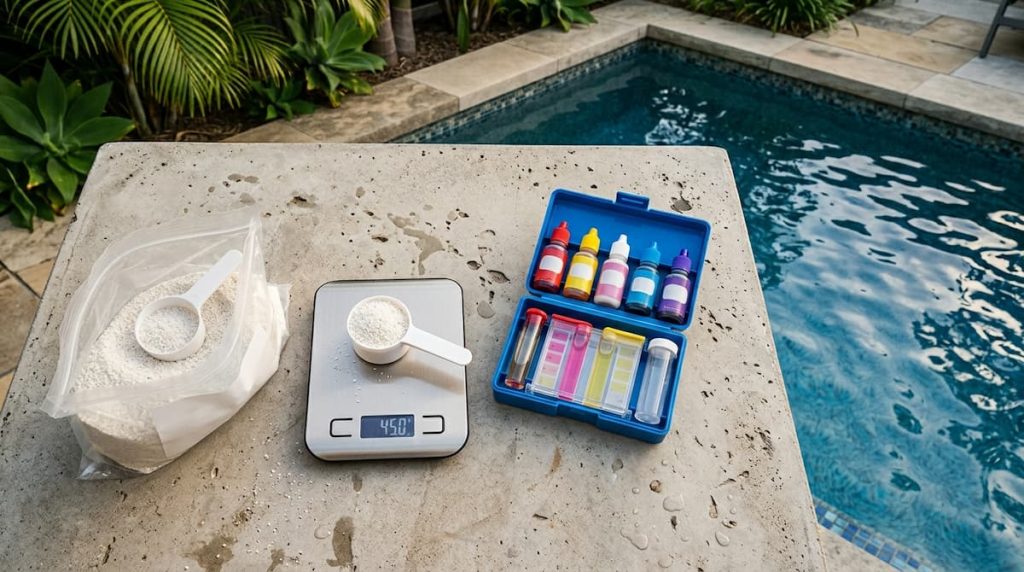
Most product labels land on the same working rule: around 13 ounces of granular CYA per 10,000 gallons buys you about 10 ppm. A few brands punch harder, closer to a pound per 10,000 gallons for a 12 ppm jump, so check yours.
The math is quick. Ounces needed = ppm increase × gallons × 0.00013.
| Pool volume | Granular CYA to raise 10 ppm |
|---|---|
| 10,000 gallons | 13 oz |
| 15,000 gallons | 19.5 oz |
| 20,000 gallons | 26 oz |
| 25,000 gallons | 32.5 oz |
| 30,000 gallons | 39 oz |
A quick worked example
Picture a 15,000-gallon pool. You test at 15 ppm and you’re aiming for 40, a 25 ppm gap. Plug it in: 25 × 15,000 × 0.00013 comes out around 49 ounces, roughly 3 pounds. Add most of that, wait it out, retest, then top up. Adding a little more later beats trying to claw back an overshoot.
Three ways to raise CYA, and when each one wins
You’ve got three tools, really. They don’t pull the same weight.
| Method | Speed | Control | Best for |
|---|---|---|---|
| Granular pure CYA | Slow (5 to 7 days) | High | Best for a big, precise jump from a low reading |
| Liquid CYA | Fast (about 24 hours) | High | Best for a quick fix before a heat wave or a party |
| Stabilized chlorine (dichlor/trichlor) | Gradual | Low | Best for tiny nudges while you also chlorinate |
Granular pure CYA. Cheapest per ppm, and the one most owners grab first. Patience is the price. The granules can need most of a week to dissolve fully, and tossing them in dry can etch plaster or bleach a vinyl liner.
- Pros: cheap, precise, easy to find.
- Cons: slow to show on a test, wants the sock trick, hard on surfaces if dumped dry.
Liquid CYA. Costs more, but it lands on your test kit in about a day. Handy when the clock matters.
- Pros: fast, pours easily, kind to surfaces.
- Cons: pricier, and not always on the shelf.
Stabilized chlorine. Every trichlor tab and every scoop of dichlor slips a little CYA into the water. A pound of trichlor drops about 6.7 ppm of CYA into 10,000 gallons; dichlor sits near 6.4. Useful when you’re short by a whisker, but it’s also the top reason CYA drifts too high across a season.
Step by step: the sock method
This is the safe route for granular stabilizer. It keeps raw chemical off the pool floor.
- Test your CYA and work out the dose from the table above.
- Tip the measured granules into a clean old sock or a leg of pantyhose, then knot it shut.
- With the pump running, hang the sock at a return jet or drop it in the skimmer.
- Squeeze it every couple of hours to move things along.
- Leave the pump on and hold off on backwashing for about 48 hours.
- Retest in a day or two for liquid, up to a week for granular. Only add more if you’re still short.
Not a fan of the sock? Dissolve the granules first in a bucket of warm water, then pour that slurry slowly around the pool. Never scatter dry chemical straight onto the surface.
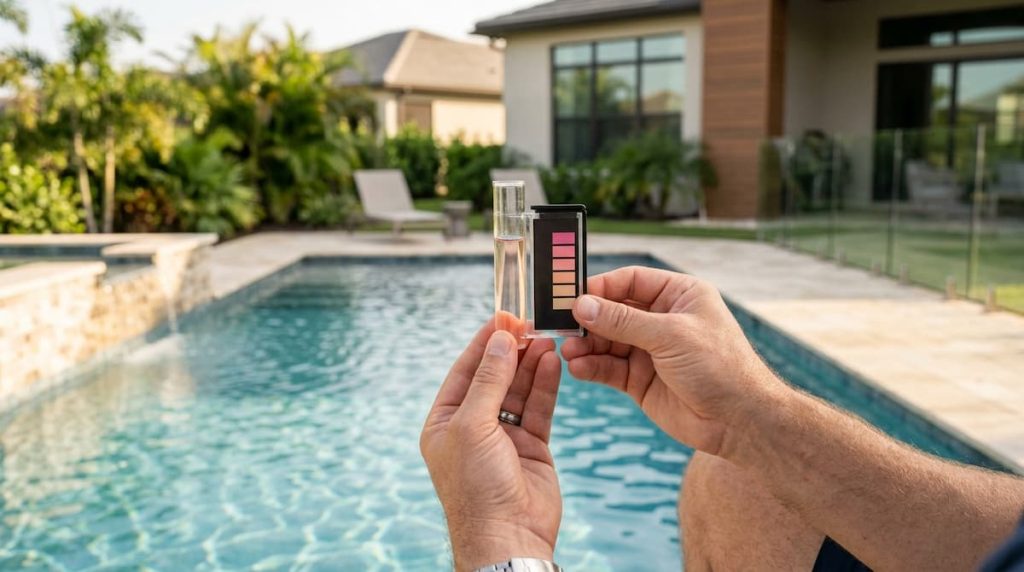
The mistake almost everyone makes: overshooting
No filter traps CYA. No additive breaks it down. Once it reads high, your only real move is draining part of the water and refilling, which dumps water and forces you to reheat the pool from cold. That runs up the bill, and it’s the sort of line item that quietly inflates your pool maintenance cost. So aim for about 80 percent of your target first, wait, then finish. Slow costs pennies. Rushing costs a refill.
After you raise CYA, raise your chlorine too
Most guides drop the ball right here, and it’s why people “fix” their stabilizer and still end up with algae. More CYA means your old chlorine target suddenly sits too low. As a floor, hold free chlorine at roughly 7.5 percent of your CYA reading, and run your day-to-day target a notch above that.
| CYA level | Minimum free chlorine | Comfortable target |
|---|---|---|
| 30 ppm | about 2 ppm | 3 to 5 ppm |
| 40 ppm | about 3 ppm | 4 to 6 ppm |
| 50 ppm | about 4 ppm | 5 to 7 ppm |
| 70 ppm (saltwater) | about 5 ppm | 6 to 8 ppm |
The two numbers travel together. If that link is news to you, it’s basic pool water chemistry worth reading up on before your next test. Get the pair balanced and the algae usually sorts itself out.
Frequently asked questions
What actually increases cyanuric acid in a pool?
Two things, and only two: adding stabilizer deliberately, or running stabilized chlorine like dichlor and trichlor. CYA won’t climb on its own, and it doesn’t evaporate off. If your reading crept up without you dosing it, blame the chlorine tabs.
How long does it take to raise cyanuric acid?
Liquid CYA usually registers on a test within about 24 hours. Granular dissolves at its own pace and can take 5 to 7 days to fully read. Don’t retest the morning after adding granules, or you’ll assume it flopped and overdose.
Can you raise CYA without adding chlorine?
You can. Pure cyanuric acid, whether granular or liquid, lifts your stabilizer without moving the chlorine at all. That’s the smarter pick when your chlorine is already where you want it and only CYA is lagging.
Does baking soda raise cyanuric acid?
No. Baking soda pushes total alkalinity, not CYA. Two different chemicals, two different jobs. Raising stabilizer takes actual cyanuric acid or stabilized chlorine, nothing else.
How do you raise CYA in a saltwater pool?
Same method, just a higher goal. Salt systems like to sit around 60 to 80 ppm, so run the sock method with granular CYA and aim for the top of that band. Then lift your free chlorine to match, since higher CYA needs stronger chlorine to keep working.
What to do next
Start with a fresh CYA test and confirm you’re genuinely low before you buy a thing. If you are, measure your pool volume, dose granular stabilizer through a sock to about 80 percent of your target, and give it a week before topping up. Then reset free chlorine to match the new CYA. Do it in that order and you’ll kill the sun-eating-your-chlorine problem for the whole season, without wasting a dollar on draining.
External references: CDC Healthy Swimming, and the Trouble Free Pool FC/CYA chart.