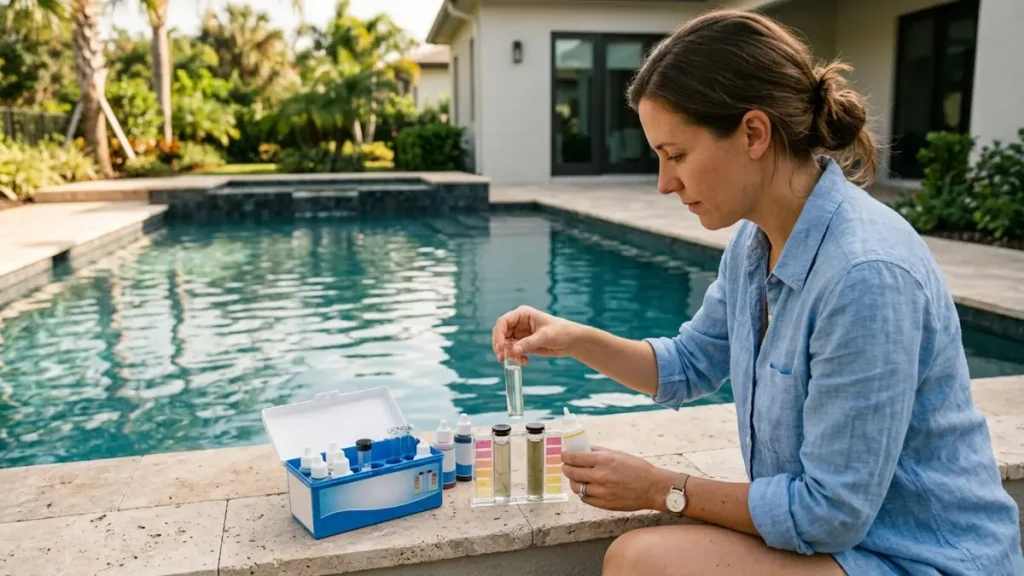
Your chlorine keeps vanishing. You add it in the morning, and by evening the test kit reads close to zero. Before you buy another jug or bucket, check the number many new pool owners miss: cyanuric acid. It can be the difference between chlorine that survives the afternoon and chlorine that burns off before lunch.
Think of cyanuric acid (CYA) as sunscreen for your chlorine. Get the level right and your pool is easier to keep steady. Let it drift too low or too high, and you pay for it either way.
The short answer on cyanuric acid
Cyanuric acid helps outdoor pool chlorine survive sunlight. It does not sanitize the water by itself. Instead, it protects free chlorine from UV loss so the chlorine can keep working longer. For most outdoor chlorine pools, aim for 30 to 50 ppm. Salt pools usually run higher, around 60 to 80 ppm. Too much CYA slows chlorine down.
| Question | Quick answer |
|---|---|
| What it does | Protects chlorine from sunlight (UV) |
| Ideal level (chlorine pool) | 30–50 ppm |
| Ideal level (salt pool) | 60–80 ppm |
| Too high | 70–100+ ppm slows chlorine down |
| How to lower it | Drain and refill with fresh water |
What cyanuric acid actually does
Sunlight is rough on chlorine. In an unstabilized outdoor pool, UV exposure can chew through free chlorine fast. One field study found that after one hour of direct sun, only about 25% of unprotected chlorine remained in the water. Swim University explains the same problem in everyday terms: on a bright day, half your chlorine may disappear in roughly 17 minutes.
CYA changes that. Some of the free chlorine forms a weak, temporary connection with cyanuric acid. You can think of it as chlorine being parked instead of spent. As the water needs active chlorine to fight bacteria or algae, more becomes available again. The UV retention data shows why even a small amount matters:
- No CYA: about 25% chlorine left after one hour of sun
- Just 5 ppm CYA: jumps to 54%
- 10 ppm: around 65%
- 20 ppm: roughly 75%
Why more is not better
The big gain happens early. Once you reach the 20 to 30 ppm range, extra CYA gives less added sun protection while the downsides keep growing. That is why the target is a range, not “as much as possible.” You want enough stabilizer to protect chlorine, not so much that chlorine responds too slowly.
By the way, cyanuric acid shows up under a few names. More on what is pool stabilizer explains the same compound if the product label says “stabilizer” or “conditioner.”
The ideal cyanuric acid level for your pool
There is no single perfect number for every pool. The right target depends on the way you chlorinate, the amount of sun the pool gets, and whether the pool is residential, commercial, indoor, or saltwater. Use this as your practical range:
| Pool type | Ideal CYA range | Best for |
|---|---|---|
| Standard outdoor chlorine pool | 30–50 ppm | Most backyard pools in full sun |
| Saltwater pool (salt chlorine generator) | 60–80 ppm | Salt systems that make chlorine slowly all day |
| Public / commercial pool | Keep low (often capped near 15–50 ppm by code) | High bather loads where fast disinfection matters |
| Indoor pool or hot tub | 0 ppm (skip it) | No sun means no reason to stabilize |
That last row catches people off guard. The CDC recommends against using cyanuric acid in hot tubs, and its guidance also leans away from stabilizer in indoor pools. There is no sunlight to protect against, and slower chlorine response can become a sanitation problem. If you are trying to understand how CYA fits with pH, alkalinity, and chlorine together, the pool water chemistry guide ties the numbers into one system.
The FC:CYA ratio most guides skip
This is where many pool owners get stuck. Free chlorine has to rise as CYA rises. A common pool chemistry rule of thumb is to keep free chlorine at about 7.5% of the cyanuric acid level. In plain English: the more CYA you carry, the more chlorine you need just to keep the water sanitary.
| CYA level | Minimum free chlorine to keep |
|---|---|
| 30 ppm | about 2–3 ppm |
| 40 ppm | around 3 ppm |
| 50 ppm | close to 4 ppm |
| 70 ppm | roughly 5 ppm |
| 80 ppm (salt pool) | about 6 ppm |
That is the trap. If CYA drifts to 90 or 100 ppm, your pool may need about 7 ppm of free chlorine to stay ahead of algae. Most people do not maintain that. Then the water turns dull, cloudy, or green even though the test still shows some chlorine.
When cyanuric acid gets too high
Chlorine drops day by day. CYA does not behave that way. It tends to stay in the water and build unless water leaves the pool through draining, splash-out, backwashing, or dilution. Once the level gets too high, chlorine works more slowly. The pool can look cloudy or green even when a basic chlorine test says chlorine is present.
High CYA can also complicate alkalinity readings above about 60 ppm, which makes troubleshooting harder. You think you are chasing one problem, but the real issue is overstabilized water.
One honest correction on a phrase you will hear at pool stores: “chlorine lock.” Techs often say high CYA locks chlorine so it stops working. Newer peer-reviewed chemistry does not support that exact idea. CYA slows chlorine release and increases the time needed to kill germs. It does not flip an off switch. The practical fix may still be dilution, but knowing the mechanism keeps you from wasting money on miracle “chlorine lock remover.”
Weigh the trade-off honestly:
| Pros of cyanuric acid | Cons when it is too high |
|---|---|
| Chlorine lasts 3 to 5 times longer in sun | Slows how fast chlorine kills bacteria and algae |
| Cuts your chlorine spending | Forces you to run higher free chlorine to compensate |
| Steadier daily chlorine levels | Can cause cloudy water and skew alkalinity tests |
How your CYA creeps up without you noticing
Most overstabilized backyard pools are not caused by one big dose of straight stabilizer. They are caused by tablets. Trichlor tabs are more than half cyanuric acid by weight, and dichlor adds CYA too. Every tablet in a floater or feeder leaves a little more stabilizer behind. Use them all season without testing, and a pool that looked fine in May can be near 100 ppm by August.
If you rely on tablets, plan around that. Test CYA monthly in peak season, especially during hot, sunny weather. Prevention beats correction here. It is also cheaper than draining a large part of the pool later.
Fixing an off-target level
Too low? Add stabilizer slowly. A common dose is about 1 pound per 3,000 gallons to reach roughly 40 ppm, but always check the product label and your current test result first. Pre-dissolve if the label allows it, add gradually, circulate well, and retest after it has fully dissolved. For the full method, follow our how to raise cyanuric acid guide.
Too high? The most predictable fix is dilution. That means partially draining the pool and refilling with fresh water, sometimes more than once. Chemical reducers exist, but results are mixed. Walk through the steps in how to lower cyanuric acid, and if you want to compare product options first, see best cyanuric acid reducer for what is worth trying and what is mostly wishful thinking.
What it costs
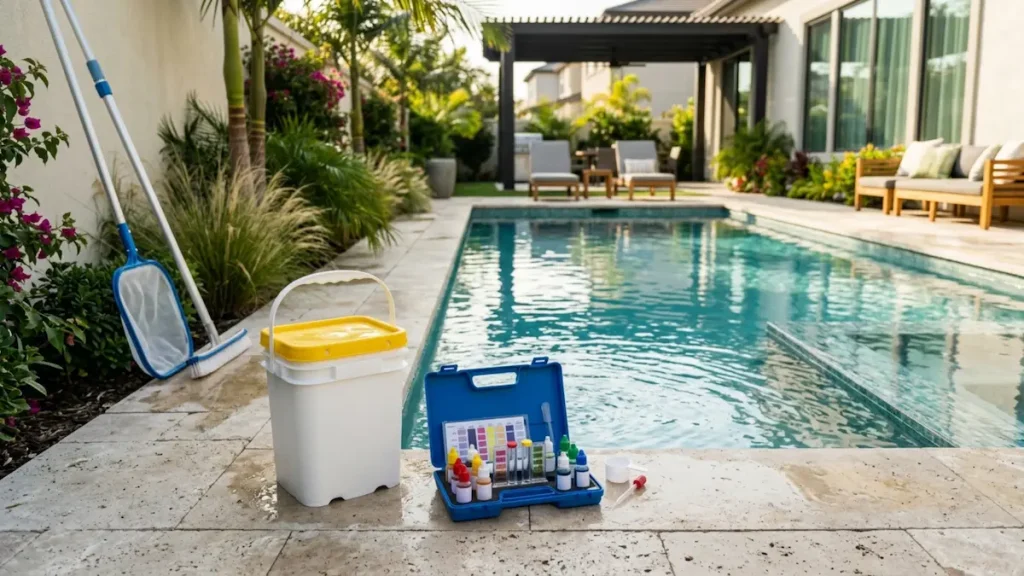
Stabilizer itself is usually not the expensive part. As a rough shopping benchmark, a 4-pound bag may be around the low-$20s, liquid stabilizer may sit around the mid-$30s per gallon, and bulk 25-pound pails can run around the low-$100s. Treat those as local price checks, not fixed prices. Brand, store, region, season, and package size can change the real number.
The bigger cost is what happens when the level is wrong: wasted chlorine, extra testing, cloudy water fixes, and sometimes a partial drain. For the broader upkeep picture, read about pool maintenance cost.
Frequently asked questions
Is it safe to swim in a pool with high cyanuric acid?
High CYA is not usually the direct problem. The bigger issue is sanitation. When CYA is too high, chlorine works more slowly, so bacteria and algae can survive longer. If the water is cloudy, green, poorly chlorinated, or outside safe test ranges, do not swim until it is corrected.
Does cyanuric acid lower on its own?
Barely. It does not break down in sunlight the way chlorine does. Heavy rain, splash-out, backwashing, or draining can dilute it a little, but if the level is truly high, you usually need to remove and replace some water.
How often should I test cyanuric acid?
Once a month is enough for many residential pools, plus a test after opening and after major water replacement. If you chlorinate with tablets, be stricter about monthly testing because tablets are one of the easiest ways to build CYA without noticing.
Do I need cyanuric acid if I have a saltwater pool?
Yes, for an outdoor saltwater pool. Salt systems make chlorine steadily through the day, and that chlorine still needs UV protection. Many salt pools target 60 to 80 ppm, but follow your salt chlorine generator manual and local guidance.
Can I add cyanuric acid and chlorine at the same time?
It is better to space them out. Add stabilizer, let it circulate and dissolve, then retest before making final chlorine adjustments. Adding everything at once can make your readings harder to trust.
What to actually do
Test your cyanuric acid this week. If you run a standard outdoor chlorine pool, aim near 40 ppm and match your free chlorine to it. Salt pool owners can usually target around 70 ppm. If you use tablets and the number is already climbing past 60, switch some of your chlorination to liquid chlorine and plan dilution before CYA reaches the trouble zone. Do that, and the mystery of disappearing chlorine gets a lot easier to solve.
Sources: CDC Healthy Swimming guidance; Montana DPHHS and Sacramento County cyanuric acid fact sheets; peer-reviewed review in Water/PMC on CYA health risk and control standards; Pulsar Systems UV chlorine-retention data; Swim University FC:CYA guidance.