How to lower pH without chemicals sounds simple, yet the honest answer trips up most pool owners. Your kit keeps flashing a high number, and you’d rather not wrestle a jug of muriatic acid with kids and the dog tearing around the deck. Fair enough. Let’s cut the myths and stick to what actually moves the needle.
The short answer
Truly dropping pool pH without some form of acid isn’t possible. Bringing it down without pool-store products, though, is. Three moves do it: dilute with fresh low-pH water, fix high-pH fill water, and quit over-aerating. Only one of them, partial water replacement, is a dependable non-chemical fix.
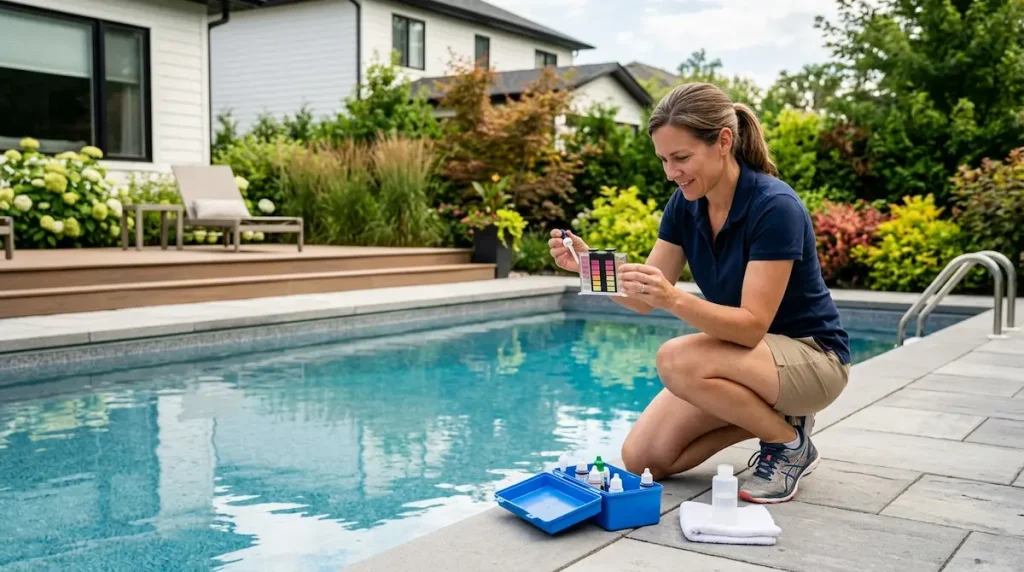
Start by knowing your target. Safe swimming water runs 7.0 to 7.8 under CDC guidance, and most pros park it tighter at 7.4 to 7.6. You can confirm the safe range yourself against the agency’s home pool water treatment and testing notes (CDC: Healthy Swimming). Sitting at 7.8? A little wiggle room. Pushing 8.2 with cloudy water and scale crusting the tile? Non-chemical tricks will only carry you so far.
What “without chemicals” actually means
Let’s pin this down, because fuzzy advice is where people slip. Here, “without chemicals” means no muriatic acid and no dry acid (sodium bisulfate). It doesn’t hand you a magic wand. If you’re hazy on what pool pH even measures, get that straight before you try to move it.
The methods that genuinely work
Three levers do the real work. None come in a bottle from the pool store, and they span from “very effective” to “damage control.”
1. Dilute with fresh, low-pH water
This is your workhorse. Trading out some pool water for fresh, low-mineral water pulls pH and total alkalinity down together, exactly what hard, stubborn water needs.
- Drain 1 to 3 inches from the pool, more if your pH is way up.
- Refill from a low-pH source: reverse-osmosis, distilled, or soft tap water.
- Let the pump circulate it for roughly 24 hours.
- Retest pH and alkalinity, and repeat if you’re still high.
The catch? Water costs money, and RO or distilled refills climb fast on a big pool. Weigh that against your wider pool maintenance cost before you drain half the deep end.
2. Fix the water you’re filling with
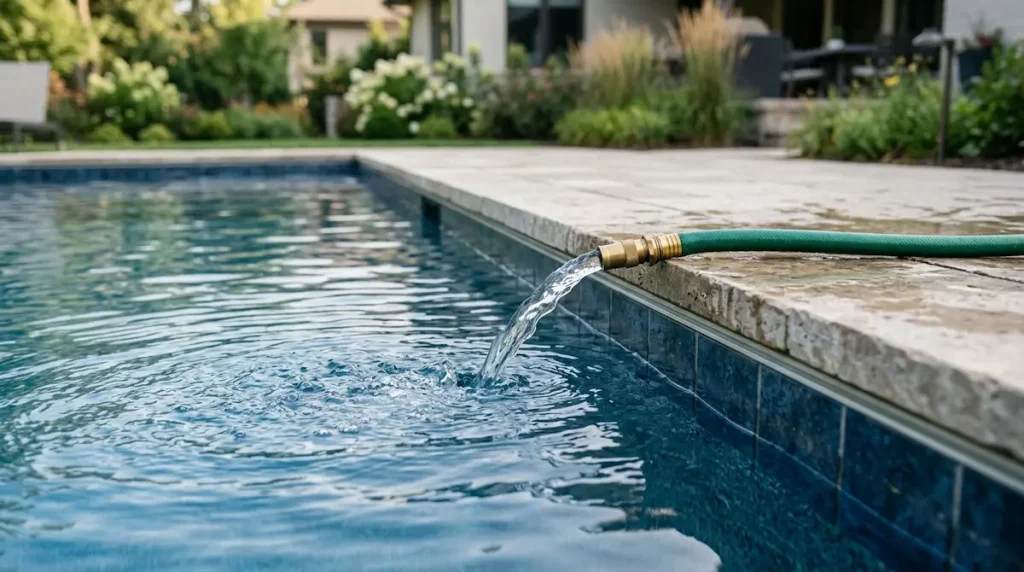
In my experience, the people fighting high pH week after week almost always start with hard, alkaline fill water. Your tap or well supply might already read pH 8.0 or higher before it ever hits the pool. Test it straight from the hose. If the source runs high, no amount of poolside effort keeps pace, and treating that fill water (a softener, an RO pre-filter, or trucking in balanced water) cures the cause instead of chasing the symptom.
3. Stop feeding the rise
Sometimes the job isn’t lowering pH, it’s not driving it up in the first place. Waterfalls, fountains, aerators, spa jets, even one loud return jet all nudge pH higher over time. Shut them off when you don’t need them. That won’t drag a high reading back down, but it halts the daily creep that has you reaching for acid. pH and alkalinity ride the same buffer, and pool water chemistry ties the two together if you want the full picture.
The aeration myth almost every guide gets wrong
Most “lower pH naturally” articles have this backwards. They tell you to aerate the water to drop pH. Flat wrong.
Aeration raises pH. Churn the surface with fountains or jets and dissolved carbon dioxide escapes into the air. As that CO₂ leaves, the carbonate balance shifts and pH climbs. That’s settled aquatic chemistry, not opinion. One pool owner ran waterfalls and a fountain for about 8.5 hours and watched pH rise from 7.2 to 7.5. Pros lean on aeration on purpose when they want to raise pH without touching alkalinity, though pushing much past 7.5 gets tough.
So when a blog tells you to fire up the waterfall to fix a high reading, close the tab. You’d be doing the exact opposite of what you set out to do.
Non-chemical methods compared
| Method | Best for | Pros | Cons |
|---|---|---|---|
| Partial water replacement (dilution) | High pH paired with high alkalinity or hard fill water | Actually lowers pH and alkalinity together; no pool chemicals | Wastes water; RO/distilled costs add up; slow on big pools |
| Treating your fill water | Well water or hard tap water that keeps driving pH up | Fixes the root cause for good | Upfront cost for softener/RO; not an instant fix |
| Reducing aeration | pH slowly creeping up from water features | Free; stops the climb immediately | Only prevents a rise, won’t lower water that’s already high |
| Household acids (vinegar, lemon juice) | Tiny above-ground pools or a pinch | Cheap; already in your kitchen | Needs huge volumes; smells; adds organics that feed algae; unreliable |
Step-by-step: bringing a high reading down
- Test pH and total alkalinity. Target pH 7.4 to 7.6 and alkalinity near 80 to 120 ppm.
- Test your fill water on its own so you know what’s going in.
- Switch off waterfalls, fountains, and jets so CO₂ stops gassing off.
- Drain 1 to 3 inches and top up with low-pH water.
- Circulate for 24 hours, then retest.
- Still high after two rounds? That’s your cue that a small dose of acid is the practical move. Non-chemical methods have limits, and that’s fine to admit.
Common mistakes I see
A handful of traps snag people over and over.
- Reaching for vinegar first. I’ve watched someone tip a gallon of vinegar into 15,000 gallons and wonder why the needle didn’t budge. Vinegar sits near pH 2 to 3, so it takes a lot, and your pool ends up smelling like a salad bar.
- Cranking the waterfall to “fix” pH, which quietly shoves it higher.
- Ignoring alkalinity. When total alkalinity runs high, pH keeps springing back no matter what you do at the surface.
- Chasing a flawless 7.4 when you’re already at 7.6. Leave it be.
Frequently asked questions
Does baking soda lower pool pH?
No, and it backfires. Baking soda pushes both pH and alkalinity up, so it’s the wrong pick when your pH already sits high.
Can I use vinegar to lower my pool’s pH?
Technically yes, since vinegar is a mild acid. In practice, it’s a weak choice. It takes large amounts, the smell lingers, and the organics can feed algae. Reserve it for a small kiddie pool at most.
Does aeration lower or raise pool pH?
It raises it. Aeration off-gasses carbon dioxide, which drives pH up. It never pulls a high reading down.
Will rain lower my pool’s pH?
Slightly. Rain is a touch acidic and can nudge pH down, but it also scrambles your other numbers, so don’t lean on it as a plan.
What’s the ideal pool pH?
Aim for 7.4 to 7.6. The CDC counts 7.0 to 7.8 as acceptable for safe swimming and effective chlorine.
So what should you actually do?
If your pH is only a hair high, kill the water features and let normal top-offs dilute it down quietly. If it’s stubbornly high and your fill water is hard, drain a few inches, refill with low-pH water, then fix the source so you’re not back here next week. And if you’re way up at 8.0-plus with cloudy water, be straight with yourself: a small, careful dose of acid is faster, cheaper, and easier on the pool than pouring in vinegar by the gallon. Non-chemical care is prevention first, correction second.