Your pH won’t sit still. One day it’s fine, the next it’s creeping toward 8 and your eyes sting after a swim. Most of the time, the real problem isn’t pH itself. It’s pool alkalinity, the quiet buffer working in the background. Get it right and everything else behaves. Get it wrong and you’ll chase your numbers all summer.
So let’s fix that. This guide covers what total alkalinity does, the range you’re aiming for, and how to nudge it back when it drifts.
What total alkalinity actually does
Total alkalinity (TA) is your pool’s reserve of bicarbonates and carbonates. Think of it as a shock absorber for pH. When acid enters the water from rain, swimmers, or chlorine, alkalinity takes the hit first. That keeps pH from swinging all over the place. For a normal backyard pool, 80 to 120 ppm is the lane you want to stay in.
The ideal pool alkalinity range
Ask ten pool pros and most will point you toward 80 to 120 parts per million (ppm). That’s the standard target for the majority of backyard pools. The wider workable band runs from about 60 ppm up to 180 ppm before you’re truly in problem territory.
But the flat “80 to 120” answer skips something useful. The right number depends on what you’re putting in the water.
Why your sanitizer changes the target
Sanitizers don’t all behave the same way. Some push pH upward. Others are acidic and need more buffer behind them. Liquid chlorine and cal-hypo usually make more sense near the lower end. Trichlor and dichlor tablets do better with a little more alkalinity above them.
| Sanitizer type | Ideal total alkalinity | Best for |
|---|---|---|
| Liquid chlorine, cal-hypo, lithium hypochlorite | 80–100 ppm | Pools that trend high on pH |
| Dichlor, trichlor, chlorine gas, bromine | 100–120 ppm | Acidic tablet systems |
| Vinyl-liner and fiberglass pools | 100–150 ppm | Softer surfaces, low scaling risk |
Vinyl and fiberglass can run a little higher
Got a vinyl liner or a fiberglass shell? You’ve got more wiggle room. Many installers aim for 100 to 150 ppm on these surfaces because there’s no plaster to scale up, and the extra buffer helps pH stay steady. Plaster and concrete pools usually sit closer to 80 to 100 ppm to avoid cloudy water and scale.
Alkalinity vs pH: the difference that trips everyone up
People mix these two up constantly. Here’s the clean version. pH is the snapshot reading: where the water sits on the 0-to-14 acid/base scale today. Alkalinity is the resistance behind that reading. One tells you where the water is. The other tells you how hard it is to move.
For safety and chlorine performance, CDC recommends keeping pool pH between 7.0 and 7.8 (CDC: Home Pool and Hot Tub Water Treatment and Testing), and most pros tighten that to 7.4 to 7.6. Alkalinity is what helps you stay parked in that zone. Low buffer, and pH jumps after every storm. High buffer, and pH gets stubborn, drifting up and shrugging off your corrections.
What happens when alkalinity drifts out of range
Both directions cause headaches, just different ones. Quick rundown before we fix it.
| Condition | What you’ll notice | The fix |
|---|---|---|
| Low (under 80 ppm) | pH swings, corroded metal, etched plaster, stinging eyes | Add baking soda |
| High (over 120 ppm) | Cloudy water, scale on tile and equipment, pH stuck high, lazy chlorine | Add acid, slowly |
When it’s too low
Low TA is the one that can do damage faster, because the water starts acting hungry. I’ve seen homeowners blame a “bad heater” when the real issue was TA sitting at 40 ppm, quietly chewing on the copper. Ladders stain. Plaster etches. And your pH? All over the map.
When it’s too high
High alkalinity is more of a slow annoyance. Water goes cloudy, scale creeps along the tile line, and pH locks up high no matter how much acid you pour in. Your chlorine works lazier too, so you burn through more of it than you should.
How to bring alkalinity back into range
Two chemicals do almost all the work. Baking soda raises it. Muriatic acid lowers it. Dose by your pool’s volume, add in stages, and always retest before you add more.
| Goal | What to add | Rough dose per 10,000 gal | Effect |
|---|---|---|---|
| Raise TA | Baking soda (sodium bicarbonate) | About 1.5 lbs | +10 ppm |
| Lower TA | Muriatic acid (31.45%) | About 1 quart (32 oz) | −10 ppm |
Raising it with baking soda
Sodium bicarbonate is just baking soda, and it’s cheap. As a working dose, 1.5 pounds per 10,000 gallons usually lifts alkalinity by about 10 ppm. Run the pump, broadcast it across the surface, and don’t dump more than that in one pass. Wait around six hours, retest, then repeat if you’re still low. Want the full walkthrough? Read our how to raise alkalinity in pool guide.
Lowering it the smart way
Bringing high alkalinity down takes muriatic acid, and this is where people slip up. A common starting point is 1 quart of 31.45% acid for every 10,000 gallons, which is about a 10 ppm TA drop, based on National Swimming Pool Foundation dosing. Don’t “slug” it by pouring a concentrated stream into one spot, though. That trick sinks fast and barely touches your alkalinity. Dilute the acid, pour it across a wide area with the pump running, and let it work through the whole pool. For the step-by-step, see how to lower alkalinity in pool.
The mistake that keeps your numbers bouncing
Most people adjust pH first. Wrong order. Since alkalinity buffers pH, tweaking pH while your TA is off is like steering a car with loose wheels. You’ll get somewhere, just not where you wanted. Get TA in line first. Then pH adjustments actually stick. Your chemical bill drops and the water stops fighting you.
One thing the “just hit 80 to 120” crowd rarely mentions: temperature matters. In cold water, or a pool you’re closing for winter, the same TA reading behaves differently on the water’s saturation index, so slightly higher alkalinity can actually protect your surfaces. If you’re weighing that against your yearly budget, it ties into more on pool maintenance cost. And for how every reading connects into one system, see pool water chemistry.
Pool alkalinity FAQ
Should I fix alkalinity or pH first?
Alkalinity first, almost every time. It buffers pH, so once TA sits in range, your pH settles down and needs far less chemical to correct.
How much baking soda raises alkalinity?
About 1.5 pounds per 10,000 gallons raises total alkalinity by roughly 10 ppm. Add it in stages and retest after about six hours.
What’s the ideal pool alkalinity level?
80 to 120 ppm works for most pools. Aim lower (80 to 100) with liquid chlorine, higher (100 to 120) with acidic tablets, and up toward 150 for vinyl or fiberglass.
Can alkalinity be too high?
Yes. Once TA climbs past 120 ppm, expect the usual trio: cloudy water, scale buildup, and pH that refuses to come down. Bring it down with diluted muriatic acid.
Does rain lower pool alkalinity?
It can. A big storm can push TA down two ways: it adds slightly acidic water and it dilutes what was already in the pool. Test after a big one.
Where to land your numbers
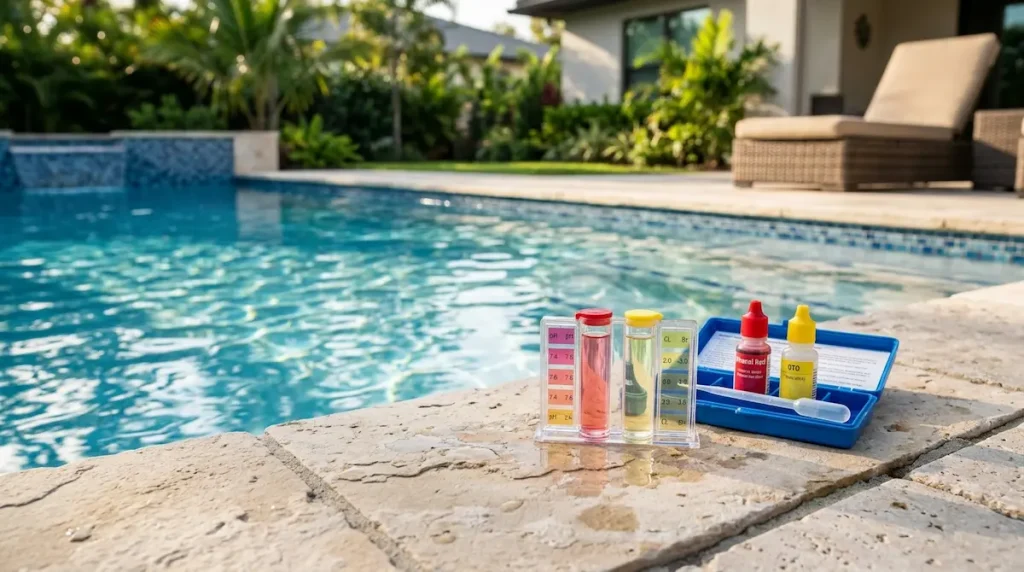
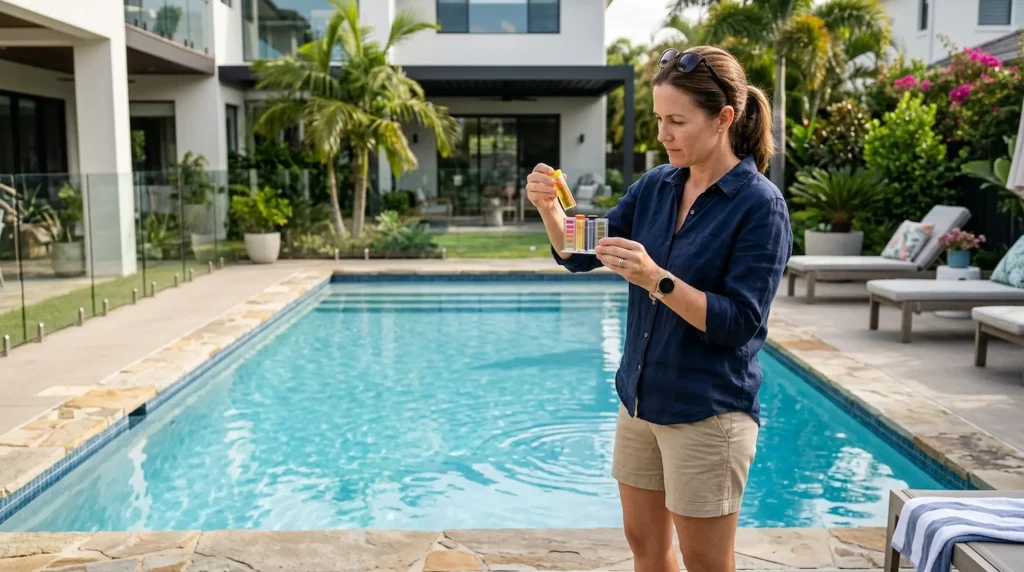
Keep it simple. Test total alkalinity every week, aim for 80 to 120 ppm, and shade toward the low end for liquid chlorine or the high end for tablets and vinyl. Balance alkalinity before you ever touch pH. If you’re low, reach for baking soda. If you’re high, dilute your acid and take your time. Do that, and your pH stops acting up while your pool stays clear with a lot less fuss.