A crack in your pool doesn’t always spell disaster. Sometimes it’s just a thin line in the plaster that you can patch in an afternoon. Other times, the break reaches the shell and lets water slip into the ground while your bill quietly climbs. Pool concrete repair covers both situations, but the right fix depends on what kind of crack you’re actually looking at.
Start there. Name the crack before you price the repair.
Is that crack serious, or just cosmetic?
Start with one question: is the line only in the finish, or is the pool shell itself opening up? Surface cracks usually live in the plaster or finish. They look annoying, but they often do not leak. Structural cracks go deeper into the concrete or gunite shell, and those are the ones that can move, widen, and drain water.
If you’re losing water, treat the crack as structural until a leak specialist proves otherwise.
Surface cracks: mostly a looks problem
These are the fine, shallow lines you see in the plaster of older pools. Spider-web patterns, often called crazing, are common and rarely leak. They can come from curing shrinkage, temperature swings, or pool water that has stayed out of balance too long.
Chronically high pH or hard water can rough up a finish faster than many homeowners expect. That is one more reason to keep your chemistry in range instead of waiting for the surface to tell you something is wrong.
Structural cracks: the ones that leak
Once the break passes the finish and reaches the gunite or concrete shell, you are no longer dealing with a cosmetic mark. Leak-repair specialists at Torque Lock note that structural cracks often show through multiple layers: plaster, tile line, bond beam, or nearby deck. They may also run in a straight vertical or horizontal path.
The easy clue? You keep topping off the pool and can’t explain where the water went.
Quick gut-check before you panic:
- If the gap is around 1/8 inch or wider, especially if it keeps stretching through the season, take it seriously.
- Water loss: more than roughly a quarter inch a day beyond normal evaporation is a warning sign.
- The crack appears in the same area on the plaster, tile, and deck above it.
- Cracks radiate from skimmers, returns, or the main drain, where the shell has more weak points.
If two or more of those sound familiar, get leak detection before you patch anything. Guessing gets expensive fast.
What pool concrete repair actually costs
Prices swing because pool cracks are not all the same job. A cosmetic plaster patch and a reinforced shell repair are priced like two different projects. Use the numbers below as planning ranges, then check current local pricing because labor, materials, access, and region can change the quote.
| Repair scenario | Typical cost | Best for |
|---|---|---|
| Small surface or hairline crack (DIY patch) | $100 to $200 | Cosmetic crazing, tight non-leaking lines |
| Large, spider-web, or deep cracks (pro) | $700 to $1,000 | Wider cracks, divots, and bulges |
| Structural crack repair with staples or stitches | $3,000 to $8,000 | Leaking shell cracks that keep moving |
| Bond beam crack patching | $4,000 to $6,000 | Cracks along the top edge of the shell |
| Full interior resurface | Up to $20,000 | Widespread cracking, scaling, or old plaster |
Shell crack pricing, in plain terms
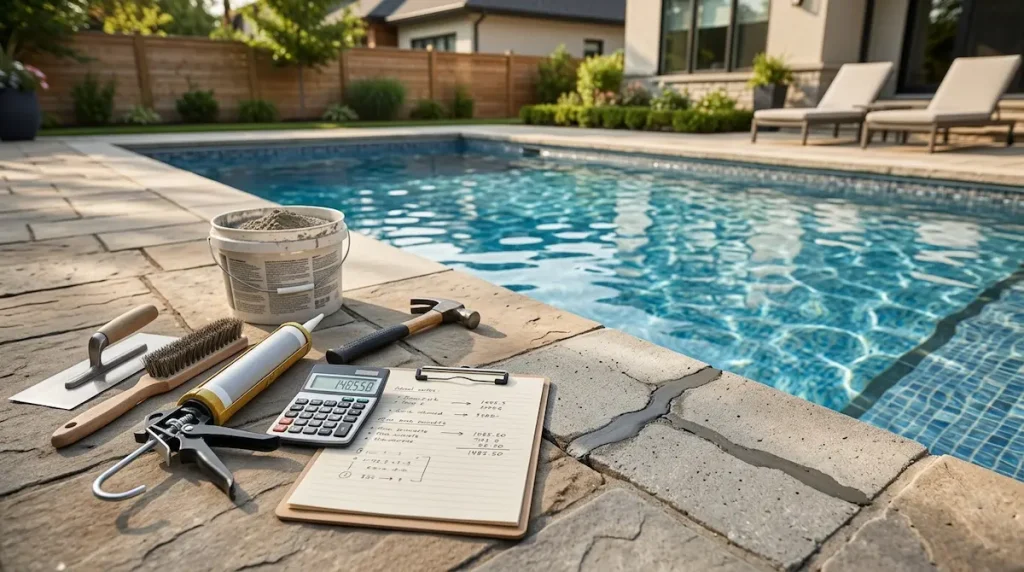
For a concrete or gunite shell, HomeGuide lists small crack repairs around $100 to $200 as a typical starting range. Larger spider-web cracks, bulges, and divots may run closer to $700 to $1,000 because the repair takes more prep and skill. Those are still planning numbers, not fixed prices. Check current pricing in your area before you budget the job.
Structural work sits in a different bracket. Some regional guides price structural cracks around $75 per linear foot, with bond beam repair landing near $70 to $80 per linear foot. A reinforced professional crack repair with diagnosis often falls in the $3,000 to $8,000 range. That can still be cheaper than a full renovation, which may run $15,000 to $40,000 depending on the scope.
One cost people forget: leak detection. Before any structural fix, a specialist has to confirm where the water is escaping. That inspection usually costs a few hundred dollars on its own, but it is money well spent. A patch in the wrong place fixes nothing.
Deck crack pricing
Your deck plays by different rules than the shell. Minor crack sealing and joint repairs on a concrete pool deck often land around $500 to $2,000. If the surface is tired all over, resurfacing with an overlay may cost roughly $3 to $7 per square foot. A full tear-out and replacement can reach about $15 to $35 per square foot, depending on finish, demolition, drainage, and site access.
For context, Concrete Network puts a brand-new concrete pool deck at about $6 to $18 per square foot. That makes replacement a bigger decision, especially around a large pool.
Keeping cracks small keeps these numbers small. If you’re budgeting for upkeep across the whole pool, pool maintenance cost shows where repair spending fits alongside chemicals, cleaning, and routine service.
Repair methods that actually hold
Not every fix is built for the same problem. Some materials seal water for a while. Others reinforce the concrete so the crack is less likely to keep moving. Match the method to the crack, not to the cheapest tube on the shelf.
| Method | Best for | Pros | Cons |
|---|---|---|---|
| Hydraulic cement / V-groove patch | Small surface cracks, minor drips | Cheap, DIY-friendly, sets fast even damp | Cosmetic only; cracks can return if the shell keeps moving |
| Epoxy or polyurethane foam injection | Narrow leaking cracks | Fills voids front to back, stops the leak | Limited if movement is not addressed; may be temporary on structural cracks |
| Rebar staples | Wider structural cracks | Adds tensile strength across the crack | Steel can corrode and stain; more concrete has to be cut out |
| Carbon fiber stitches | Structural cracks, long-term | Non-corrosive, low profile, strong reinforcement, less demolition | Needs a pro; higher upfront cost |
The trap of a pretty patch
A lot of DIY repairs fail because they treat a structural crack like a surface blemish. Filler can stop water for a while, but it does not stop a moving shell from pulling apart again. If the concrete shifts after the patch cures, the repair can separate and the leak comes back.
That is why leak-repair specialists are careful about reinforcement. Filling a moving crack without stabilizing it is usually a temporary band-aid, not a real fix. If the crack is structural, plan on staples or carbon fiber stitches instead of filler alone.
Why carbon fiber won homeowners over
Old-school repairs often used rebar bent into staples. That meant cutting larger channels and trusting the steel not to rust later. Carbon fiber stitches solve some of that problem. They are thin, non-corrosive, and designed to lock across the crack without as much demolition.
Some systems rate a single stitch at around 2,900 pounds of holding strength, but the result still depends on diagnosis, prep, spacing, and the condition of the pool shell. The big advantage is simple: less rust risk, a cleaner repair, and stronger reinforcement than filler alone.
Fixing small cracks yourself before they spread
Caught a hairline early and confident it is not leaking? You can handle a cosmetic patch on a weekend. Drain the water below the crack first, then work slowly.
- Widen the crack into a shallow “V” with an angle grinder or chisel so the filler has something to grab.
- Clean out all dust, grit, and loose concrete. A clean surface makes or breaks the bond.
- Mix a pool-rated hydraulic cement or two-part epoxy filler according to the label.
- Pack the filler into the crack, leave it slightly proud of the surface, then smooth it flush.
- Let it cure fully, sand back any high spots, then refinish or paint to blend.
If the crack reopens within a season, stop patching. That is the shell telling you it may still be moving, and you have crossed into pro territory. Balanced water helps prevent the next round of surface cracks too, so it is worth reading our pool water chemistry guide to stop etching and crazing at the source.
Shell and deck cracks need different playbooks
Most guides focus on one or the other. Yours doesn’t have to. A shell crack is a watertightness and structural issue, so it calls for leak detection and reinforcement. A deck crack is usually about slab movement, poor drainage, or a failed expansion joint. Same word, different repair logic.
| Where the crack is | Main risk | Right first move |
|---|---|---|
| Pool shell (walls, floor) | Leaks and structural spread | Leak detection, then staples or stitches |
| Bond beam (top edge) | Tile and coping damage, leaks | Injection plus reinforcement, reset coping |
| Concrete deck | Trip hazard, water intrusion under slab | Seal joints, lift the slab, or resurface |
One practical tip from the field: a lot of deck cracking traces back to a missing or failed expansion joint between the deck and the pool coping. Install or recaulk that joint when you repair, or the crack can come back in the same line next winter.
When repair stops making sense
There is a point where small fixes turn into expensive chasing. If your shell has widespread spider-webbing plus active structural leaks, and piecemeal repair quotes start stacking toward five figures, price a full resurface or renovation alongside them.
Repair and restoration often cost less than replacement, so repair wins in many cases. The exception is an old, tired shell where you are fixing one crack after another every year. At that stage, resurfacing the whole interior may be the smarter spend.
Frequently asked questions
Can you repair a cracked concrete pool without draining it?
Sometimes. Small surface and hairline cracks can be sealed underwater with pool-rated epoxy putty. Structural cracks, staples, and stitch repairs usually need the water dropped below the work area so the shell can be prepped and reinforced properly.
Are cracks in a concrete pool normal?
Fine surface crazing is common in older concrete pools and is often cosmetic. Wide, growing, or leaking cracks are different. Those are not normal maintenance marks, and they should not be ignored.
How do I know if my pool crack is leaking?
Try the bucket test. Float a filled bucket on a step, mark the water level inside and outside, and check after 24 hours. If the pool drops noticeably more than the bucket, you probably have a leak worth a professional inspection.
How long does a professional crack repair last?
A reinforced structural repair can last for many years when the crack is diagnosed correctly and the underlying movement is controlled. Cosmetic patches and paint are less durable and may need redoing after a season or two.
Will homeowners insurance cover pool crack repair?
Insurance usually depends on the cause of the damage, not just the crack itself. A sudden covered event may be treated differently from gradual settling, age, or wear. Check your policy language and ask your insurer before assuming either way.
So what should you do next?
Start by naming the crack. If it is a thin cosmetic line and the water level holds, patch it with pool-rated hydraulic cement or epoxy and keep your chemistry balanced so the surface does not keep deteriorating.
If the crack is around 1/8 inch wide, keeps growing, or comes with water loss, book leak detection first. Then plan for a reinforced structural repair, often in the $3,000 to $8,000 range depending on the crack, access, region, and current local pricing. If cracks are showing up all over an aging shell, get a resurface quote before spending more money on one-off patches. Fix the cause, not just the line you can see.