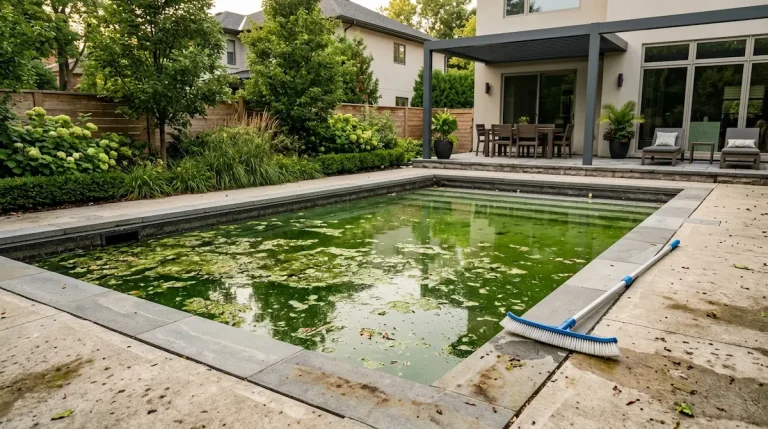
Opening day. Your cover’s off, the pump is humming, and the water looks… questionable. Before you crack open a single bottle, get this straight. The chemicals to open a pool cover two separate jobs, balancing the water and sanitizing it, and the sequence you follow decides whether you swim this weekend or babysit a cloudy pool for a week.
You don’t need a garage full of bottles. Five or six, added in the right order, will do it.
What chemicals do you need to open a pool?
Opening a pool takes two groups of products. First the balancers: an alkalinity increaser, a pH increaser or decreaser, a calcium hardness increaser, and cyanuric acid. Then the sanitizers: shock plus chlorine tablets or granules. Balance first, shock second, and reach for a clarifier or stain-and-scale product only if your water actually calls for it.
Picture two buckets. One dials in the water chemistry so your chlorine can actually work. The other wipes out whatever took up residence over the winter. Want the full season-long rundown of pool chemicals? That’s a longer story. Opening only needs the shortlist below.
| Chemical | What it does | Best for |
|---|---|---|
| Alkalinity increaser | Buffers pH so it stops bouncing around | The very first adjustment |
| pH increaser / decreaser | Sets a comfortable, chlorine-friendly pH | Dialing in after alkalinity |
| Calcium hardness increaser | Keeps soft, hungry water from chewing on plaster and gear | Plaster and concrete pools |
| Cyanuric acid (stabilizer) | Shields chlorine from sunlight | Outdoor pools burning off chlorine fast |
| Chlorine shock | Clears out winter bacteria and organics | The reset that clears the water |
| Chlorine tablets or granules | Holds a steady sanitizer level after shock | Day-to-day upkeep once you’re open |
The order to add them (this is what most people get wrong)
Sequence beats brand every time. Dump shock in before your pH is dialed in and half of it goes to waste. Slow down. Work through it one step at a time, testing as you go.
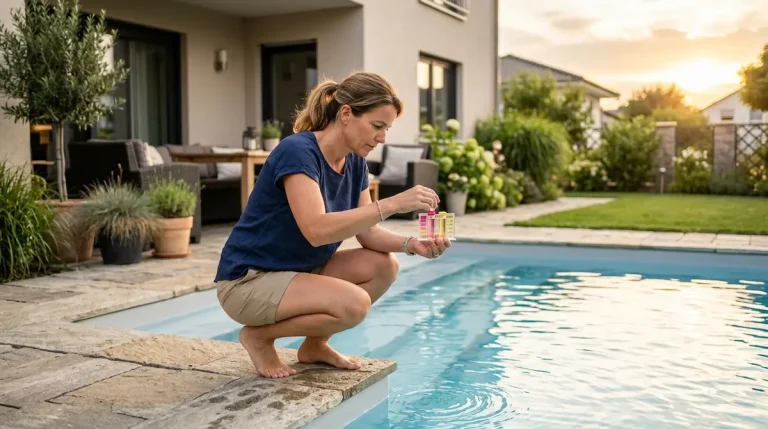
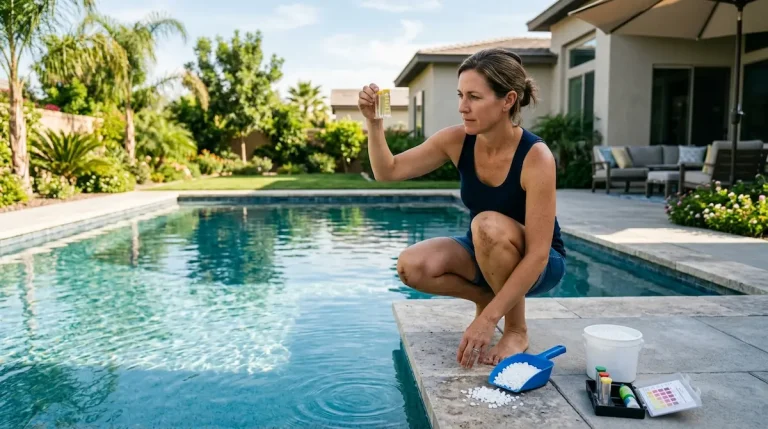
- Test first. Let the filter run a few hours, then read pH, alkalinity, calcium, cyanuric acid, and chlorine.
- Bring total alkalinity into the 80 to 120 ppm band and let it circulate.
- Dial pH in next, somewhere around 7.4 to 7.6.
- Nudge calcium hardness up if your test came back low.
- Top off cyanuric acid so the sun stops eating your chlorine.
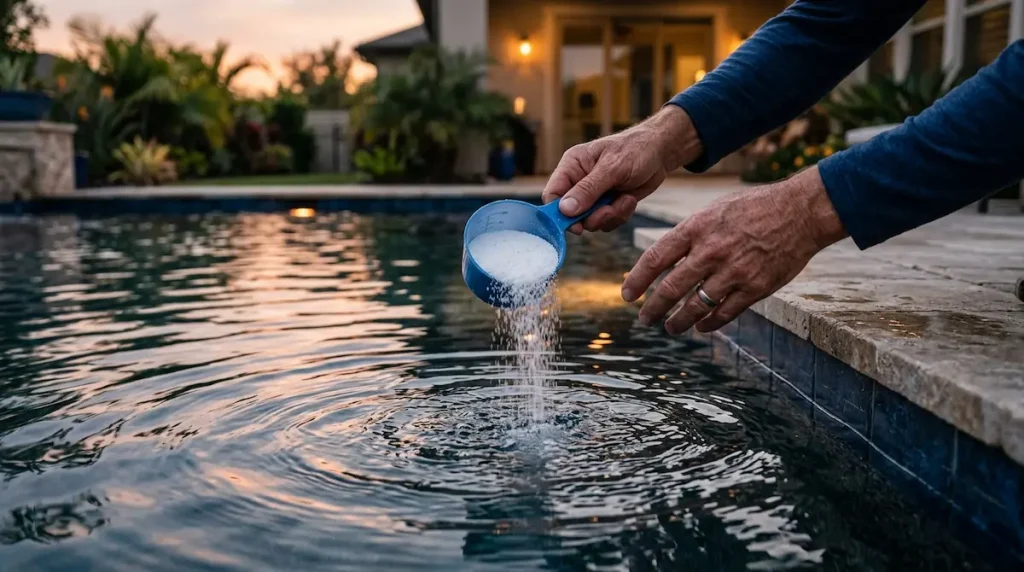
- Only now do you shock, and do it at dusk so daylight doesn’t burn it off.
- Once chlorine drops into range, start running your tablets or granules.
Why alkalinity goes before pH
Think of alkalinity as the seatbelt for pH. Set pH first and it slips the second you touch alkalinity, so you end up chasing the number in circles. Lock alkalinity down and pH tends to stay where you put it. For the science on why the two move together, we dig into pool water chemistry in the pillar guide.
How much of each to add
Read the label first, because product strengths aren’t all the same. That said, the targets below are where the industry and public-health guidance line up, and they make a reliable starting point for any backyard pool.
| Reading | Ideal range | Quick note |
|---|---|---|
| Total alkalinity | 80 to 120 ppm | Handle this one first |
| pH | 7.4 to 7.6 | CDC allows 7.0 to 7.8 |
| Calcium hardness | 200 to 400 ppm | Vinyl and fiberglass run lower |
| Cyanuric acid | 30 to 50 ppm | About 1 lb per 10,000 gal adds ~10 ppm |
| Free chlorine | 2 to 4 ppm | Hold at least 2 ppm when you run stabilizer |
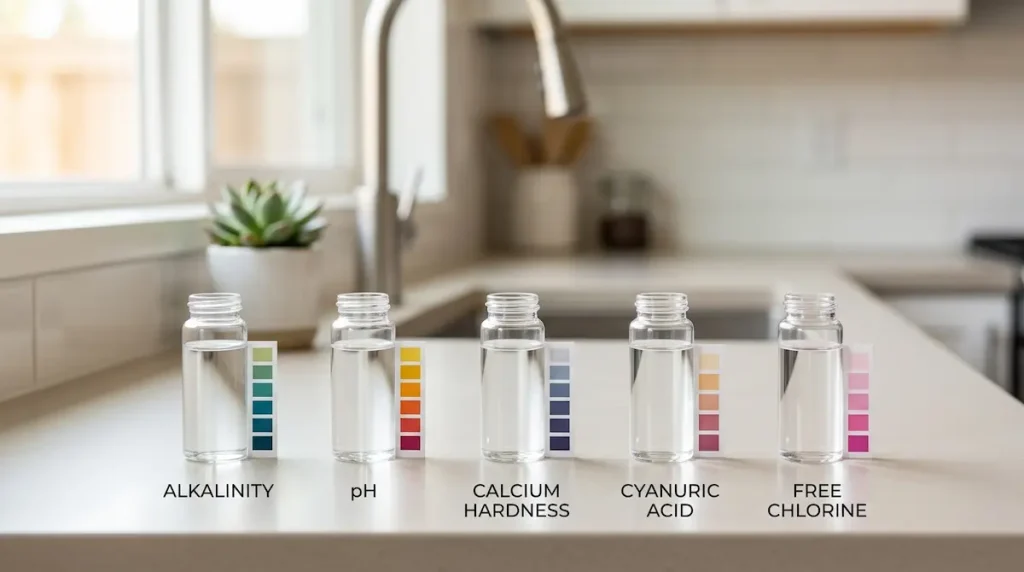
For shock, clear water is easy math: figure about a pound of cal-hypo for every 10,000 gallons. If the water still looks dull or green after a full circulation, keep adding until it turns a cloudy blue gray instead of green. When cyanuric acid is in the water, the CDC’s home pool guidance (CDC: Home Pool Water Treatment and Testing) sets the free chlorine floor at 2 ppm, and that describes just about every outdoor pool.
The spring catch nobody warns you about
Cold water pushes back. Early in the season, with your pool still sitting in the 50s, chemicals dissolve and react slowly, and a test kit can read low even after you’ve dosed it right.
I’ve watched people panic over a stubborn reading, pour in a second dose, then blow way past target once the water warms and everything finally reacts. Skip that mistake. Add your dose, let the water turn over fully, and retest before you add more. A little patience here saves both money and a week of cleanup.
Test kit vs test strips at opening
Strips are fine for a quick weekly look. At opening, though, a liquid test kit gives you the precision you want while the water is cold and the readings keep shifting. Trying to figure out the season’s spend? Our pool maintenance cost guide lays out what a year of chemicals and testing really adds up to.
When is the water actually swim-ready?
Balancers clear quickly. With pH, alkalinity, calcium, and stabilizer, most guidance says you’re good to swim after roughly 20 to 30 minutes of pump time.
Shock is the wait. After you shock, keep the filter running 12 to 24 hours and hold off until free chlorine falls back to 4 ppm or lower. Test it. Don’t guess. A single strip costs less than a chemical rash.
Do you really need a pool opening kit?
Honestly? Not always. Pre-packaged startup kits are handy, and they take the guesswork out. Trouble is, they often throw in clarifiers and algaecides you won’t need if your water is already reasonably clear. Balancing and shocking usually handle the job on their own.
Grab a kit if you want one box and zero decisions. Skip it if you already keep balancers around and only need to top up what’s low. Either way, the chemistry above is the part that counts.
Frequently asked questions
What order do you add pool chemicals when opening?
Start with alkalinity, then pH, then calcium hardness, then cyanuric acid. Shock comes last, only after the water is balanced. Shock added before pH is set just burns off chlorine.
How long after opening a pool can you swim?
Give balancers about 20 to 30 minutes with the pump running. After shock, wait 12 to 24 hours, and until free chlorine has dropped to 4 ppm or below.
How much shock do I need to open my pool?
Clear water needs roughly a pound of cal-hypo shock per 10,000 gallons. Cloudy or green water takes more, so keep going until the green is gone.
Can I add all the opening chemicals at once?
No. Space them out. Combining chemicals in the water or in the same bucket can be dangerous and can cancel each other out. Add one, let it circulate, then move on.
Do I need a stabilizer if I use chlorine tablets?
Usually not much. Trichlor tablets carry their own cyanuric acid, so they push stabilizer up as they dissolve. Test before adding more or you’ll sail past the 30 to 50 ppm range.
What to do this weekend
Keep it simple. Test the water, sort out alkalinity and pH, top up calcium and stabilizer if they’re low, then shock at dusk and let the filter run through the night. Retest in the morning, drop in your tablets, and confirm chlorine has settled to 4 ppm or under before anyone jumps in. Get that sequence right and you’ll be swimming in clear water by the weekend instead of fighting a green pool next week.