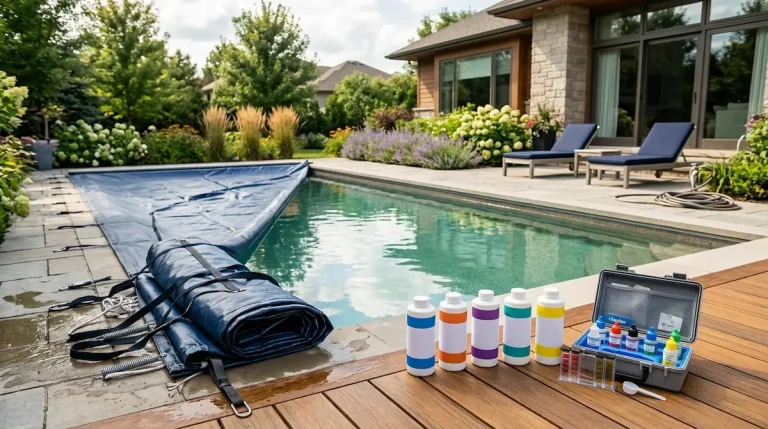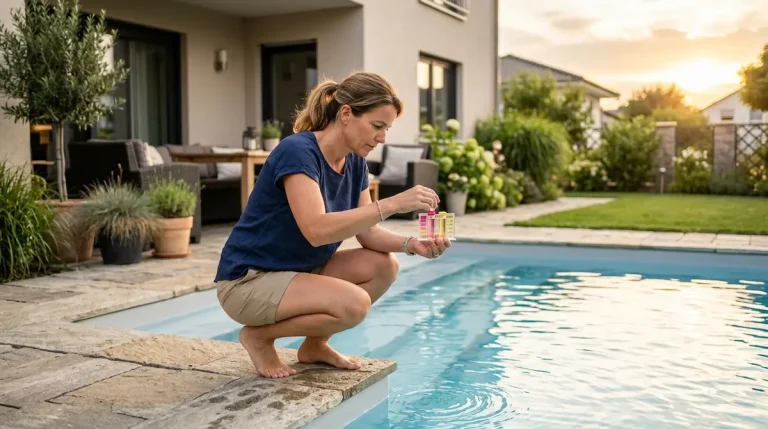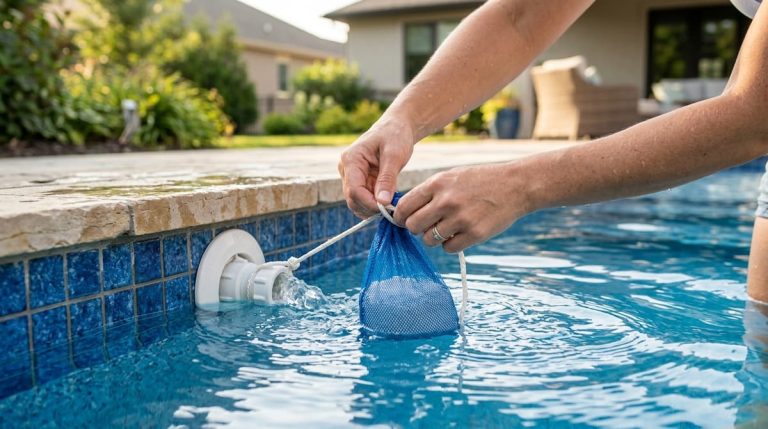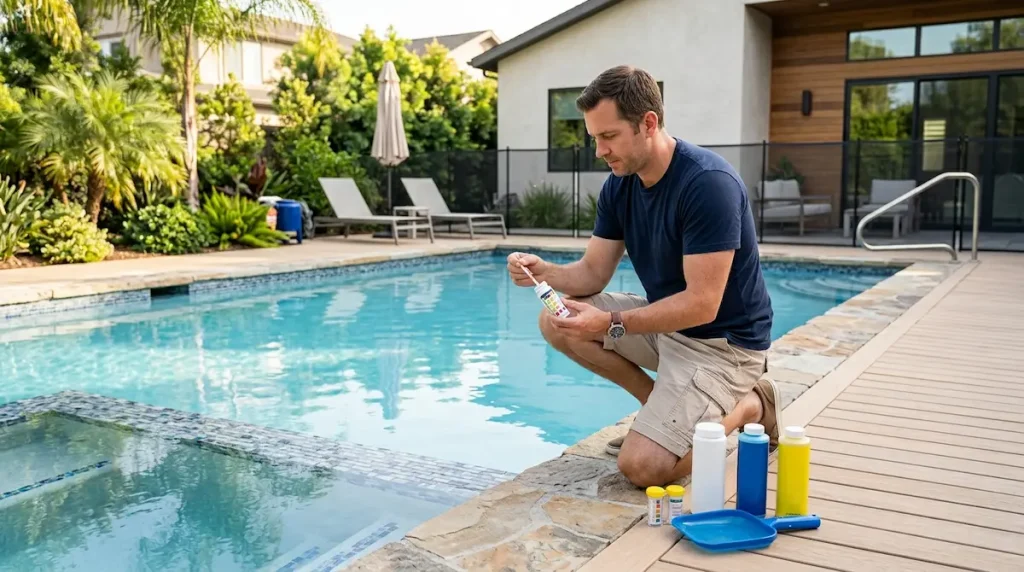
You’re standing at the edge with a box of chemicals in one hand and a water test in the other. Tempting, isn’t it, to pour everything in at once and go back inside. That’s also the fastest way to waste product, cloud your water, or set off a reaction you really don’t want. So how long to wait between pool chemicals? Short version: usually a few hours, sometimes far less, and once in a while a full day.
Let’s make it simple.
The quick answer
For most pool chemicals, use 4 hours as your safe default and keep the pump running so the product can spread through the water. Some quick-dissolving balancers may only need about 30 minutes. Shock is the slow one: before adding algaecide, test first and wait until free chlorine drops below 5 ppm, which often means waiting until the next day.
That’s the rule of thumb. Now the details that actually keep your water clear and your lungs safe.
The general rule, and when you can bend it
Most balancing products are not complicated. They need circulation, dilution, and enough time to stop sitting in one strong pocket of water. Leslie’s Pool Supplies gives a safe default of “at least 4 hours between chemical applications,” and that is a good number to use when the label does not give you a longer wait.
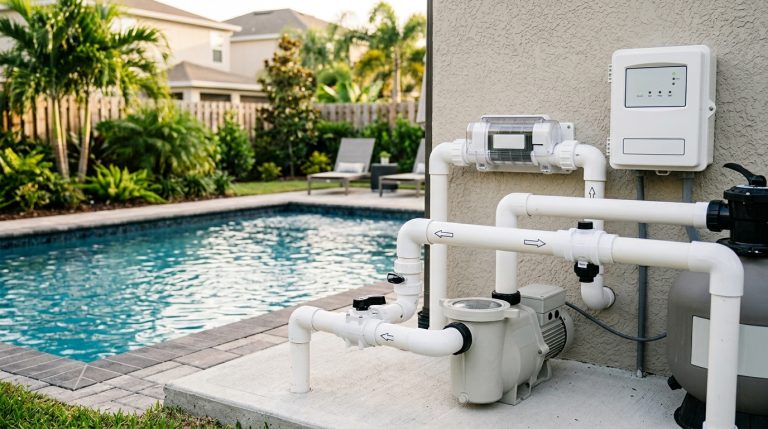
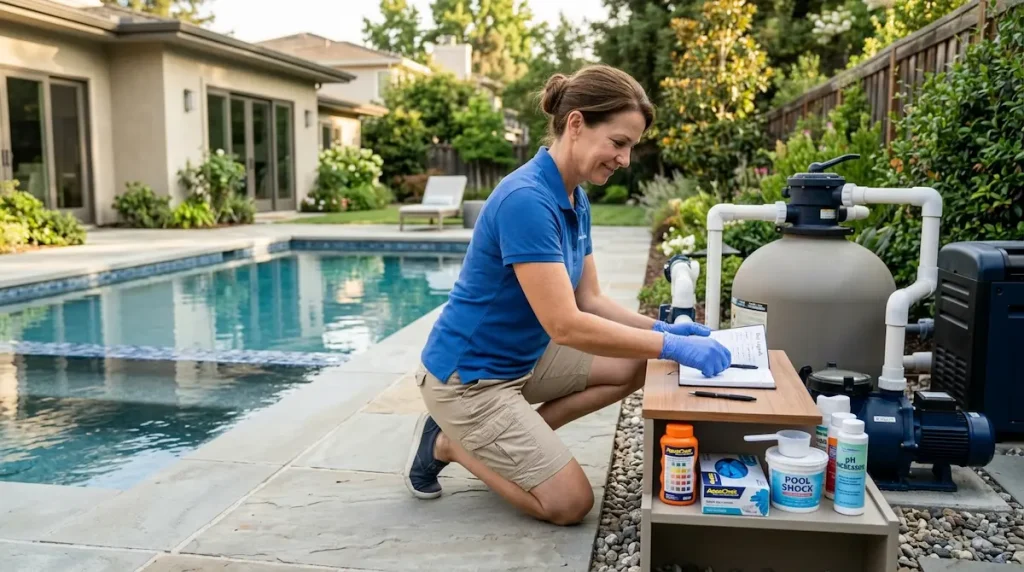
Circulation is the part people skip. Turn the pump on before you add anything, and leave it running for at least 30 minutes afterward. Without flow, a chemical sits in a concentrated pocket right where you poured it, and your 4-hour clock means nothing. Want to know exactly which products you’re juggling in the first place? Start with the chemicals you actually need for a pool before you worry about timing.
Wait times by chemical
Here’s a cheat sheet you can keep near the equipment pad. These assume the pump is running. Always follow your product label if it lists a longer wait.
| Chemical you just added | Wait before the next chemical | Why it matters |
|---|---|---|
| Alkalinity increaser (baking soda) | About 6 hours, or one full turnover | It can move pH too, so give the water time before you adjust pH |
| pH increaser (soda ash) or pH decreaser (dry acid) | Around 4 hours, then retest | pH can keep shifting for a while after dosing |
| Muriatic acid | At least 4 hours before chlorine or shock | Acid and concentrated chlorine can create a gas hazard |
| Liquid chlorine or shock | At least 4 hours before acid; below 5 ppm free chlorine before algaecide | High chlorine wastes algaecide and can react badly with acid |
| Calcium hardness increaser | 12 to 24 hours before anything else | It dissolves slowly and can cloud the water if you rush it |
| Cyanuric acid (stabilizer) | 24 to 48 hours, and don’t backwash | It can take a long time to dissolve, especially through the skimmer |
| Clarifier | About 1 hour | It needs gentle circulation to gather fine particles |
| Flocculant | Follow the label; pump usually off | It drops debris to the floor so you can vacuum to waste |
The pairs you should never rush
One combination is genuinely dangerous, not just wasteful. Treat chlorine and acid like two products that should not meet while either one is still concentrated. That means muriatic acid, dry acid, liquid chlorine, and shock all need breathing room from each other. The risk is chlorine gas, which is not a cloudy-water problem. It is a get-away-from-the-pool problem.
Don’t shock right after adding acid, and don’t add acid when chlorine is sky-high from a recent shock. Give them at least 4 hours, keep the pump running, and add them at opposite ends of the pool if you are handling both on the same day.
The slow dissolvers most people underestimate
Calcium hardness increaser and stabilizer are sneaky. They can look like they disappeared before they are actually mixed. Broadcast a handful of calcium over the surface and it can drift to the floor, where it may bleach or mark a liner before the pump ever catches it. Stabilizer is even slower, sometimes taking a day or two to dissolve fully through the skimmer.
I’ve watched people backwash the next morning and flush half their pricey cyanuric acid straight down the drain. Add these products solo, give them a long runway, and skip the backwash for 48 hours.
Can you add pool chemicals at the same time?
Mostly, no, and not only because of safety. Chlorine and acid are the pair you should treat as truly off-limits close together. Salt, stabilizer, and calcium chloride can technically go in near other products in some routines, according to longtime Trouble Free Pool experts. Still, if you dump four things in at once and the water turns cloudy, you will not know which one caused it.
Adding products one at a time, with a test between, turns guesswork into a routine you can trust. Keep these ground rules close:
- The bucket is not a mixing bowl. Never combine pool chemicals together before they go into the pool.
- Test first, then adjust in one direction. Chasing pH up and down in the same afternoon wastes product.
- Add acid, wait, retest, and only then touch chlorine.
When is it safe to swim again?
Different question, related answer. Most balancers clear the water for swimming faster than they clear it for the next chemical.
| Chemical added | Wait before swimming |
|---|---|
| pH, alkalinity, clarifier | 20 minutes to 1 hour |
| Liquid chlorine (routine dose) | About 4 hours, or until free chlorine reads 1 to 4 ppm |
| Calcium hardness increaser | 2 to 4 hours, or one full turnover |
| Algaecide (non-metallic) | 15 to 30 minutes |
| Chlorine shock | Until free chlorine falls to 1 to 4 ppm, often around 24 hours |
For the swim decision, trust the test reading more than the clock. The CDC recommends at least 1 ppm free chlorine and a pH of 7.2 to 7.8 for safe swimming. That range is the real green light. For shock specifically, let the level fall on its own and test before anyone gets in.
Stop watching the clock. Start counting turnovers.
This is the part most guides leave out. A generic “wait 4 hours” is really a stand-in for “wait about half a turnover,” and turnover time depends on your pool, not on a blog. Turnover is how long your pump takes to cycle all the water once.
The math is simple: pool gallons divided by gallons per hour from the pump. If you have a 20,000-gallon pool and the pump moves 3,000 gallons per hour, one turnover takes about 6.7 hours. For that pool, a “one turnover” chemical like calcium deserves a solid 7-hour wait. A half-turnover balancer lands closer to 3 to 4 hours.
Run the number once for your own pool and you’ll stop guessing. If you want to go deeper on how these levels interact, there is more on pool water chemistry to build on.
A realistic same-day timeline
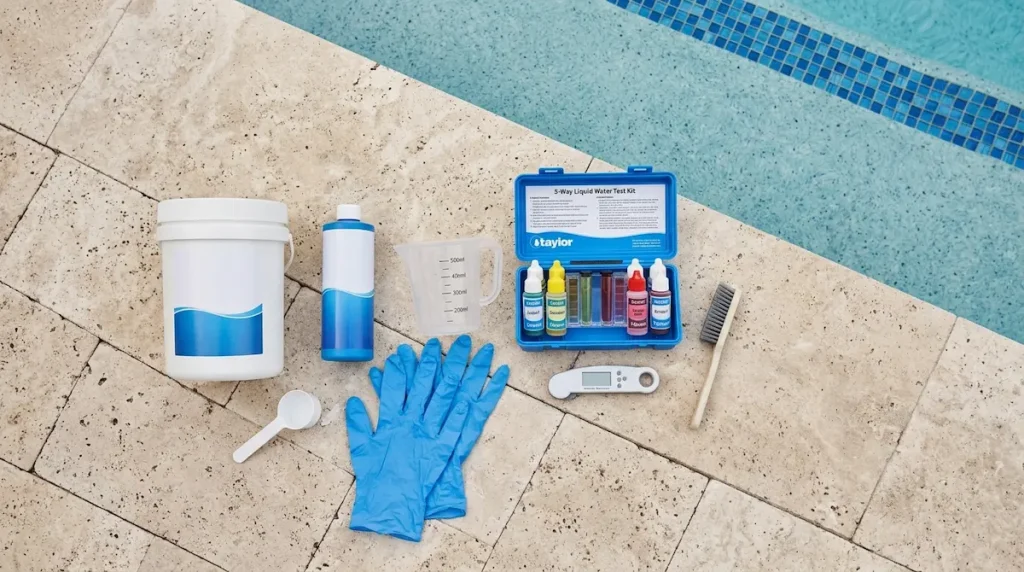
Say it’s Saturday morning and your water needs alkalinity, pH, and chlorine. Here’s how the day actually flows with the pump running throughout:
- 9:00 a.m. Test the water. Add alkalinity increaser.
- 3:00 p.m. Retest. Adjust pH now that alkalinity has settled.
- 7:00 p.m. Retest pH. Add chlorine in the evening so the sun doesn’t burn it off.
- Sunday morning. Test once more. If everything sits in range, you’re swimming.
Not glamorous. But it beats cloudy water and a second trip to the store.
Common mistakes I see all the time
- Pouring the whole weekly lineup in during one five-minute visit.
- Adding acid right after shocking, which is the risky one.
- Tossing calcium or cal-hypo granules across the surface, where they settle and mark the floor.
- Backwashing the day after adding stabilizer and rinsing money down the drain.
- Trusting the clock over a test kit. The kit is the only thing that actually knows.
So what should you actually do?
Build a rhythm and let the water tell you when it is ready. Default to 4 hours between different chemicals, run the pump throughout, and give calcium and stabilizer a full day of grace. Keep chlorine and acid far apart in time and place. Then test before the next step instead of watching a timer. If timing feels fiddly, remember it is a small slice of ownership cost, and our pool maintenance cost guide breaks down the rest. Patience here is cheaper than a tank of shock you wasted by rushing.
Frequently asked questions
Can you add all pool chemicals at once?
You shouldn’t. Chlorine and acid are the only truly dangerous pair, but adding everything together makes it impossible to tell what fixed or broke your water. One product, one wait, one test. That routine is faster in the long run.
How long after adding chlorine can you add muriatic acid?
Give it at least a 4-hour buffer, with the pump running. If you shocked the pool recently and chlorine is still high, wait longer. Chlorine and acid can react badly when they meet in concentrated form, so keep them separated by time and by location in the pool.
Do you still have to wait if the pump is running?
Yes. Circulation shortens the wait, but it does not erase it. Quick balancers still need about 30 minutes to mix, and reactive pairs like acid and chlorine still deserve their full wait. If the pump is off, the usual wait times are mostly guesswork.
How long should the pump run after adding chemicals?
Run it for at least 30 minutes after most additions, and longer when the product dissolves slowly. For shock, calcium hardness increaser, or a bigger correction, several hours or overnight is safer.
Can you add algaecide and shock together?
No. If you pour algaecide into high-chlorine water, the chlorine attacks the product before it can help your pool. Shock first, wait until free chlorine drops below 5 ppm, usually around 24 hours, then add algaecide.