You pulled off the cover, or you just woke up, and the water looks like something out of a swamp. So why is my pool green, and can you sort it out yourself? Nearly always, yes. A green pool is one of the problems homeowners hit most, and in most cases you can bring it back in a few days without draining anything or paying for a service call.
Quick answer: A green pool usually comes down to algae, and algae shows up when your chlorine slipped too low to keep it in check. Now and then the green comes from high pH, dissolved metals such as copper, or plain pollen. Nail the real cause first, then brush, balance, shock, and filter until the water clears.
What’s actually turning your pool green
Green isn’t a single problem. There are four of them, and they don’t respond to the same fix. Pin down the cause before you start pouring chemicals, because one wrong move can burn a whole weekend or stain your liner.
Algae from low chlorine (the usual suspect)
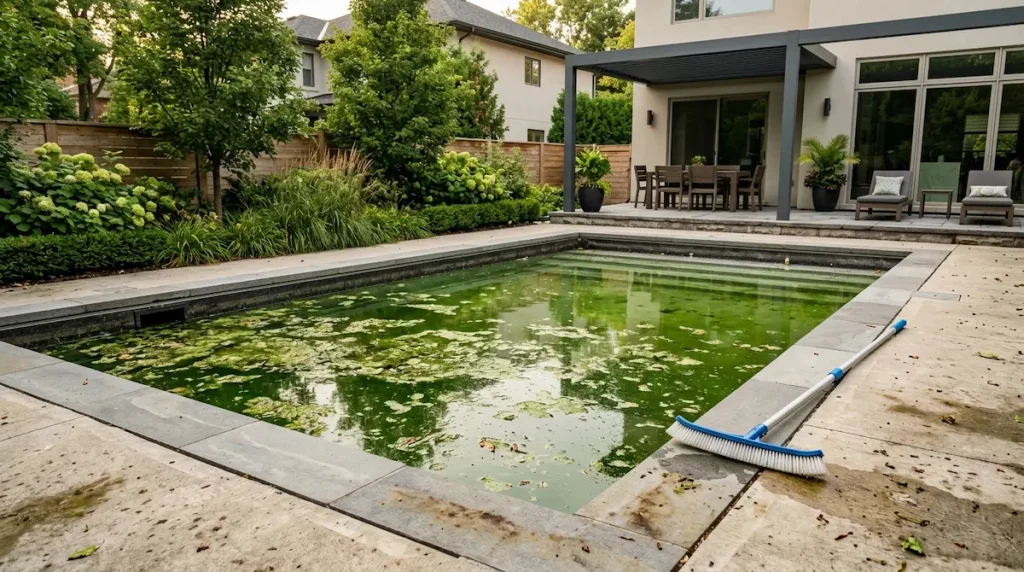
Green, cloudy water you can’t see the bottom of, plus walls that feel slick under your hand, points straight to a live algae bloom. It sets in fast once free chlorine drops too low to sanitize, and warm, still, nutrient-heavy water only speeds things along. According to the CDC, blooms take off most in water that’s warm, barely moving, and loaded with nutrients like nitrogen or phosphorus, which is pretty much what a neglected pool becomes after one hot week (CDC: Harmful Algal Blooms). To tell green apart from black or mustard, our guide on pool algae breaks down each type.
High pH that quietly shuts your chlorine off
Sometimes the chlorine reading looks fine and the pool still turns. Look at your pH next. Let it creep above roughly 7.8 and your chlorine goes weak no matter how strong the number reads, so algae pushes through anyway. Bring the pH back down and the chlorine you already have suddenly starts pulling its weight again.
Metals like copper (green but clear)
This is the one that fools people. Water that’s green yet still see-through, floor clearly visible, usually isn’t algae at all. More often it’s dissolved metal, copper especially, coming from your fill water, a bargain algaecide, or acidic water chewing on metal pool parts. Throw shock at a metal-stained pool and you can make things worse, plaster stains included. Different cause, different cure.
Pollen and spring runoff
Early in the season, that thin yellow-green film floating on top is often nothing but pollen. Looks worse than it is, and it rinses out easily. No shock marathon needed.
Diagnose before you dose
Most guides breeze past this step, and it’s the one that keeps money in your pocket. A couple of quick tests at home tell you what you’re really up against in less than a day.
| Test | How to do it | What it tells you |
|---|---|---|
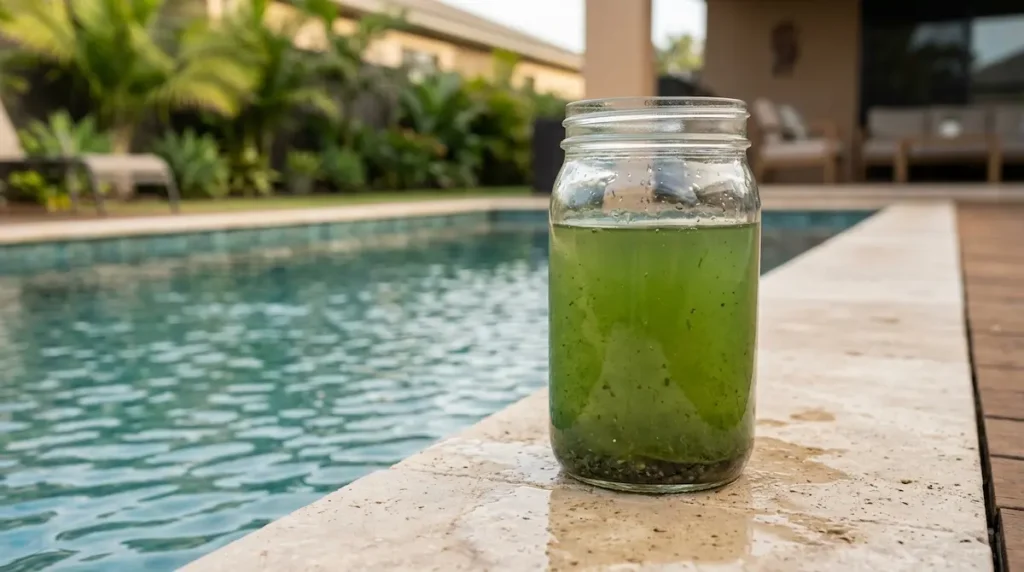
| Glass jar test | Fill a clear glass with a sample and leave it in indirect light for a full day. | Sinks and settles = pollen or dead debris. Stays green and murky throughout = live algae. |
| Overnight chlorine loss test | Bump free chlorine up in the evening, write down the reading, then check again at first light before the sun hits. | A drop of more than 1 ppm by morning = algae feeding on your chlorine. Barely any drop = point the finger at pH or metals. |
| Clarity check | Just look. Can you make out the floor? | Green and cloudy = algae. Green and clear = metals or high pH. |
How to clear a green pool, step by step
Confirmed algae? Good. Run this in order, because skipping around is exactly why people shock three times and stay green.
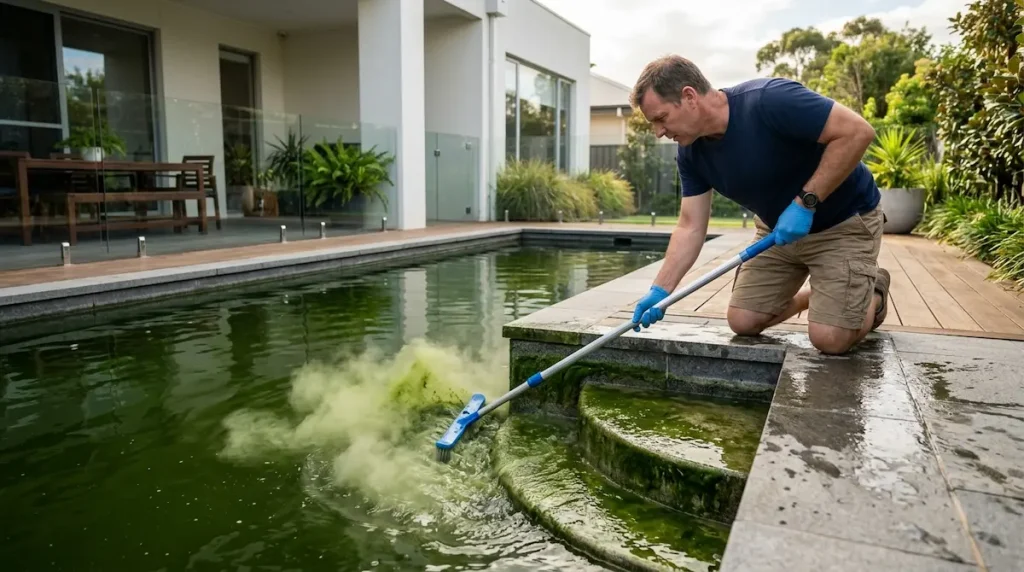
- Brush everything. Walls, floor, steps, corners. Loosening the algae is what lets chlorine actually reach it. Expect the water to cloud up while you work. That’s fine.
- Vacuum to waste. Run a manual vacuum on the waste setting so the muck exits the pool instead of jamming your filter. Add water to replace what drains out.
- Balance pH and alkalinity. Get pH into the 7.4 to 7.6 window and keep alkalinity somewhere from 80 to 120 ppm, so the shock you add next works at full strength.
- Shock hard, after dark. Daylight burns chlorine off before it can do its job, so dose at dusk with the pump running. Light green calls for a double dose, dark green a triple.
- Run the filter nonstop. Leave it going 8 hours minimum, 24 or more if you can. Water shifting to a cloudy gray-blue is a win. That’s dead algae.
- Clarify or floc, then backwash. A clarifier clumps the fine dead algae together so the filter can grab it. Backwash or clean the filter each time pressure creeps up.
- Repeat if needed. A real swamp sometimes needs a second or third pass. Patience beats panic-buying more chemicals.
One honest warning from experience: algaecide is a prevention tool, not a cure for a full bloom. Dumping it into pea-soup water mostly just burns cash. Chlorine is what does the killing.
How much shock, based on how green it is
Label directions usually peg one normal dose at about 1 pound of granular shock for every 10,000 gallons. Beating algae means going well past that. Cal-hypo shock hits the hardest, though on fiberglass or saltwater pools dichlor is the safer choice.
| Water color | Severity | Shock dose (per 10,000 gal) | Best for |
|---|---|---|---|
| Light green, slightly cloudy | Early bloom | Double (about 2 lb) | Fast recovery, caught it early |
| Deep green, can’t see steps | Established | Triple (about 3 lb) | Full blooms after rain or a closed season |
| Dark green to black, murky | Severe | Triple, then repeat | Long-neglected or reopened pools |
How long it takes and what it costs
Treat it right and most algae pools come back to clear inside 48 to 72 hours. A heavy dark bloom, or a filter that’s struggling, can drag that out to a week or two of daily filtering and backwashing. Handling it yourself still costs far less than a service call. For the wider view on upkeep spending, see our pool maintenance cost guide.
| What you’ll buy | Ballpark price (verify locally) | Notes |
|---|---|---|
| Granular shock (per lb) | around $2 to $5 | Buy extra; you’ll double or triple the dose |
| Pool clarifier | roughly $10 to $25 | Optional, speeds up filtering |
| Test kit or strips | from $15 to $40 | Non-negotiable; you’re flying blind without one |
| Metal sequestrant (if metals) | about $15 to $30 | Only if the green is copper, not algae |
Prices move with brand and region, and change over time, so treat these as rough retail ranges and check current local pricing, not fixed quotes.
How to stop it from turning green again
Clearing it is the hard part. Staying clear is easy once the habit sticks. In swim season, test your water two or three times a week. Keep free chlorine sitting between 1 and 3 ppm. Run the pump long enough each day to turn the whole pool over. Brush the walls weekly, and don’t let pH drift high.
Most green pools come back to one skipped week of testing. If you want the numbers locked in for good, read more on pool water chemistry and build a simple weekly routine.
Green pool questions people ask
What causes a pool to turn green overnight?
An overnight bloom almost always means chlorine crashed right when conditions favored algae: heat, sun, and often rain that watered down your sanitizer and washed in nutrients. A pump that stopped circulating can trigger it too.
Can I shock a green pool during the day?
You can, but you’re throwing it away. Daytime sun burns off free chlorine in no time, so shock added at noon fizzles out before it kills much algae. Hold off until dusk and keep the pump running.
Is it safe to swim in a green pool?
No. Skip it. The algae itself isn’t always harmful, but you can’t see what’s below the surface, and the same water breeds bacteria. Wait until it’s clear and chlorine sits back in the 1 to 3 ppm range.
Will algaecide alone clear a green pool?
Not a genuine bloom. Algaecide holds growth back and helps as a follow-up after shocking, but chlorine is what actually clears a green pool. Lead with shock, then finish with algaecide.
How long does it take to clear a green pool?
For a typical algae bloom, figure 2 to 3 days. Severe or black-green water, or a filter that can’t keep up, can stretch it to a week or two of steady treatment.
Your move
Before you spend a cent, start with the glass jar and the overnight chlorine test. If the sample settles or your chlorine barely moves, you’re probably looking at pollen or metals, not algae, and shocking would be the wrong call. If it’s cloudy green and your chlorine disappears by morning, work the seven steps above, shock after dark, and keep that filter running until the water turns clear. Then lock in a weekly testing habit so this question never comes up again.