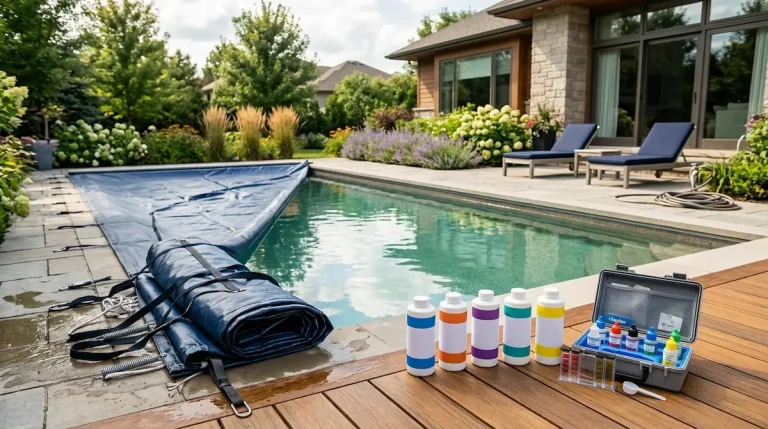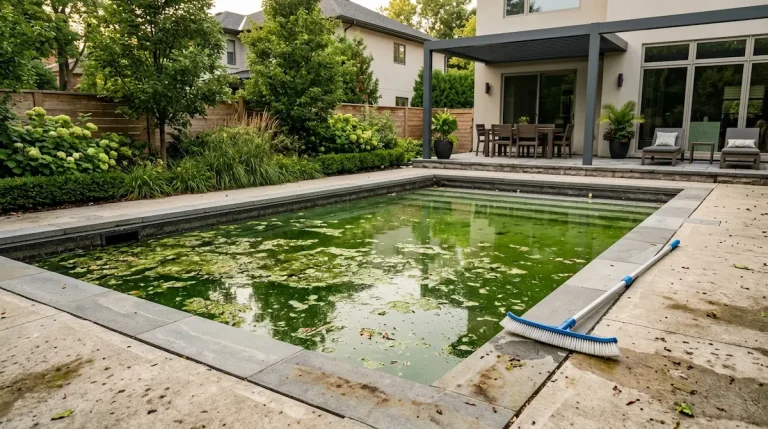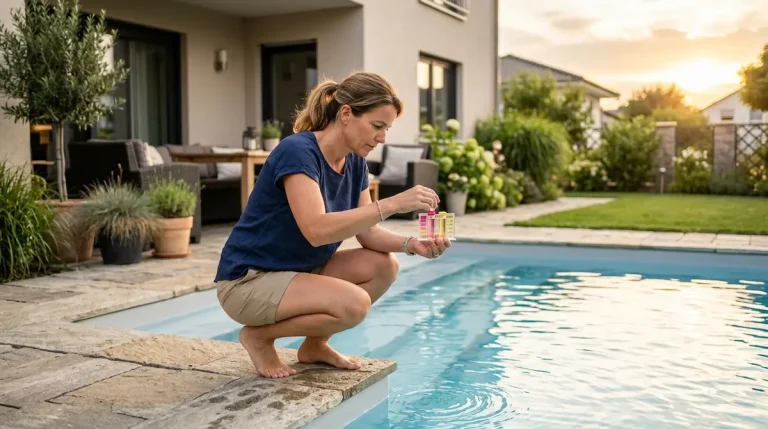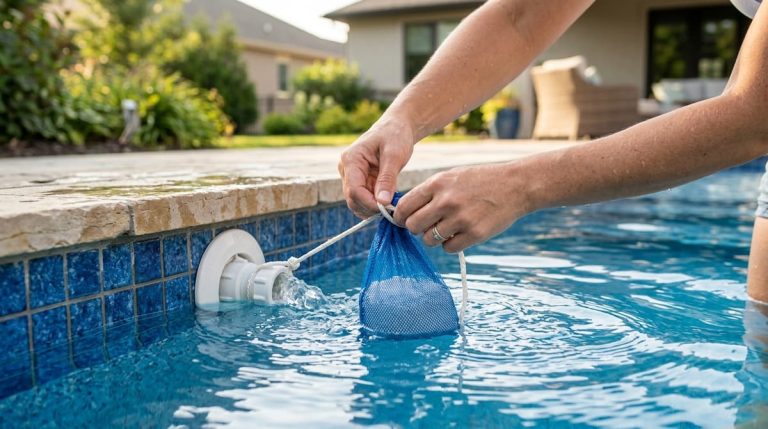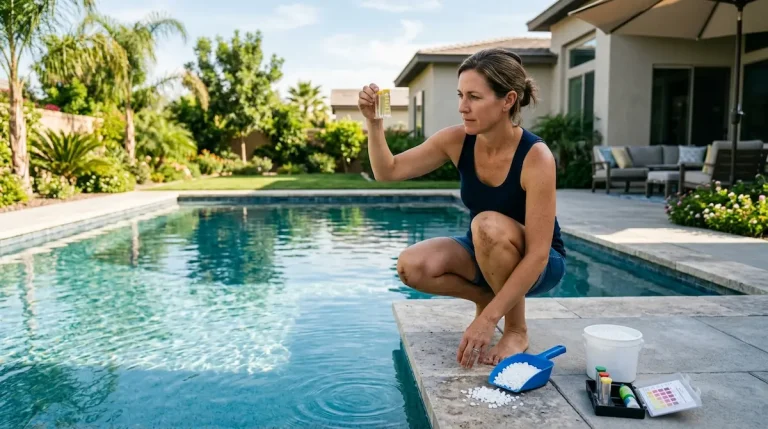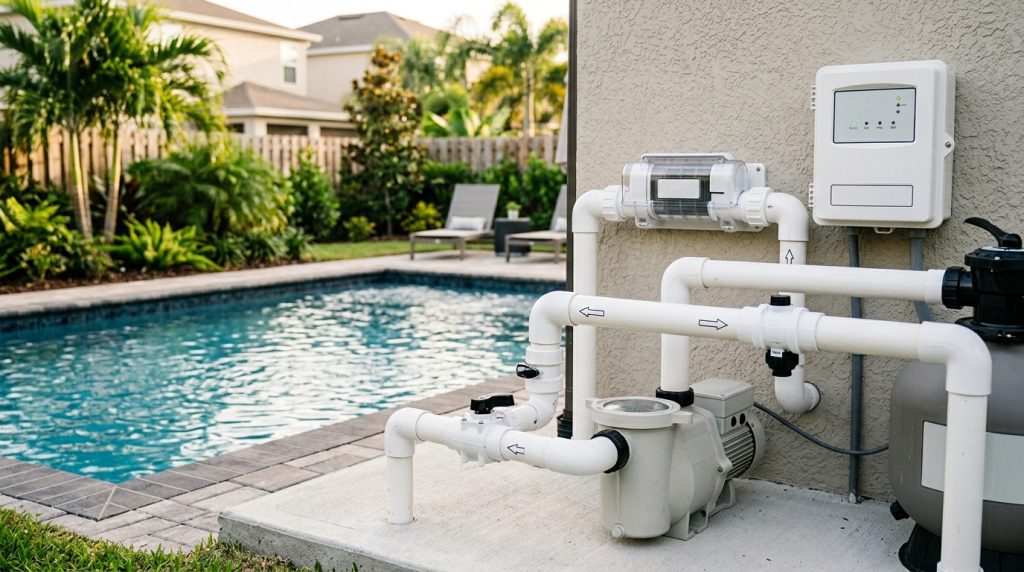
Figuring out how to convert pool to saltwater is easier than most people expect, and you can usually knock it out in an afternoon. So if you’re tired of hauling chlorine jugs and softer water sounds good right now, here’s the plan: what to buy, how much salt to add, what it actually costs, and the small mistakes that quietly kill a brand-new salt cell. No draining required.
The short version
To convert a pool to saltwater, balance the water, install a salt chlorine generator on your return line, add pool-grade salt to roughly 3,200 ppm, let it dissolve for about 24 hours, then switch the unit on. Most inground conversions run $1,700 to $2,500 plus the salt.
| Question | Quick answer |
|---|---|
| Do I drain the pool? | No. You keep your existing water. |
| How long does it take? | An afternoon to install, then 24 hours for salt to dissolve. |
| Typical cost | $1,700 to $2,500, plus salt. |
| Salt target | Usually 2,700 to 3,400 ppm (3,200 is the sweet spot). |
| DIY-friendly? | Yes, if you can handle basic plumbing and wiring. |
What you need to convert a pool to saltwater
The shopping list is short. A salt chlorine generator does the heavy lifting, and everything else is support.
- A salt chlorine generator (cell plus control box), sized for your pool’s gallons.
- Pool-grade salt, at least 99% pure sodium chloride. Skip rock salt, iodized salt, and anything with anti-caking additives.
- A reliable test kit or test strips that read salt, pH, alkalinity, and stabilizer.
- Basic plumbing and electrical tools if you’re doing the install yourself.
Is your pool ready? A quick compatibility check
Most guides skip this part, and it’s the one that bites people. Salt is gentle on skin but a little rough on certain materials. Run through this before you buy anything.
- Heaters with bare copper parts can corrode faster. Look for a heater with a corrosion-resistant heat exchanger.
- Soft natural stone coping, like some limestone, can pit over time. Sealed stone and concrete handle salt fine.
- Older metal ladders, rails, and light rings should be rinsed and checked. Sacrificial zinc anodes help a lot.
- Match the generator to your real gallon count, not a guess. An undersized cell runs constantly and dies young.
None of this is a dealbreaker for most pools. You just want to know before, not after.
How to convert pool to saltwater, step by step
- Balance the water. Aim for pH 7.2 to 7.8 and alkalinity near 80 to 120 ppm, which lines up with what the CDC recommends for safe swimming. Salt pools also like stabilizer (CYA) around 60 to 80 ppm so your chlorine doesn’t burn off in the sun. Sort your numbers out now. For the full walkthrough, read more on pool water chemistry before you add a single grain of salt.
- Mount the control box. Fix it on a wall near your equipment pad, within reach of a power source and after the filter and heater in the plumbing line.
- Plumb in the salt cell. The cell goes on the return line, the last piece of equipment before water heads back to the pool. Cut in, glue the unions, and wire the box to power. If that sentence made you nervous, hire a pro for this step.
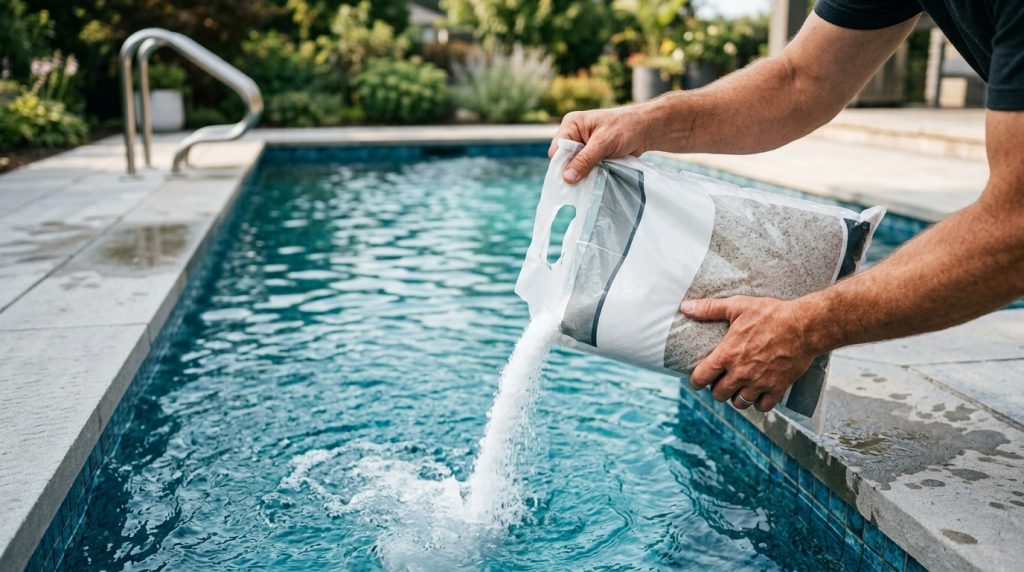
- Add pool-grade salt. Pour it slowly across the deep end with the pump running. Amounts are in the table below.
- Let it dissolve. Give it about 24 hours with the pump circulating, and brush the bottom to help. Turning the generator on before the salt fully dissolves is a classic rookie move.
- Power on and set output. Switch the generator on and start around 50% output. Most units show a live salt reading once water passes through.
- Retest and fine-tune. After a day, test salt, pH, and free chlorine. Nudge the output until free chlorine holds at 1 to 3 ppm. Done.
How much salt to add
This depends on your current salt level and your target. Starting from a fresh chlorine pool at zero, here’s a rough map to hit about 3,200 ppm. Always check your generator’s own chart first.
| Pool size | Salt to reach ~3,200 ppm (from zero) | 40 lb bags |
|---|---|---|
| 10,000 gallons | about 250 to 280 lb | 6 to 7 |
| 15,000 gallons | about 380 to 420 lb | 9 to 10 |
| 20,000 gallons | about 500 to 600 lb | 12 to 15 |
| 25,000 gallons | about 620 to 700 lb | 15 to 18 |
Add in stages. It’s easy to pour more salt in later. Getting it back out means draining water, and nobody enjoys that.
What a saltwater conversion really costs
The generator is the big line item. Salt is cheap, and it’s basically a one-time buy since it doesn’t evaporate. Here’s the honest breakdown.
| Item | Typical cost | Notes |
|---|---|---|
| Salt chlorine generator (equipment) | $800 to $1,500+ | Complete systems start around $800; average buy is $1,300 to $1,500. |
| Professional install (labor) | a few hundred dollars | On top of equipment. |
| Full conversion (equipment + install) | $1,700 to $2,500 | What most inground owners pay. |
| DIY route, all in | $1,000 to $1,500 | You supply the labor. |
| Pool-grade salt | $0.25 to $0.63 per lb ($125 to $380 for a 20,000-gal pool) | Mostly a one-time cost. |
| Replacement salt cell (every 5 to 10 years) | roughly $200 to $900 (check local pricing) | Cell lifespan is 5 to 10 years; budget for a swap down the road. |
Want the bigger picture on ongoing upkeep across the whole pool? Check our pool maintenance cost guide.
Common mistakes that ruin a new conversion
I’ve watched people spend two grand and then trash the cell in a season. Almost always one of these.
- Running the generator before the salt dissolves. Wait the full day.
- Using the wrong salt. Iodized or anti-caking salt clouds the water and gunks the cell.
- Ignoring stabilizer. Low CYA means your generated chlorine vanishes in sunlight, so the unit works overtime.
- Letting pH drift high. Salt chlorine generation nudges pH upward, so you’ll test it more often, not less.
- Buying an undersized cell to save a hundred bucks. It runs nonstop and fails early.
After the switch: what upkeep looks like
A salt pool isn’t hands-off, it’s just lower-fuss. You’ll still test the water weekly, keep pH in check, and clean calcium off the cell a few times a year. For the full routine once you’re up and running, see saltwater pool care.
Frequently asked questions
Do I have to drain my pool to convert to saltwater?
No. You keep your current water. You just balance it, add salt, and install the generator.
How much does it cost to convert a pool to saltwater?
Most inground conversions land between $1,700 and $2,500, plus the salt. Going DIY can bring it down to $1,000 to $1,500.
How long does the conversion take?
The install itself is an afternoon job. Then you wait roughly 24 hours for the salt to dissolve before the generator does its thing.
Can I convert an above-ground pool too?
Yes. The process is the same, and there are generators built specifically for above-ground pools. Just size the unit to your gallons.
Is a saltwater pool chlorine-free?
No, and this trips a lot of people up. A salt pool still sanitizes with chlorine. Your generator just makes it on demand from salt, so you’re not buying and storing chlorine tabs.
The verdict
If your equipment is salt-friendly and you’re comfortable with light plumbing, do the DIY conversion and pocket the difference. Buy a generator rated one size above your pool’s gallons, use only 99% pure pool salt, and give it the full 24 hours before flipping the switch. Not handy? Pay a pro for the install, then handle the salt and testing yourself. Either way, you end up with softer water and a lot less time spent babysitting chlorine.