Your pool water really comes down to five numbers. Keep them in range and most of the usual headaches fade on their own: the green tinge, the itchy eyes, cloudy water, that faint chemical smell. This guide gives you the ideal pool chemical levels for a home pool in one clean chart, then shows you which number to fix first and the one detail most charts leave out.
For a typical residential pool, the ideal pool chemical levels sit in five bands: pH from 7.4 to 7.6, free chlorine at 1 to 3 ppm, total alkalinity between 80 and 120 ppm, calcium hardness of 200 to 400 ppm, and cyanuric acid around 30 to 50 ppm. Test weekly, and adjust them in that order.
Your ideal pool chemical levels chart
Print this one and tape it inside the shed. The whole game fits on a single card.
| Chemical | Ideal range | What it does | How often to test |
|---|---|---|---|
| Free chlorine | 1–3 ppm | Sanitizes the water and knocks out germs | 2 to 3 times a week |
| pH | 7.4–7.6 | Keeps swimmers comfortable, protects surfaces, and lets chlorine work | Weekly |
| Total alkalinity | 80–120 ppm | Acts as a buffer so pH stops drifting | Weekly |
| Calcium hardness | 200–400 ppm | Guards against both corrosion and scale | Monthly |
| Cyanuric acid (CYA) | 30–50 ppm | Shields chlorine from UV, the way sunscreen shields skin | Monthly |
Those bands sit comfortably inside what the CDC and most pros advise. For a home pool, the CDC’s baseline runs from a pH of 7.0 to 7.8 with free chlorine at 1 ppm or higher (CDC: Home Pool Water Treatment and Testing), so the tighter targets here just buy you a safety margin.
Spa and saltwater tweaks
Two setups follow slightly different rules.
- Hot tubs run hot, so they burn through chlorine fast. Aim for 3 ppm free chlorine or more, and drop cyanuric acid altogether.
- In a spa, calcium hardness sits lower, somewhere around 150 to 250 ppm.
- Running salt? You’ll track salt too, usually about 2,700 to 3,400 ppm. Check your generator’s manual, since the target moves from brand to brand.
Fix the numbers in the right order
This is where most new owners slip. Balance in a random order and you’ll end up correcting the same reading two or three times, burning through chemicals along the way.
- Total alkalinity first. It steadies everything downstream.
- pH next, once alkalinity holds.
- Chlorine last.
Flip that order and you’ll watch pH bounce around again, right after you thought it was locked in.
The number the simple charts skip
Now the part quick charts tend to skip. On its own, a chlorine reading barely tells you anything. It only makes sense once you read it next to your CYA level.
Here’s why. Cyanuric acid guards chlorine against sunlight, but pile on too much and it ties that chlorine up instead. Once CYA climbs past roughly 75 ppm, a “normal” 2 ppm of chlorine can do almost nothing. That’s how water tests fine on paper yet still goes cloudy.
The answer is a ratio, not a single fixed target. A lot of seasoned owners, the Trouble Free Pool community among them, hold free chlorine near 7.5% of their CYA. At 40 ppm CYA, that puts your chlorine target around 3 ppm. And pH pulls its weight here too. Let it drift above 7.6 and chlorine loses a good chunk of its punch, even when the level looks right. If you want the full picture, we break it all down in our pool water chemistry guide.
What happens when a level drifts
These numbers won’t stay put. Rain, heat, sunscreen, and a busy weekend of swimmers all nudge them around. This quick reference tells you what each drift actually feels like in the water.
| Chemical | If it’s too low | If it’s too high |
|---|---|---|
| pH | Stinging eyes, plus corrosion on metal and plaster | Cloudy water, scale buildup, weaker chlorine |
| Total alkalinity | Wild pH swings and etched surfaces | Cloudy water and pH that refuses to move |
| Calcium hardness | Corrosion and plaster damage | Scale across tile and equipment |
| Cyanuric acid | Chlorine burns off within a few hours of sun | Chlorine gets tied up, so you keep needing more |
Frequently asked questions
What are the most important pool chemical levels?
Free chlorine and pH. One keeps the water safe, the other decides whether that chlorine can actually do its job. Short on time? Check those two.
How often should I test my pool water?
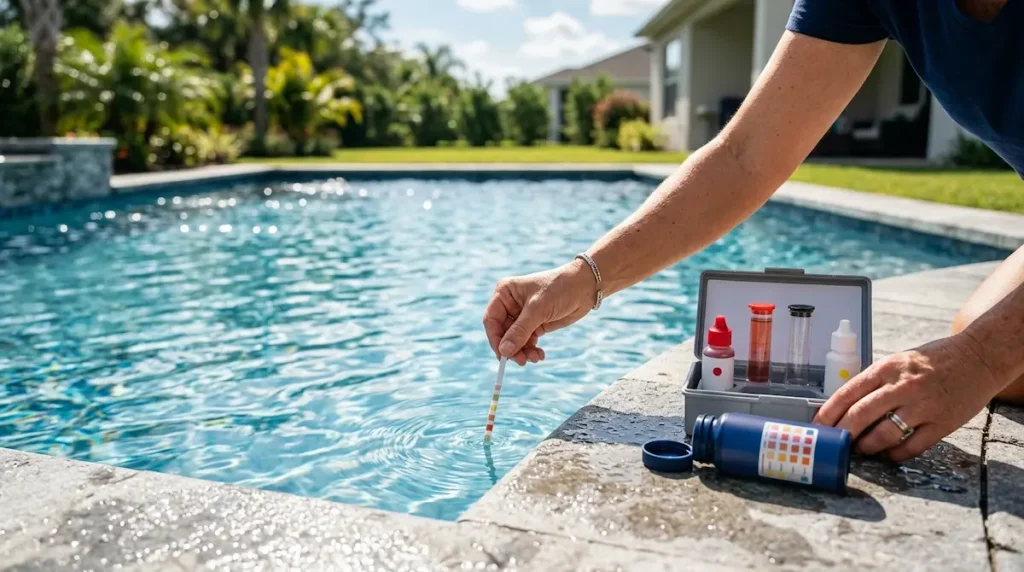
During swim season, test chlorine and pH two to three times a week, and give alkalinity a weekly look. Calcium and CYA are fine on a monthly check. For where testing sits in your yearly spend, our pool maintenance cost guide breaks it down.
Why isn’t my chlorine working if the level looks fine?
Usually one of two things. Either your pH has crept above 7.6, or your CYA has climbed too high. Both quietly drain chlorine’s strength even when the strip reads “normal.”
What’s the ideal pH for a pool?
Somewhere between 7.4 and 7.6. That range feels easy on swimmers and keeps chlorine efficient. If yours keeps creeping up, our guide on pool pH covers how to bring it down and hold it there.
Keep it simple and stay consistent
You don’t need a chemistry degree to run a clean pool. Test twice a week through summer, hold those five numbers in range, and settle alkalinity before you touch pH. Do that and you’ll spend far more time in the water than hunched over a test kit. When a reading looks off, check pH and CYA before you reach for more chlorine. Nine times out of ten, that’s where the answer is hiding.