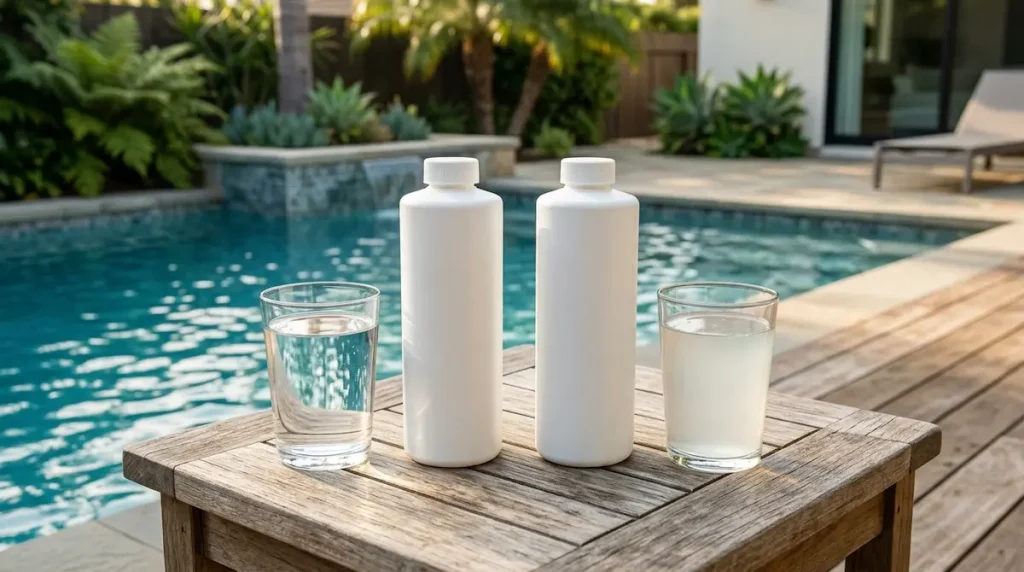
Your water’s gone cloudy, and you’re standing in the pool aisle holding two bottles that promise the exact same thing. The labels barely explain the difference. That’s the whole pool clarifier vs flocculant problem in a nutshell. Both clear murky water. They just get there in completely different ways, and grabbing the wrong one can clog your filter or send a tub of clean water down the drain for no reason.
So which bottle goes in your cart? Depends on how bad it looks and what filter you run.
Pool clarifier vs flocculant: the quick verdict
Use a clarifier for light to moderate haze when you’re not in a hurry. Reach for a flocculant when the water’s badly clouded, you want it fixed fast, and you can vacuum the pool floor to waste. Clarifier works alongside your filter over a day or two. Flocculant sinks everything to the bottom overnight, then you vacuum it out.
| Factor | Pool clarifier | Pool flocculant |
|---|---|---|
| Best for | Mild to moderate cloudiness | Severe, can’t-see-the-bottom cloudiness |
| How it works | Clumps fine particles so the filter catches them | Clumps particles into heavy masses that sink |
| Speed | About 1 to 3 days | Overnight, then you vacuum |
| Effort | Low. Add it and let the filter run | High. Pump off, wait, vacuum to waste |
| Filter types | Cartridge, sand, or DE | Sand or DE with a waste setting only |
| Water loss | None | Some, from vacuuming to waste |
What a pool clarifier actually does
Think of a clarifier as a magnet for the junk your filter keeps missing. It’s a coagulant, so once it’s in the water it carries a positive charge. All that microscopic stuff drifting around, oil, pollen, dead algae, fine dirt, happens to carry a negative one. They grab onto each other. Loose specks turn into clumps big enough for your filter to finally trap.
One thing people miss: a clarifier destroys nothing on its own. All it does is bundle the mess into filterable clumps, which means your filter still does the real work. Filter dirty or undersized? Clarifier won’t bail you out.
When a clarifier is the right call
- The water looks dull or slightly milky, not gray.
- You’ve got a cartridge filter with no waste setting.
- Routine upkeep, like clearing haze after a busy pool weekend.
- You’d rather add a capful and walk away than vacuum for an hour.
What a flocculant does differently
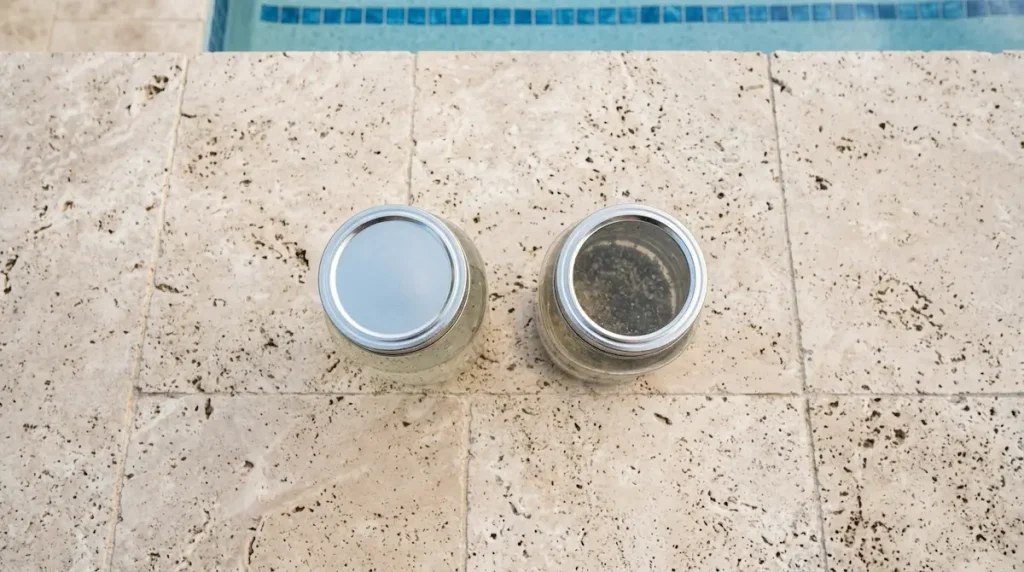
Flocculant is the aggressive cousin. It grabs the same fine particles, but it skips your filter completely. Instead it packs them into clumps heavy enough to sink. Shut the pump off, leave the water undisturbed for 8 to 12 hours, and by morning you’ll find a clear layer up top sitting over a blanket of sediment on the floor.
Then the real work starts. Set your filter valve to waste first, then vacuum that settled layer up nice and slow so the debris skips the filter and heads straight out the backwash line. Go too fast and you’ll churn the whole cloud right back up.
The filter warning nobody prints big enough
Never run floc through a cartridge filter. It gums up into sludge and can ruin the cartridge, so treat flocculant as a sand-or-DE product that needs a waste setting. No way to vacuum to waste? Skip floc completely and stick with a clarifier. That one rule has saved plenty of pool owners the price of a brand-new filter.
The hidden cost of flocculant: the water you pour down the drain
Most guides skip past this. Vacuuming floc to waste doesn’t only pull out debris. It sends perfectly good, chemically balanced water out with it. A heavy cleanup can drop your level by several inches, which leaves you refilling from the hose and rebalancing the chemistry from scratch.
Live somewhere dry, or pay for metered water? That refill adds up fast. A clarifier keeps every gallon right where it is, which quietly makes it the cheaper pick even when the two bottles cost about the same. Worth a thought before you rush the fast route.
What each one costs
Pricing swings by brand, bottle size, and where you shop, so treat these as ballpark retail figures and check current prices at your local store before you buy.
| Product | Typical retail price | Extra costs to expect |
|---|---|---|
| Pool clarifier | Roughly $15 to $25 per bottle | A bit more filter cleaning |
| Pool flocculant | Around $20 to $30 per bottle | Water refill plus rebalancing chemicals |
Chemicals like these are a small slice of your yearly spend anyway. If you want the full breakdown, check our pool maintenance cost guide for what the whole season really runs.
Which should you pick?
Match the product to your situation and your filter. Quick decision guide:
- Water only a little hazy, or you run a cartridge filter? Clarifier, every time.
- Water badly clouded and you own a sand or DE filter with a waste setting? Flocculant will reset it fastest.
- Can’t vacuum to waste? Clarifier is your only safe choice.
- Not sure how bad it is? Start with clarifier. It’s gentler and reversible. You can always escalate.

One more thing before you dump either one in. Both work best on water that’s already sanitized and pH-balanced, because chemistry problems cause most cloudiness in the first place. If you’re not sure what turned your water milky, our guide to cloudy pool water walks through the usual suspects, and there’s plenty more on pool water chemistry if you want to get the balance dialed in first. Good filtration and balanced water are also what public health agencies point to for safe, clear pools, per the CDC’s Healthy Swimming guidance.
Frequently asked questions
Can you use clarifier and flocculant together?
Not at the same time, and there’s rarely a reason to. They pull in opposite directions. Clarifier wants particles floating so the filter grabs them, while floc wants them on the floor. Pick one. If clarifier hasn’t worked after a couple of days, then switch to floc.
How long after adding flocculant can you swim?
Hold off until the settled debris is fully vacuumed and your readings are back to normal, which usually lands in the 24 to 48 hour window after you dose. Jump in too early and you’ll just stir the sediment back up.
Why is my pool still cloudy after using clarifier?
Three common reasons: your filter is dirty or too small, your chemistry is off, or you overdosed. Too much clarifier can actually gum things up and keep the water hazy. Clean or backwash the filter, balance the water, and give it another day before adding more.
Does flocculant clear water faster than clarifier?
Yes, noticeably. Floc can settle a badly clouded pool overnight, while clarifier often takes one to three days. The trade-off is the vacuuming and the water you lose to waste.
Is a clarifier or flocculant better for a cartridge filter?
Clarifier. Flocculant can clog and damage cartridges, and you can’t vacuum floc to waste through a cartridge system anyway. Cartridge owners should stick with clarifier.
The takeaway
For everyday haze and any cartridge filter, keep a bottle of clarifier on the shelf and let your filter do the rest. Save flocculant for the bad days when the water’s gray, you own a sand or DE filter with a waste line, and you’ve got an hour to vacuum. Buy for the mess you actually have, run a clean filter, and you’ll spend far less time fighting cloudy water in the first place.