So your test kit just came back sky-high, and now you’re staring at the water wondering how to lower chlorine in a pool before anyone jumps in. It happens to almost every pool owner sooner or later. Maybe you double-dosed the shock. Maybe a rainy week kept the chlorine from burning off the way it usually does.
High chlorine is annoying. It can sting your eyes, dry out your skin, irritate your lungs, and fade swimsuits over time. The good news? Bringing the level back down is usually simple. You just need to pick the method that matches your deadline.
High chlorine is annoying. It can sting your eyes, dry out your skin, irritate your lungs, and fade swimsuits over time. The good news? Bringing the level back down is usually simple. You just need to pick the method that matches your deadline.
The quick answer
To lower chlorine in a pool, first stop feeding the problem: turn off the chlorinator, remove tablets, uncover the pool, and keep the water circulating. If you can wait, sunlight may bring the level down over a day or two. If you need the pool ready sooner, use a chlorine neutralizer such as sodium thiosulfate, using about 2 oz per 10,000 gallons for roughly a 1 ppm drop, then retest before swimming.
If you’re in a real hurry, the ranked options look like this:
- Fastest: sodium thiosulfate or pool-grade hydrogen peroxide, usually minutes to under an hour
- Cheapest: stop dosing, uncover the pool, and let the sun do the work
- Last resort: drain part of the water and top up with fresh water
How to lower chlorine in a pool, step by step
Don’t just dump a chemical in and hope. That’s how you overshoot and end up with the opposite problem: no sanitizer left in the water.
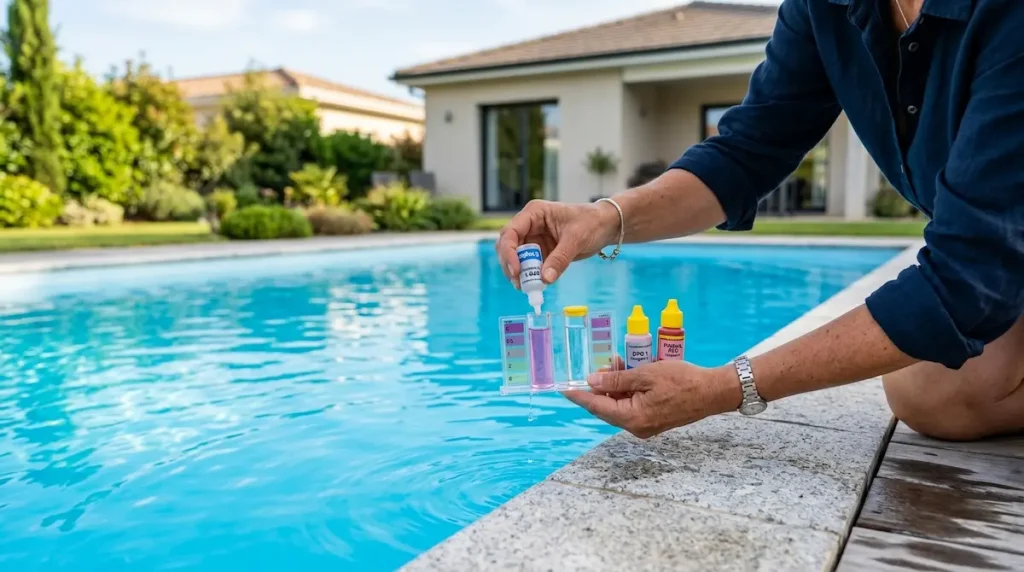
- Test first. You can’t fix a number you don’t know. Use a fresh test kit or strips and write down your free chlorine reading.
- Turn off the source. Shut off the salt cell or chlorinator, remove any floating tablet feeder, and stop adding shock.
- Take the cover off and run the pump. Moving, uncovered water lets chlorine fall faster than still, covered water.
- Choose a method based on your deadline. The comparison table below makes that decision easier.
- If you’re using a neutralizer, dose small. Add it, wait 20 to 30 minutes, then retest.
- Recheck pH and rebalance. Neutralizers and peroxide can nudge the water out of range.
- Swim only once your free chlorine is back in the safe range.
Not sure which product spiked your water in the first place? Some are much stronger by weight than others, so it helps to understand the different types of pool chlorine before you reach for the next tub.
Ways to bring the level down, compared
Every method trades speed for cost, effort, or control. Use this table as the quick decision tool.
| Method | How fast | Best for | Watch out for |
|---|---|---|---|
| Stop dosing, uncover, aerate | 1 to 3 days | No rush and no budget | Barely works in shade or cloudy weather |
| Sodium thiosulfate (neutralizer) | Minutes | Getting back in the water today | Easy to overshoot; may lower pH |
| Hydrogen peroxide (pool grade) | Under an hour | Chlorine-sensitive skin | Needs pH 7.0 or higher; lowers pH |
| Ascorbic acid (vitamin C) | 15 to 30 min | Clearing metal stains at the same time | Pricey for big drops |
| Partial drain and refill | A few hours | Very high levels or hard water | Wastes water; costs to refill |
Let the sun and time do it for free
Sunlight is the slow, free chlorine reducer. On a bright day, leave the pool uncovered, keep the pump running, and you’ll often see the level fall within 24 hours. Sometimes it drops a few ppm.
The catch is control. You can’t rush the sun, and a shaded or covered pool may barely move. Great when you’re not in a hurry. Useless the morning of a pool party.
Neutralize it fast with sodium thiosulfate
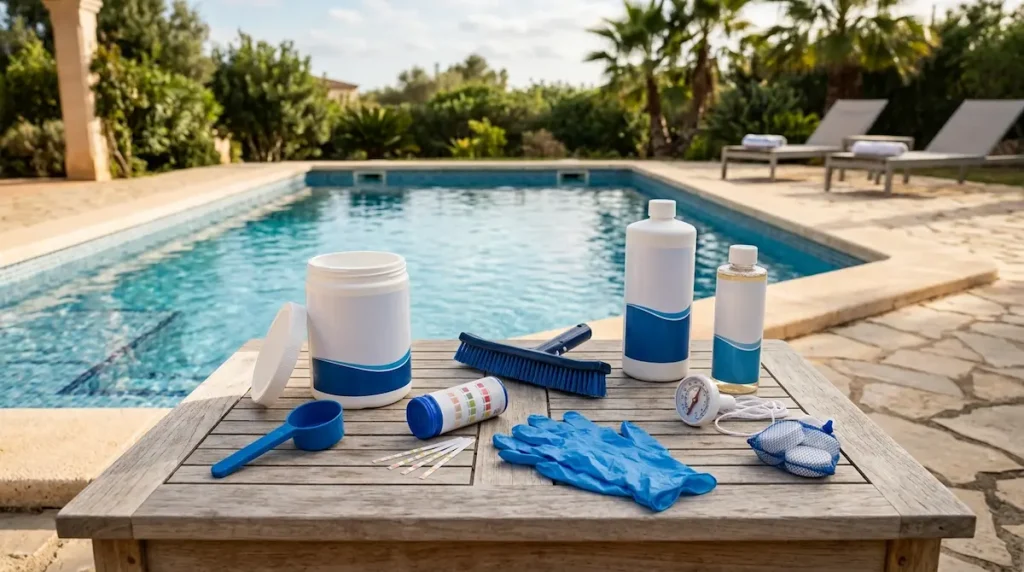
For same-day swimming, sodium thiosulfate is the usual shortcut. It’s sold as chlorine neutralizer and works quickly, which is exactly why you need to dose carefully.
In The Swim lists a dose of 2 oz per 10,000 gallons to lower chlorine by 1.0 ppm. Treat that as a starting point, not an excuse to pour in the whole bottle. If you overshoot, you’ll spend the next day or two trying to get chlorine back up, and the water will be under-protected while you wait.
Hydrogen peroxide or vitamin C
Hydrogen peroxide is pickier. Pool-grade peroxide can work well when your pH is 7.0 or higher, and some chlorine-sensitive swimmers prefer it. Ascorbic acid, which is plain vitamin C, also knocks chlorine down and can help with metal stains at the same time.
Both can push pH lower, so plan to rebalance afterward. Skip household bleach or random additives here. Stick with products meant for pools.
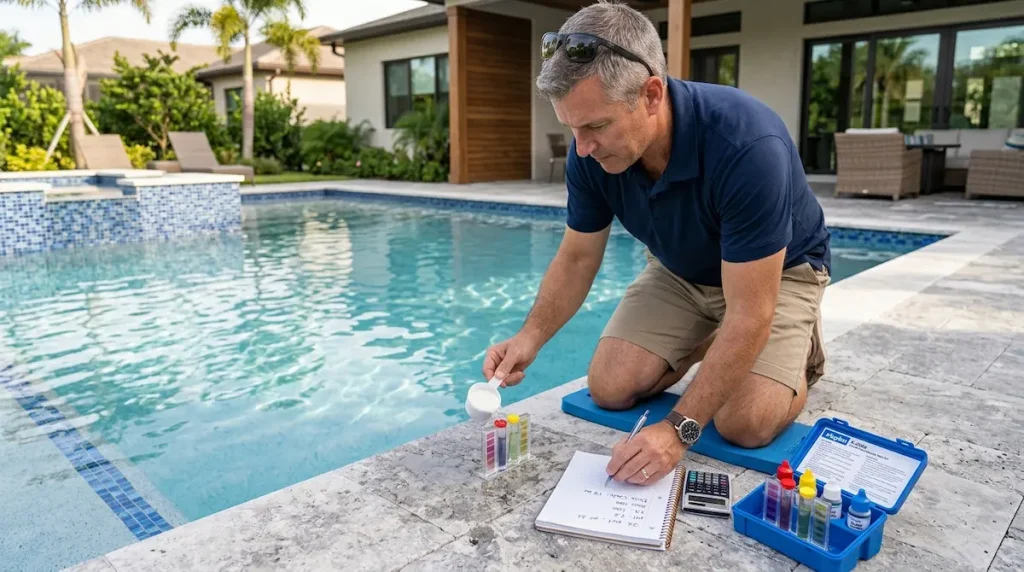
How much neutralizer do you actually need?
Most guides quote “2 oz per 10,000 gallons” and leave you doing math at the pool edge. Here is that same dose mapped to common pool sizes, based on the In The Swim figure of 2 oz per 10,000 gallons per 1 ppm drop.
| Pool size | To lower about 1 ppm | To lower about 5 ppm |
|---|---|---|
| 5,000 gallons | about 1 oz | about 5 oz |
| 10,000 gallons | 2 oz | 10 oz |
| 15,000 gallons | 3 oz | 15 oz |
| 20,000 gallons | 4 oz | 20 oz |
One practical tip: start with about three-quarters of the calculated dose, retest, then top up if needed. It’s far easier to add a little more than to fight a pool you’ve knocked down to zero.
Neutralizer is usually a small chemical buy, not a major yearly expense. If you’re curious where these little purchases fit overall, check our pool maintenance cost guide.
What’s a safe chlorine level to swim?
Before you let anyone in, bring free chlorine back into a normal band. For ordinary swimming, use the CDC range as the line: 1 to 4 ppm chlorine and pH 7.0 to 7.8 (CDC: Healthy Swimming).
| Reading | What to do |
|---|---|
| 1 to 4 ppm free chlorine | Good to swim, but check pH too |
| 5 to 9 ppm | Wait it out or neutralize; retest before swimming |
| 10 ppm and up | Keep everyone out and treat it now |
Chlorine never acts alone. Your pH, alkalinity, and stabilizer all change how strong that chlorine feels in the water, so it’s worth reading more on pool water chemistry before you start pouring things in.
Mistakes that keep chlorine stuck high
- Leaving a tablet floater in the water while you try to lower the level. Pull it out first.
- Reaching for baking soda. It solves the wrong problem: alkalinity, not high chlorine.
- Assuming the pump alone fixes it. Circulation helps, but the filter does not neutralize chlorine by itself.
- Dumping in a full bottle of neutralizer at once, then spending two days unable to sanitize the water.
- Testing once and walking away. Levels shift as chemicals react, so retest before the first swim.
FAQ
How long does it take for chlorine to drop on its own?
On a bright, uncovered day with the pump running, you may see a noticeable drop within 24 hours. Shade, a cover, cool weather, or cloudy skies can slow the drop a lot.
Can I swim in a pool with high chlorine?
Not comfortably, and not safely if the level is far above range. Around 5 ppm and up, many swimmers notice stinging eyes, dry skin, or throat irritation. Wait until free chlorine is back in the 1 to 4 ppm range.
Does baking soda lower chlorine?
No. Baking soda raises total alkalinity. It does not meaningfully lower a high chlorine reading, so use time, sunlight, dilution, or a proper neutralizer instead.
Will hydrogen peroxide from the drugstore work?
For a small spa, a little 3% peroxide can help. For a full-size pool, use a pool-grade formula so you can dose it accurately, and check that your pH is 7.0 or higher first.
Why does my chlorine keep spiking?
Usually the source is still adding chlorine: an overactive chlorinator, too many tablets, or a heavy shock dose before a cool, cloudy stretch. Dial back the source and test more often for a few days.
So what should you do first?
Test the water and shut off every chlorine source. If you can wait a day, uncover the pool, run the pump, and let the sun handle it for free. If people want to swim today, measure sodium thiosulfate for your pool size using the table above, add about three-quarters of the dose, retest after half an hour, and rebalance pH once the water lands back in the 1 to 4 ppm range.
That routine gets most pools swim-ready without guesswork.