You bought the house with the pool, or you just had one installed, and now the water is your problem. Good news: learning how to test pool water is one of the cheapest habits in pool ownership, and it can save you from cloudy water, itchy eyes, and a $200 emergency trip to the pool store. No lab coat required. You need a clean sample, a reliable test, and a few quiet minutes before anyone jumps in.
This guide walks you through the whole thing. What to measure, how to pull a clean sample, which testing method fits you, and the small mistakes that quietly wreck your readings.
The short version, if you’re in a hurry
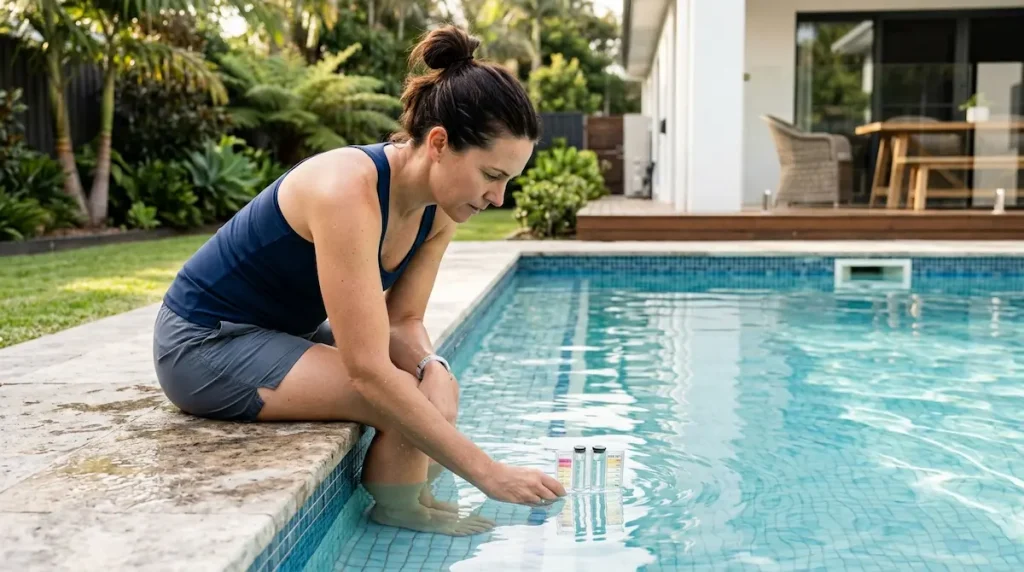
To test pool water, let the pump run first, then take a sample from about elbow depth, roughly 18 inches down, away from the jets. Use a test strip or liquid reagent kit to check free chlorine, pH, and total alkalinity. Read the colors in good light, and retest before dosing if anything looks strange.
- Run the pump about an hour so the water is mixed.
- Collect your sample deep and away from returns.
- Dip the strip, or add reagent drops to a rinsed vial.
- Read the colors in daylight, within the time window on the label.
- Anything strange? Retest before you add a single chemical.
What you’re actually testing for
Five numbers do most of the work. Keep them in range and the water is easier to manage: clearer, safer, and gentler on skin. Let them drift too far and you’re either fighting algae or swimming in water that feels harsh.
The ranges to aim for
| Reading | Ideal range | Why you care |
|---|---|---|
| Free chlorine | 2.0 to 4.0 ppm | This is the active sanitizer left in the water, the part that actually fights germs and algae. |
| pH | 7.4 to 7.6 | It affects swimmer comfort and how well chlorine can work. |
| Total alkalinity | 80 to 120 ppm | It gives pH some stability, so one small dose does not send the water all over the chart. |
| Calcium hardness | 200 to 400 ppm | It helps protect plaster, grout, and equipment from aggressive water. |
| Cyanuric acid (stabilizer) | 30 to 50 ppm | It slows down how fast sunlight burns through chlorine. |
Test free chlorine and pH most often because those can move fast. Alkalinity can usually be checked every week or two. Calcium hardness and stabilizer move more slowly, so a monthly check is usually enough unless you’re correcting a problem. If you want the bigger picture behind these numbers, our full breakdown of pool water chemistry ties them all together.
How to test pool water, step by step
The test itself is quick. Getting a representative sample is where people slip up, so slow down on the first two steps.
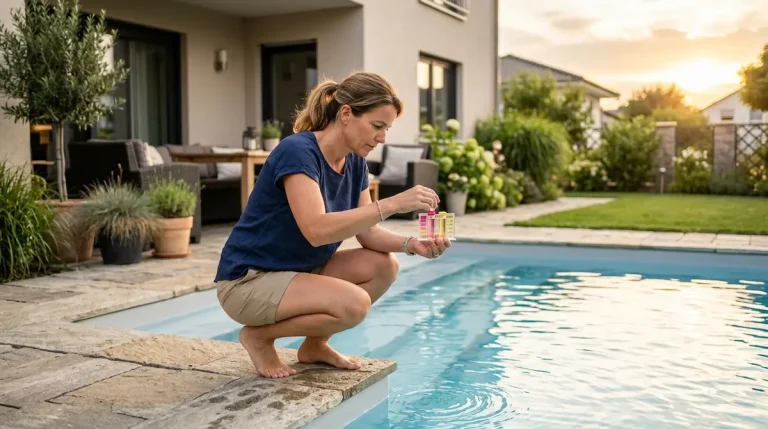
- Run the pump first. Give it about an hour so surface water and deep water are the same water.
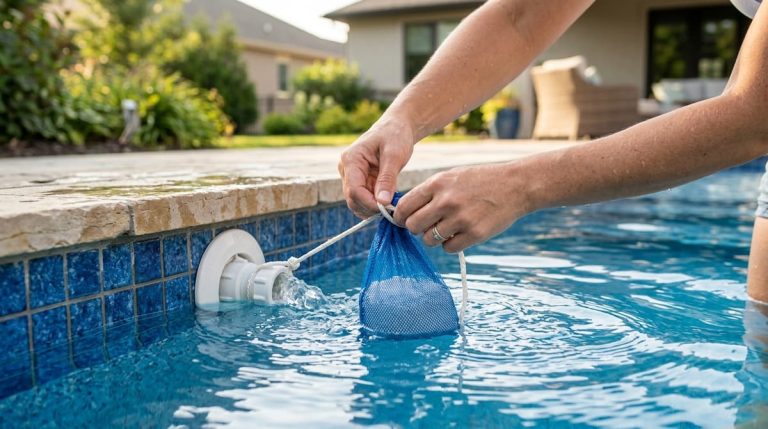
- Pull the sample deep. Reach in to elbow depth, roughly 18 inches, and stay away from the return jets and the skimmer. Surface water reads differently.
- Use clean gear. Rinse the vial or your container with pool water before you fill it. Soap residue or old sample water skews everything.
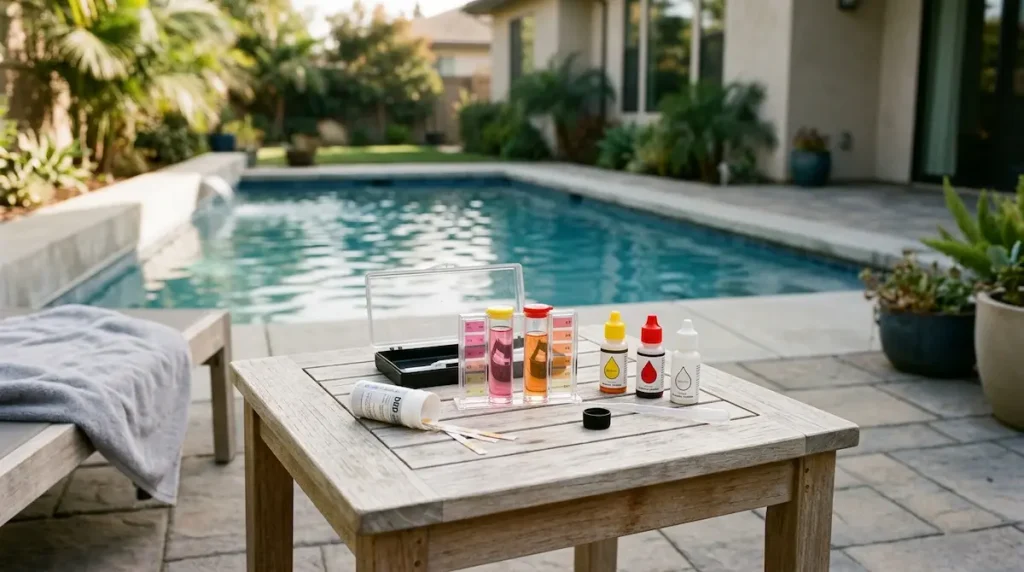
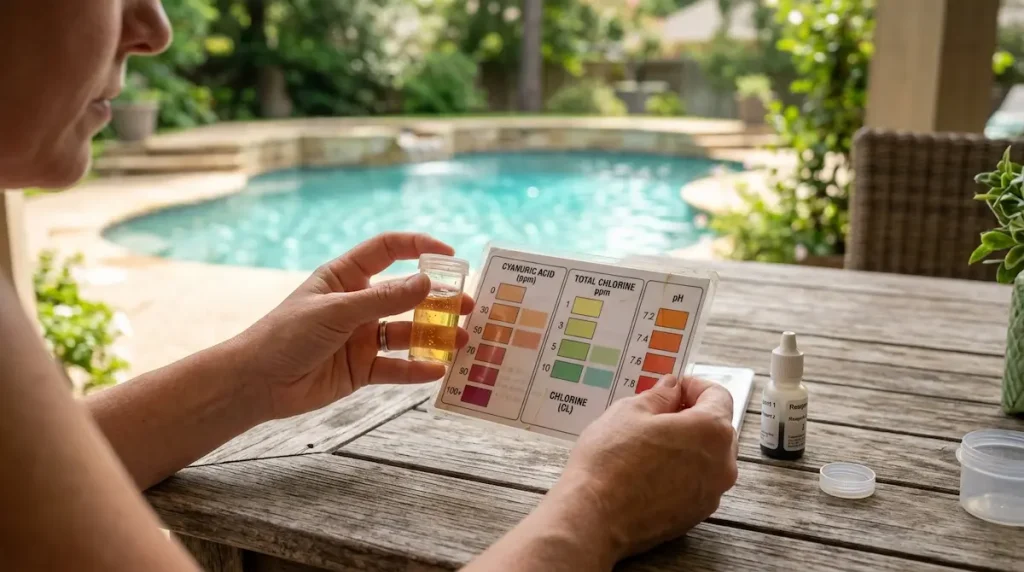
- Run the test. Dip a strip and hold it still, or add the reagent drops to a liquid kit, cap it, and turn it upside down a few times to mix.
- Read it in good light. Compare against the printed chart within the time the instructions give you. Colors keep changing after that.
- Confirm before you dose. A weird reading is often a bad sample, not a real crisis. Test again.
One ordering tip. Balance alkalinity before you chase pH, because alkalinity nudges pH around. If the reagent drops feel fiddly the first few times, more on how to use a pool test kit walks through it drop by drop.
Strips, liquid kits, or the pool store?
There’s no single “right” tool. There’s the one you’ll actually use every week, plus a more accurate one for when something’s wrong. Most people end up owning two.
| Method | Best for | Pros | Cons |
|---|---|---|---|
| Test strips | Fast weekly checks | Cheap, often about $10 to $20, results in seconds, dead simple | Least precise, and humidity ruins them fast |
| Liquid reagent kit (DPD / FAS-DPD) | Accurate home testing and troubleshooting | Precise, reads a wide range, the method public-health guidance prefers | Takes 5 to 10 minutes, color matching, and a full kit often runs about $60 to $90 depending on brand and local pricing |
| Digital tester | Anyone who hates guessing colors | Gives a number, repeatable, no squinting at charts | Pricier, needs calibration and its own reagents |
| Pool store test | A second opinion on a stubborn problem | Usually free, full panel, an expert reads it | You have to drive there, and the sales pitch comes free too |
Prices are best treated as local estimates, not fixed rules. Brands, kit size, region, and timing can change the number, so check current prices near you before buying.
For accuracy, liquid reagent wins. CDC guidance points homeowners toward DPD-style testing rather than relying on strips for chlorine and pH checks at home (CDC: Home Pool Water Treatment and Testing). Strips are still fine for a quick “are we okay?” glance mid-week. When you’re ready to buy, see best pool test kit for options that survive a real season.
The mistakes that quietly wreck your readings
Most “my numbers make no sense” moments trace back to one of these. I’ve watched new owners dump chlorine on a false reading and make things worse.
- Sampling right next to a return jet, or straight after adding chemicals. Wait and let it circulate.
- Using strips that have gone soft from bathroom or poolside humidity. Keep the cap sealed tight.
- Reading colors in shade, at dusk, or way past the time window.
- Chasing tiny decimals. A pH of 7.5 versus 7.6 is not worth a chemical.
- The bleach-out trap. Very high chlorine, especially above roughly 10 ppm, can make a DPD test lose color and look falsely low, sometimes even like zero. If you just shocked the pool and the test says “no chlorine,” don’t panic. Dilute the sample or wait it out.
The one number most beginners ignore
Free chlorine doesn’t work alone. It works in a relationship with your stabilizer, and almost no beginner guide says this out loud.
Cyanuric acid acts like shade for chlorine, slowing how fast sunlight burns it off. Useful. But the higher your CYA climbs, the more free chlorine you need to keep the same germ-killing power. A pool sitting at 70 ppm CYA needs noticeably more chlorine than one at 30 ppm to stay just as safe. So a “3 ppm chlorine” reading isn’t good or bad on its own. It depends on your stabilizer level.
That’s why testing CYA matters, not just chlorine. Keep stabilizer on the low side (many pool chemistry experts push for under 50 ppm), and a normal chlorine level actually does its job. Over a long season, dissolved buildup creeps up too, so it’s smart to check your total dissolved solids before the water turns dull and flat.
Frequently asked questions
How do I test pool water without a kit?
Scoop a clean sample and take it to a local pool store. Most test it free and print a full readout. It works in a pinch, but it’s not a weekly plan. You’ll want your own strips or kit at home.
What’s the most accurate way to test pool water at home?
A liquid reagent kit, ideally a FAS-DPD type for chlorine, is the most accurate home option for most pool owners. It reads a wider, more precise range than strips, which matters when the water looks off or chlorine is higher than usual.
Can I test pool water at night?
You can, but read the colors under bright white light, not porch shadows. And morning is the better habit anyway. Chlorine burns off during the day, so an early reading tells you where you truly stand.
How often should I test?
Free chlorine and pH at least weekly, and two to three times a week in peak heat or after a pool party. For a full schedule tuned to how hard your pool works, our how often to test pool water guide lays it out.
Do test strips expire?
Yes. And moisture kills them well before the printed date. Store them capped and dry, and replace the bottle each season if you’re unsure.
So how should you actually test?
Keep it boringly consistent. Grab a strip once or twice a week for a fast pulse-check on chlorine and pH, always from a deep sample in the morning before you add anything. Keep a good liquid FAS-DPD kit in the cabinet for a monthly deep read and for any time the water looks off. When a problem won’t budge, take a sample to the pool store as a tie-breaker.
Do that, and testing becomes a two-minute Saturday habit instead of a panic. It’s also the cheapest part of the hobby by a mile, so if you’re mapping out your yearly spend, read about pool maintenance cost to see where the real money goes.