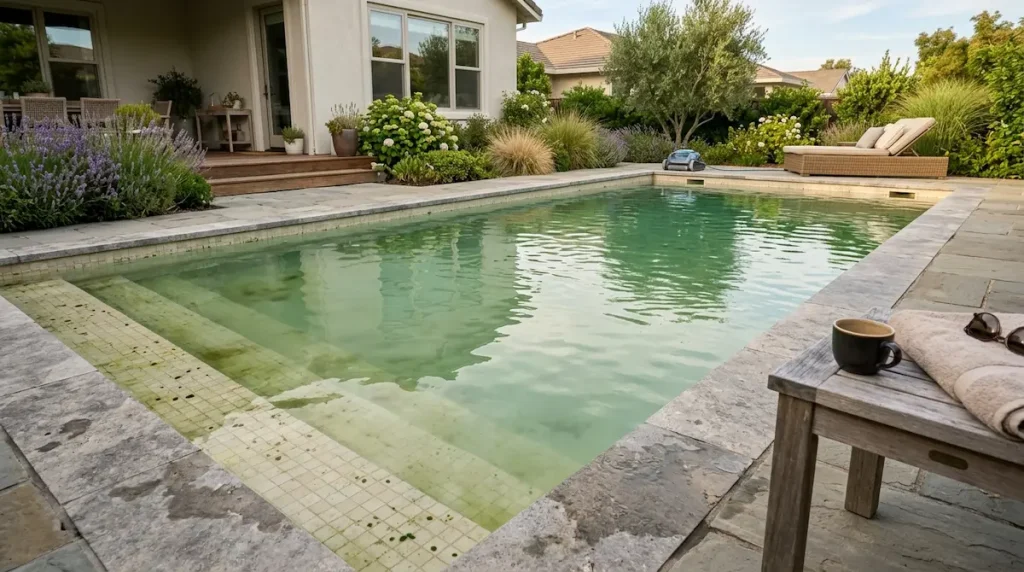
You walked out with your coffee, and the water isn’t blue anymore. Maybe it’s gone green. Maybe there are little black dots stuck to the plaster, or a dusty patch that looks like sand you can’t vacuum away. That’s pool algae. And the exact type you’re staring at decides how hard the next few days will be.
Three kinds show up in backyard pools most often: green, mustard (yellow), and black. Green is common and usually forgiving. Mustard is sneaky. Black is the one that ruins weekends. Sort out which one you have, and everything after that gets a lot simpler.
What kind of pool algae do you have?
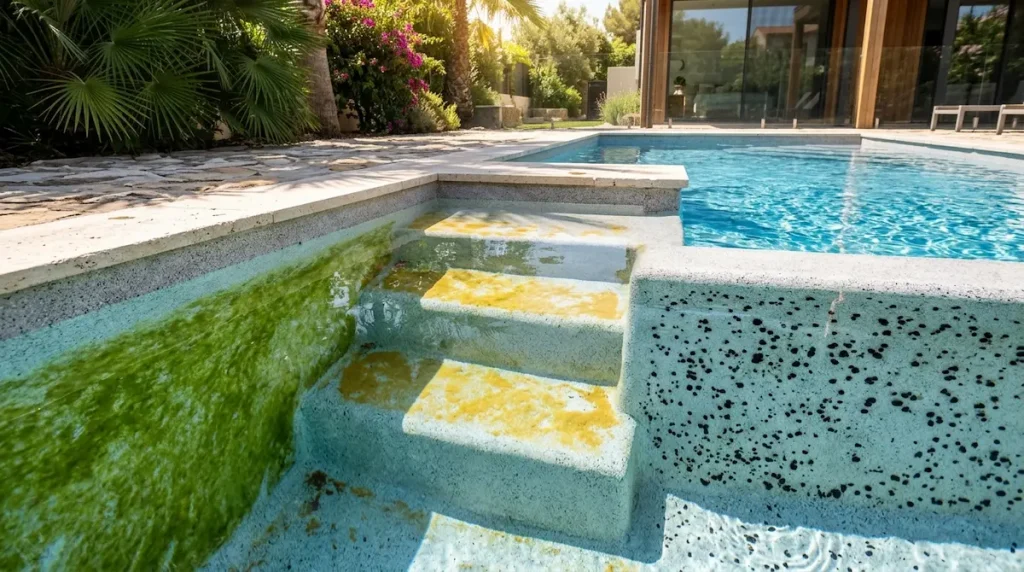
In most backyard pools, algae trouble falls into one of three buckets. Green algae clouds the water or leaves a slick film and usually clears with brushing, shock, and filtration. Mustard algae looks more like sand or pollen, then comes back after you vacuum it. Black algae forms rooted dark spots on rough surfaces and takes the most work to remove. Identify the type first, then match the treatment to it.
| Type | What it looks like | Where it clings | Chlorine resistance | How hard to clear |
|---|---|---|---|---|
| Green | Cloudy green water or a slick green film | Walls, floor, or floating free | Low | Easy |
| Mustard (yellow) | Yellow-brown powder, often mistaken for sand or dirt | Shady walls, steps, behind ladders | Moderate to high | Medium |
| Black | Pinhead to coin-sized black or blue-green spots with roots | Rough plaster, grout, gunite, exposed aggregate | Very high | Hard |
Why algae shows up in the first place
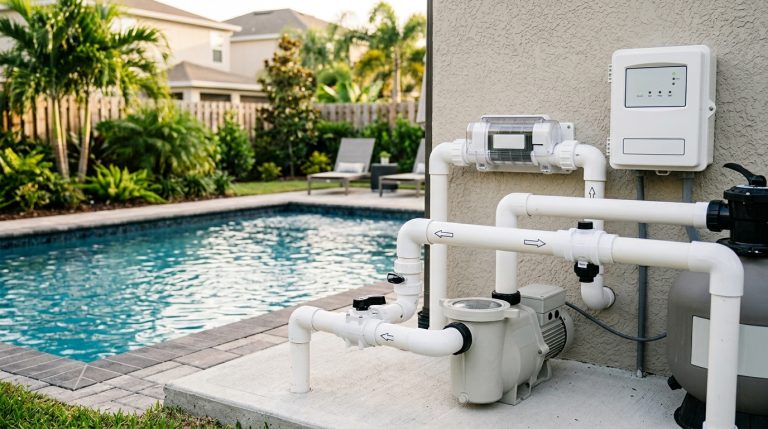
The spores are already part of the outdoor mess around a pool. Leaves, soil, pollen, toys, swimsuits, and wind can all bring them in. They usually stay harmless until the water gives them an opening. Low or inconsistent chlorine is the big one, but poor circulation, a clogged filter, warm water, and shady dead spots can all help a bloom take off.
According to Latham Pool, spores can move from soil and plant debris into your water, then take hold when sanitation, circulation, or filtration slips. So an algae bloom is rarely just bad luck. It’s a signal your chemistry drifted. If you want the deeper chemistry picture behind all of this, read our pool water chemistry guide before your next fill.
Green algae: the common one
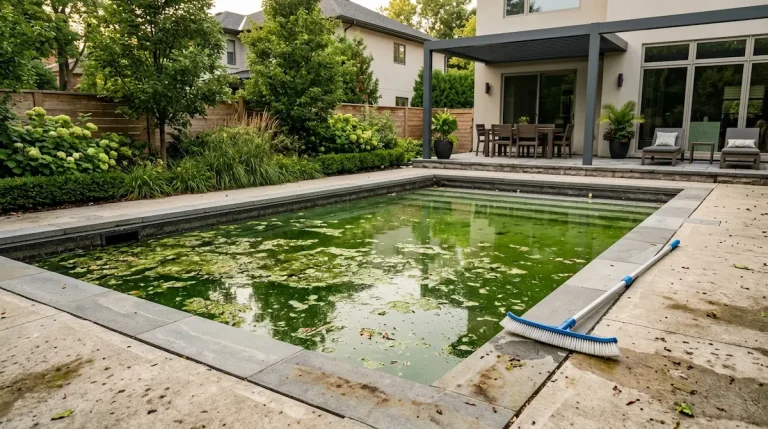
This is the algae most owners meet first. It can turn the water a hazy green, or it can leave a slippery coat on the walls and floor. The upside? It usually gives up faster than the other two. Brush it loose, shock the water hard, run the filter around the clock, and many mild green blooms clear in a few days.
If the whole pool turned pea-soup green over a weekend and you want the fast rescue version instead of the overview, that’s its own topic. Start with why is my pool green for the quick-fix walkthrough.
Is it green algae or just cloudy water?
Quick test. If the water has a green tint but you can still see the bottom, you may be catching a chlorine dip early, before a full bloom. If you can’t see your feet on the steps and the walls feel slick, treat it like algae. Brush a wall and watch what happens. A green cloud puffing off the surface is your confirmation.
Mustard algae: the one that pretends to be dirt
Mustard algae, also called yellow algae, belongs in the same problem family as green algae, but it behaves differently. It settles as a yellow-brown powder on walls, steps, and the shady side of the pool. People vacuum it up, think they’re done, and then see it sitting in the same spot the next morning. That comeback is the tell.
The tricky part is chlorine resistance. Townley Pool notes that mustard algae can carry protective compounds that help it survive oxidation, even when the pool looks properly chlorinated. You need stronger shock, aggressive brushing, and a full cleanup of anything that touched the water. Floats, brushes, swimsuits, the vacuum head. Miss one and it can reseed. For the full identification-versus-dirt breakdown and treatment, see mustard algae in pool.
Black algae: the stubborn one
Black algae usually starts as small dark dots, anywhere from pinhead size to coin size. It loves rough surfaces: plaster, gunite, exposed aggregate, and grout lines. It also is not just a normal green bloom wearing a darker color. Leslie’s Pool points out that black algae is a form of cyanobacteria, with a protective outer layer and roots that grip into the surface.
That shell-and-root setup is why it fights back. Scrub off the top and the roots can grow it right back. You have to break the cap with a stiff brush, hit the water with a heavy shock dose, and treat the rooted spots directly. Don’t rush it. For the step-by-step removal built just for this type, check more on black algae in pool.
Is it actually algae? The lookalike test most guides skip
Before you dump chemicals in, make sure you’re fighting the right enemy. Plenty of “algae” panics turn out to be dirt, pollen, or stains. This table is the part most ranking guides leave out, and it can save you money.
| What you see | Likely culprit | Quick check |
|---|---|---|
| Fine tan powder on the floor | Dirt or pollen | Vacuums up and stays gone. Algae returns to the same spot. |
| Yellow patch that keeps coming back | Mustard algae | Brushes into a cloud, resettles overnight. |
| Grey, brown, or bluish stains that won’t brush off | Metal staining (iron, copper) | Won’t move with a brush. Reacts to a vitamin-C tablet test. |
| Slick green film | Green algae | Puffs off the wall when brushed. |
If a brush does nothing and the marks stay put, you’re probably looking at stains, not algae. Shocking harder won’t fix that.
Matching your treatment to the type
The order does not change much: balance the water, brush hard, shock, filter, repeat. What changes is how much force each step needs. ASP Pool Company recommends doubling a normal shock dose for green algae, roughly tripling it for mustard algae, and going up to four times for black algae. More resistance means more firepower.
| Type | Shock vs normal dose | Brush to use | Algaecide type | Rough clear time |
|---|---|---|---|---|
| Green | About 2x | Standard nylon brush | Standard or polyquat | Usually around 1 to 3 days for a mild to moderate bloom |
| Mustard | About 3x | Stiff brush, plus clean all gear | Copper or mustard-specific | Often around 2 to 4 days, depending on how well you clean gear and surfaces |
| Black | About 4x | Steel/stainless brush (never on vinyl) | Copper-based | Often a week or more because the roots have to be attacked directly |
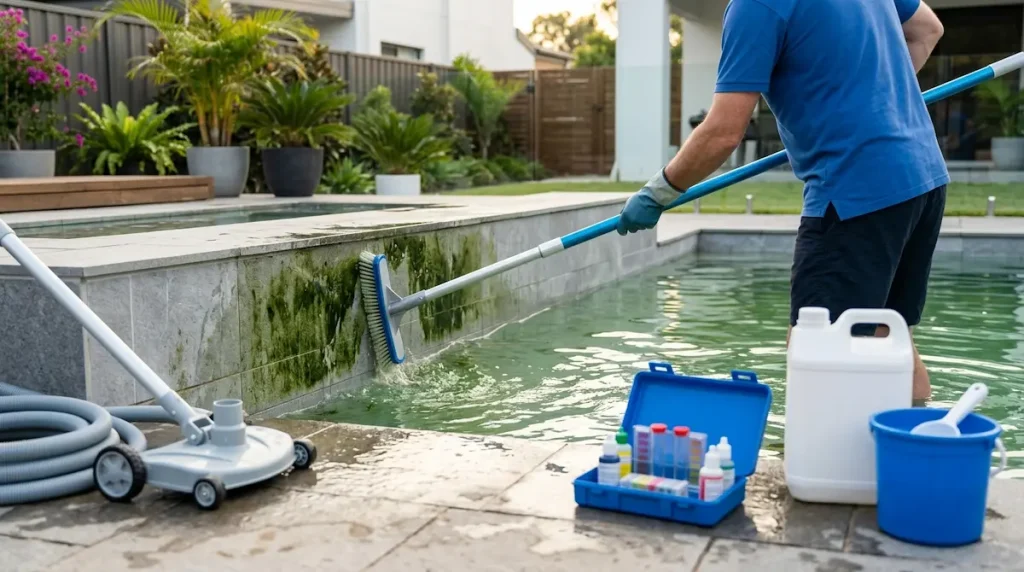
Whatever the type, the sequence and timing matter more than the brand of chemical. For the full ordered process that works across all three, read about how to get rid of pool algae. And if you’re choosing a product to finish the job and keep it away, compare our best pool algaecide guide.
What it costs to clear an algae bloom
Treating algae yourself is cheap compared to calling a pro, especially for green algae. The numbers below are ballpark ranges, not fixed prices. Pool size, product strength, local labor, brand, season, and how bad the bloom got can all move the final cost. Check current local prices before you buy.
| Item | Rough cost |
|---|---|
| Pool shock (per bag) | Usually around $5 to $8 per bag as a starting range |
| Algaecide bottle | Often roughly $15 to $30, depending on formula and size |
| Phosphate remover | Commonly about $20 to $40, depending on concentration |
| Pro “green to clean” service | Often from about $150 to $400 or more, depending on market and bloom severity |
A stubborn black or mustard outbreak burns through more shock and more of your time, which is the real cost. For how algae treatment fits your yearly upkeep budget, see pool maintenance cost.
How to keep algae from coming back
Prevention is not exciting. It is still the whole game. Algae has a much harder time taking hold when sanitizer stays steady. CDC: Home Pool Water Treatment and Testing recommends keeping free chlorine at a minimum of 1 ppm and pH between 7.0 and 7.8 in pools, and at least 2 ppm free chlorine if you use a stabilizer like cyanuric acid.
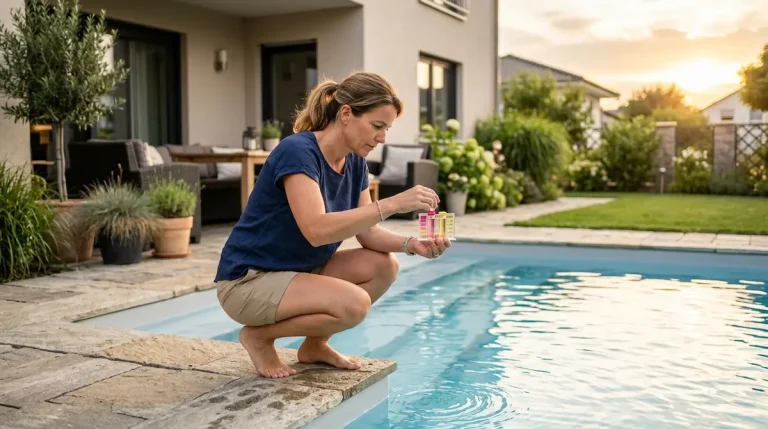
- Test your water two or three times a week in swim season, and more after heavy rain or a pool party.
- Keep chlorine steady in the 1 to 3 ppm range and don’t let it crash for days.
- Run the pump long enough for good daily circulation so warm, still pockets do not sit untouched.
- Brush the shady corners and steps weekly, since that’s where blooms often start.
- Watch your cyanuric acid. Compass Pools suggests keeping it around 30 to 50 ppm, because too much can make chlorine less effective.
Do those five things and you’ll rarely see algae at all. Skip them for a hot week with a lazy filter, and green water becomes a lot more likely.
Frequently asked questions
Can you swim in a pool with algae?
Better not. The bigger problem is what cloudy, poorly sanitized water can hide: bacteria, slippery surfaces, and low visibility. Clear the water first, confirm the chemistry is safe, then swim.
Will shock alone kill pool algae?
For green algae, shock plus brushing and a full day of filtration often does the job. Mustard and black algae usually need more. Expect higher doses, harder scrubbing, and an algaecide or spot treatment to finish the work.
Is black algae really algae?
Not exactly. It is a form of cyanobacteria, which helps explain the protective shell, rooted growth, and stubborn behavior. Treat it like a rooted organism on the surface, not a simple green cloud in the water.
How do I tell mustard algae from sand or dirt?
Brush the patch. Dirt lifts, filters out, and stays gone. Mustard algae puffs into a cloud and settles right back in the same spot within a day. The return is the giveaway.
How long does it take to clear a green pool?
Many green pools clear in about one to three days when the water is balanced, the pool is shocked properly, and the filter runs nonstop. Cloudy blue water afterward is normal. That usually clears as the filter catches the dead algae.
The bottom line on beating pool algae
Start by naming what you’ve got. Green means brush, shock, filter, and you may be swimming again soon. Mustard means the same routine at higher intensity, plus cleaning every toy and tool that touched the water. Black means patience, a stiff brush, and treatment aimed at the roots.
Then keep it from coming back the easy way: steady chlorine at 1 to 3 ppm, balanced pH, a filter that actually runs, and a weekly brush of the shady spots. Get the prevention right and you’ll spend far less time fighting the green monster than the folks who only react once the water turns.