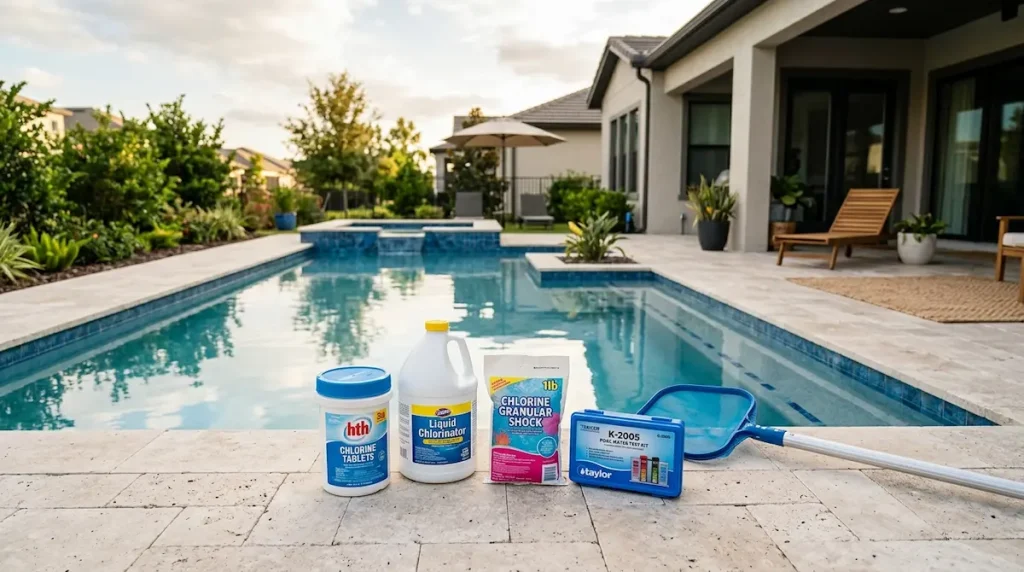
Standing in the pool aisle, staring at five tubs that all say “chlorine” on the label? You’re not the only one. The main types of pool chlorine (tablets, liquid, granular, and shock) all sanitize the same way once they dissolve, but they behave very differently in your water. Pick the wrong one and you’ll chase cloudy water, a stabilizer level that keeps climbing, or a pH that won’t sit still. This guide breaks down each type, what it’s genuinely best for, and how to choose without overthinking it.
The short answer
Most home pools come down to four chlorine choices: trichlor tablets for low-effort weekly sanitizing, dichlor granules for quick top-ups, calcium hypochlorite (“cal hypo”) for strong shocking, and liquid chlorine for everyday dosing. Salt systems are the fifth path, because they make chlorine on site. The big split is simple: tablets and dichlor are stabilized, while liquid chlorine and cal hypo are not.
Quick comparison at a glance
| Type | Form | Available chlorine | What it adds to water | Best for |
|---|---|---|---|---|
| Trichlor | 3″ tablets / pucks | about 90% | CYA up, pH down | Hands-off weekly sanitizing |
| Dichlor | Granular | about 56–62% | CYA up, near-neutral pH | Spot dosing and spas |
| Cal hypo | Granular / briquette | 65–78% | Calcium up, pH up | Shocking and algae blooms |
| Liquid (sodium hypochlorite) | Liquid | about 10% to 12.5% | No CYA, no calcium, pH up | Cheap routine dosing, big pools |
| Salt chlorine | Generated on site | n/a (made as needed) | Mild, steady | Low-effort saltwater setups |
The five types of pool chlorine, explained
Once dissolved, these products all work toward the same goal: creating the active sanitizer your pool needs, mainly hypochlorous acid. The difference is what comes along for the ride. Some add stabilizer. Some add calcium. Some push pH up or down. That’s the part that decides whether your water stays easy or becomes a weekly puzzle.
Trichlor tablets
If you’ve ever used a floating dispenser, you’ve probably used trichlor. Trichlor (trichloroisocyanuric acid) is the familiar 3-inch puck used in floaters and inline chlorinators. It is strong, slow-dissolving, and stabilized, with around 90% available chlorine. For a set-and-forget weekly routine, it’s tough to beat.
The trade-off shows up later. Trichlor is acidic, so it tends to pull pH and alkalinity down. It also adds cyanuric acid (CYA) with every tablet. As a rough rule, adding 1 ppm of chlorine from trichlor also adds close to 1 ppm of CYA. Chlorine gets used up. CYA mostly stays.
- Pros: high strength, cheap per dose, sun-protected, minimal effort.
- Cons: CYA creeps up over the season, and it slowly pulls pH and alkalinity down.
- Best for: outdoor pools where you want a steady, low-labor routine.
Dichlor granules
Dichlor is also stabilized, but it comes as fast-dissolving granules instead of tablets. It sits closer to pH-neutral than trichlor, so it is easier on water balance in the short term. That makes it handy for spas, small pools, and quick chlorine top-ups after a busy swim day.
Same catch, different package. Dichlor still adds CYA. If you use it as your daily sanitizer, your stabilizer can climb faster than you’d expect.
- Fast-dissolving and gentle on pH.
- Handy for spot treatments and hot tubs.
- Downside: raises CYA, and it usually costs more per pound than the alternatives.
Calcium hypochlorite (cal hypo)
When algae shows up, cal hypo is the bag many pool owners reach for first. It is an unstabilized chlorine product, so it adds no CYA. Most products land around 65–78% available chlorine, and a common 73% cal hypo product delivers about 70% available chlorine. That’s why it works well for shock dosing.
Instead of stabilizer, cal hypo leaves calcium behind. A practical estimate is about 0.6 to 0.8 ppm of calcium hardness per pound per 10,000 gallons. In a vinyl or fiberglass pool with soft water, that may not be a problem. In a plaster pool that already tests high for calcium, repeated use can push you toward cloudy water and scale. Its pH is high, around 12, so it can nudge pH up for a while. Many brands also recommend pre-dissolving it in a bucket before adding it to the pool.
- Pros: powerful, fast, no stabilizer buildup, cost-effective for shocking.
- Cons: adds calcium, can cloud water if dumped in dry, and it can bleach vinyl liners.
Liquid chlorine (sodium hypochlorite)
Liquid chlorine is the workhorse for pool owners who want clean water without extra stabilizer or calcium. Pool-grade liquid chlorine is usually 10% to 12.5% sodium hypochlorite, while household bleach is often closer to 6%. It is unstabilized, easy to dose, and usually one of the cheapest ways to chlorinate a large pool.
The downside is handling and freshness. Liquid chlorine is heavy, it takes up space, and it loses strength on the shelf. Heat and sunlight speed that up. Buy it fresh, store it cool and shaded, and don’t let a jug sit around all season. It also has a high pH, around 13, so pH can drift up over time.
- Cheapest per dose and leaves no residual buildup.
- Perfect for routine dosing and for shocking without adding calcium.
- The trade: it’s heavy to haul, degrades on the shelf, and needs a separate stabilizer if your pool is outdoors.
Salt chlorine (the fifth option)
A salt system doesn’t come in a jug. A generator converts dissolved salt into chlorine on demand, giving you a mild, steady feed with far less handling. You still run chlorine, just made on site. It’s a bigger upfront cost and a different decision, so we cover the trade-offs against a traditional pool separately.
Stabilized vs unstabilized: the CYA question that trips people up
This is where many chlorine choices go wrong. Stabilized chlorine, meaning trichlor and dichlor, already includes cyanuric acid. That helps protect chlorine from sunlight, so it lasts longer outdoors. Unstabilized chlorine, meaning liquid and cal hypo, does not include CYA. It can disappear faster under UV, but it will not keep raising your stabilizer level.
Why care? Too much CYA and your chlorine gets lazy. It’s still in the water, just less able to sanitize, which is how pools with “normal” chlorine still turn green. If your stabilizer or chlorine climbs too high from tablets, see how to lower chlorine in pool. When the opposite happens and your reading bottoms out, check our how to raise free chlorine guide. Either way, it all ties back to keeping the whole panel balanced, which we cover in read about pool water chemistry.
The CDC gives pool owners a simple baseline: keep pH between 7.0 and 7.8, and keep free chlorine at least 1 ppm. If you use CYA or stabilized products, the CDC says free chlorine should be at least 2 ppm. See the CDC’s home pool water treatment guidance for the full recommendation.
What each type quietly does to your water over a season
Most guides stop at pros and cons. The thing that actually bites you is the slow buildup. Use one chlorine type week after week, and its side effect starts to shape the whole pool.
| Type | CYA over time | Calcium over time | pH direction | The season-long risk |
|---|---|---|---|---|
| Trichlor | Climbs fast | None | Drifts down | CYA lock, weak chlorine by August |
| Dichlor | Climbs fast | None | Roughly flat | Same CYA creep as trichlor |
| Cal hypo | None | Climbs | Drifts up | Scale and cloudiness in hard water |
| Liquid | None | None | Drifts up | Rising pH, needs acid now and then |
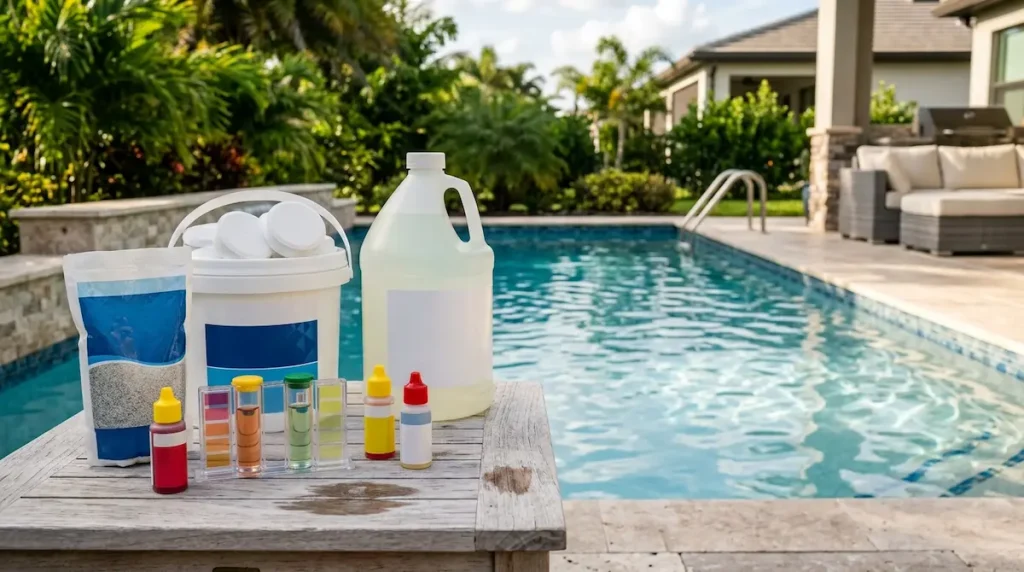
Read it left to right and the smart move jumps out. Rotate. Many owners run liquid chlorine as the daily workhorse, lean on trichlor tabs for vacations, and keep cal hypo on the shelf for algae emergencies. That mix keeps any single side effect from running away from you.
So which type should you use?
Depends on your pool surface and how much you want to fuss. Quick read:
- Vinyl or fiberglass pool: liquid chlorine for routine dosing, cal hypo for shock (the added calcium is welcome here). Keep cal hypo off painted or vinyl surfaces when pouring, and pre-dissolve it.
- Plaster or gunite pool with hard water: favor liquid chlorine and trichlor, and go easy on cal hypo so calcium doesn’t spike.
- You travel a lot: trichlor tabs in a floater buy you a week of hands-off sanitizing.
- Indoor pool: liquid or cal hypo. No sun means you don’t need stabilizer, so skip the CYA-adding types.
When it’s time to actually dose, don’t eyeball it. Match the amount to your pool volume with more on how much chlorine to add to pool.
A quick word on cost
As a general pattern, liquid chlorine is often the cheapest per dose, cal hypo is close behind for shock treatments, trichlor tablets cost more but save labor, and dichlor usually sits on the pricier side per pound. Treat that as a budgeting guide, not a fixed price. Chlorine prices change by brand, region, store, season, and container size, so check current local pricing before you plan the whole year. For a broader upkeep budget, see pool maintenance cost.
Frequently asked questions
Which type of chlorine is best for my pool?
For most home pools, liquid chlorine for everyday sanitizing plus cal hypo for shock is the cleanest combo, because neither locks up your water with stabilizer. If you want low effort and travel often, trichlor tablets win. Match the choice to your surface and your schedule.
Can you mix different types of chlorine?
Keep each chlorine type in its own container, feeder, floater, and scoop. Do not combine them before they go into the pool. Mixing cal hypo and trichlor, for example, can react violently and may start a fire. Add products separately, follow the label, and rinse tools between uses.
Is liquid chlorine better than tablets?
For water chemistry, often yes. Liquid adds no CYA, so your chlorine stays effective all season. Tablets win on convenience. The honest answer is that a lot of owners use both: liquid as the base, tablets for hands-off stretches.
What’s the difference between chlorine and shock?
Regular chlorination keeps a steady sanitizer level in the pool. Shock is a larger, faster dose used after heavy use, algae, or contamination. It is often cal hypo, dichlor, or liquid chlorine, and it may raise chlorine to around 10 ppm for a short time. Same chemical family, different job.
Can you use chlorine in a saltwater pool?
Yes. A salt pool is a chlorine pool that makes its own. You can still add liquid chlorine or cal hypo to shock it after heavy use. Avoid dumping trichlor into a salt system, since the CYA and pH swings work against it.
The bottom line for your pool
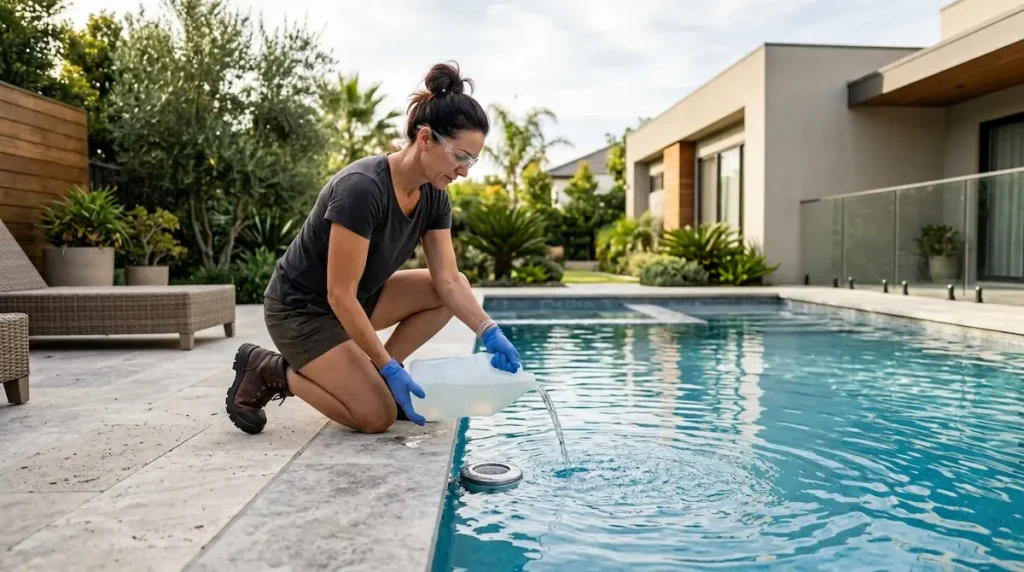
Don’t overthink the label. Pick liquid chlorine as your everyday sanitizer if you want the healthiest water and the lowest running cost, keep a bag of cal hypo for shocking and algae, and reach for trichlor tablets only when you need a week of hands-free coverage. Test weekly, watch your CYA and calcium as they build, and rotate your types so no single side effect takes over. Do that and your water stays clear without turning pool care into a second job.