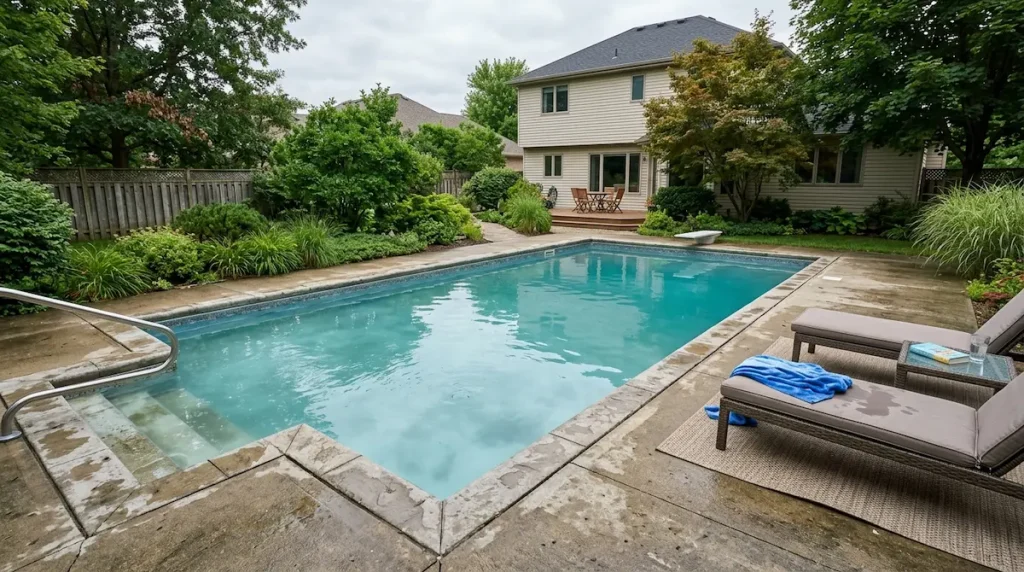
Your pool looked great last week. Now it’s a hazy, milky mess, and you’ve got people coming over Saturday. If you own a pool long enough, cloudy pool water eventually shows up. Most of the time, the cause sits in one of three buckets: drifting chemistry, weak filtration, or organic debris that slipped in.
Find the right bucket, and the fix gets simple. Guess wrong, and you’ll spend money on products that never touch the real problem.
Why is your pool cloudy?
Cloudiness is basically stuff your filter has not caught yet. Tiny particles stay suspended in the water, so the pool looks hazy instead of clear. The usual suspects are weak filtration or circulation, high pH or alkalinity, low free chlorine, early algae, and too much calcium. Figure out which one you’re dealing with before you reach for a clarifier.
Read the cloud before you treat it
Not all cloudy water looks the same. The color, timing, and texture give you a real clue. Start here.
| What the water looks like | Most likely cause | First move |
|---|---|---|
| Bright white or milky, worse in sunlight | High pH, high alkalinity, or calcium scale | Test and rebalance chemistry |
| Dull, grayish, slightly green haze | Low chlorine or early algae | Shock, brush, keep filtering |
| Hazy right after a rainstorm | Diluted chlorine plus fresh debris | Skim, test, shock, filter nonstop |
| Fine haze while your test kit reads perfect | Filtration limit or ultra-fine particles | Clean the filter, then add clarifier |
| Cloudy right after you add DE powder | Torn DE grid leaking powder back in | Inspect and replace the grids |
What makes pool water go cloudy
Most clouds trace back to five culprits. They overlap, too. It is common to have two problems at once.
Weak filtration or circulation
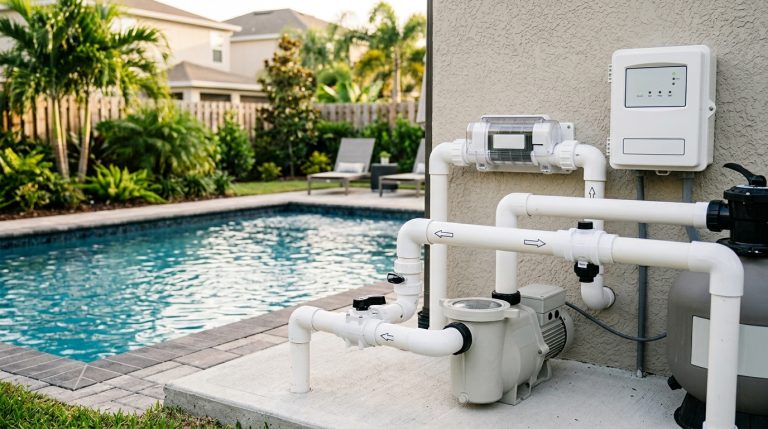
This is the big one. A dirty cartridge, channeled sand, or a pump that only runs a few hours a day simply can’t grab the fine stuff floating around. For day-to-day upkeep, eight hours is a practical floor for many residential pools. While you’re clearing a cloud, run the system around the clock.
Backwashing alone won’t always save you. Oils and sunscreen can cling to the filter media and drag down its efficiency. If your sand filter is more than five years old, the sand may have lost its bite and need replacing.
pH and alkalinity out of range
When pH or total alkalinity climbs too high, chlorine works less effectively and calcium can fall out of the water as fine white specks. That’s the classic milky look. Start with alkalinity. Keep it around 80 to 120 ppm, then fine-tune pH. Chasing pH while alkalinity is still high is a losing game because alkalinity is the buffer that keeps pH from swinging. Want the full balancing rundown? see pool water chemistry.
Low chlorine and organic gunk
Sweat, sunscreen, body oil, pollen, leaves. All of it eats your chlorine. When free chlorine can’t keep up, the water goes dull and hazy, and algae gets its opening. For most pools, 1 to 4 ppm free chlorine is the working zone to watch. According to CDC healthy swimming guidance, pH should sit between 7.0 and 7.8 with free chlorine held at effective levels, and both can drift fast on a busy pool day. If your chlorine plummets, you’ve got a demand problem, not a clarity problem. (CDC: Healthy Swimming Guidance)
Early algae you can’t see yet
Algae rarely starts green. The first sign is usually water that looks flat or slightly cloudy even though your numbers seem okay. Catch it at this stage and a solid shock plus a good brushing usually stops it before your pool turns into a pond.
Too much calcium
Once calcium hardness gets up around 400 ppm or higher, the water can start looking chalky and scale can show up on the walls. You’ve got two ways out. You can use a clarifier to help the filter catch the particles, or drain part of the pool and refill with fresh water to dilute it. Test and rebalance afterward, whichever route you pick.
Find the real cause before you spend a dime
Skip this step and you’re just guessing. Two quick checks tell you almost everything.
The overnight chlorine test
This one’s free, and it settles the algae question fast. Test your free chlorine in the evening, then again first thing in the morning, with no swimmers and no sun in between. If the level dropped hard overnight, something living or organic is eating it, so treat it as algae.
If the chlorine held steady but the water is still cloudy, you’re probably fighting fine particles or a filter that can’t keep pace. That single test stops people from dumping clarifier on an algae problem. That never ends well.
Check flow, not just “pump on”
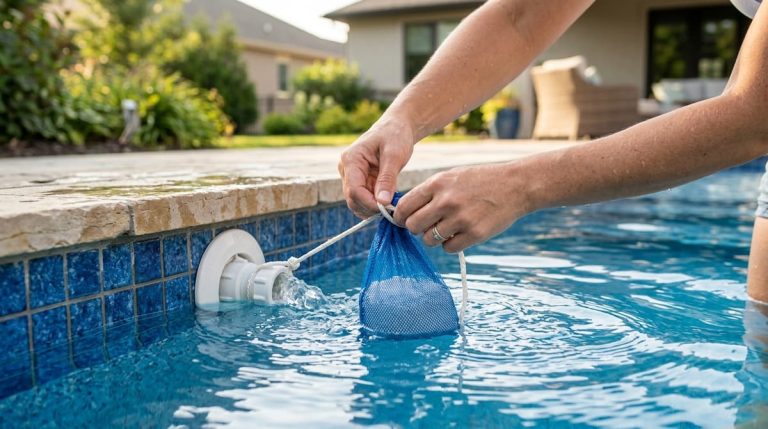
Water moving isn’t the same as water turning over. Peek in your pump and skimmer baskets for clogs. Look at the return jets. Weak returns point to a dirty filter, a clog, or an air leak. Then compare your filter pressure to its clean starting number. A big jump means the filter is loaded and needs cleaning before it can do anything for clarity.
How to get your water clear again
Once you know the cause, cleanup follows a simple order. Correct the chemistry, run the filter hard, clean up debris mechanically, and only then reach for a clarity product. For exact timing and dosing, read our how to clear cloudy pool water fast guide. The short version:
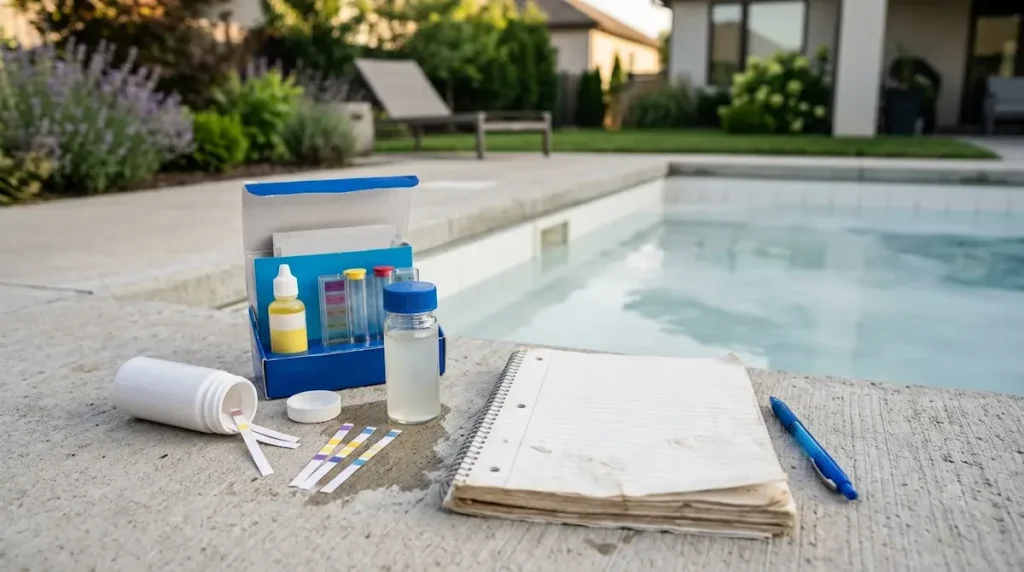
- Test everything: free chlorine, pH, alkalinity, and calcium hardness.
- Balance alkalinity, then pH, then bring chlorine up to an effective level.
- Shock in the evening if organics or early algae are in play.
- Brush the walls, steps, and shallow-end corners where haze likes to hide.
- Run the filter nonstop and clean it whenever pressure spikes.
Then give it time. With the chemistry corrected and the filter actually doing its job, expect a one-to-three-day clearing window. See zero change after a full day of continuous circulation? Your filter is the bottleneck, not your chemicals.
Match the product to the problem
Treat clarifier and flocculant as finish tools, not the first move. They work best once your chemistry is stable. Pick the wrong one and you’ll either gum up a cartridge or spend an afternoon vacuuming sludge. For a deeper breakdown, see pool clarifier vs flocculant. Quick comparison:
| Treatment | Best for | How fast | Trade-off |
|---|---|---|---|
| Clarifier | Mild haze with balanced chemistry; bottom still visible | 1 to 3 days | Slower, and can clog cartridges if you overdose |
| Flocculant | Severe cloudiness when you need results now | Overnight, about 8 to 12 hours | Lots of manual work; you must vacuum to waste |
| Shock | Organic cloud, chloramine buildup, early algae | 1 to 3 days | Does nothing for particle or calcium haze on its own |
The pros and cons shake out like this. Clarifier is the low-effort pick that plays nice with your filter, though it tests your patience. Flocculant is the fastest option, yet it needs a vacuum-to-waste setup and careful cleanup, so above-ground pools without that valve should stick with clarifier. Shock is essential when something organic is behind the cloud, and useless against plain mineral haze.
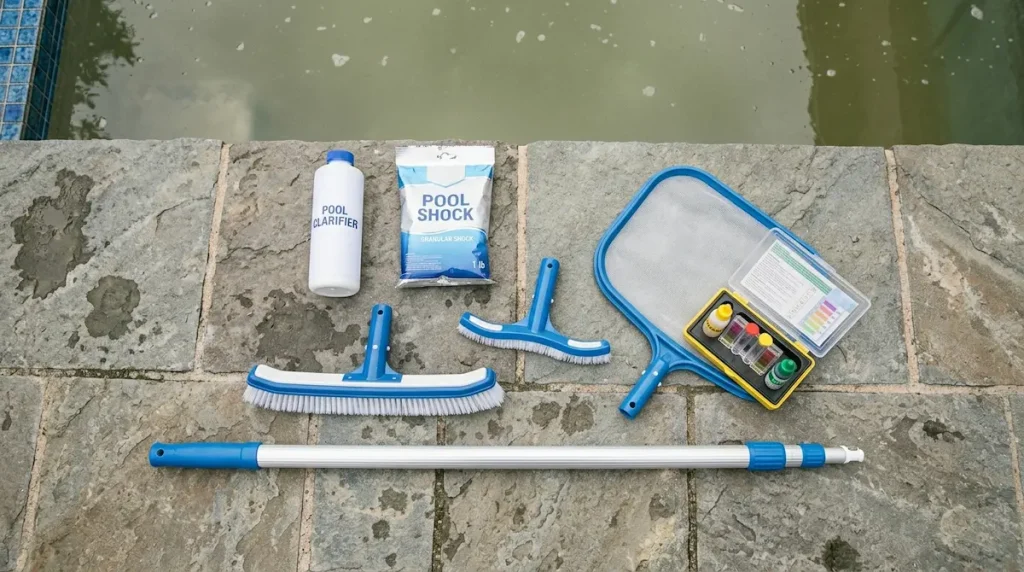
What it costs to clear a cloudy pool
Clearing a cloud is usually cheap next to the panic it causes. Most fixes are a bottle or a bag away. Use these as typical U.S. retail ranges, not fixed prices. Brand, pool size, region, and timing can all change the number, so check current local pricing before you buy.
| Fix | Typical cost (USD) | Notes |
|---|---|---|
| Water clarifier | around $15 to $30 | One bottle treats most residential pools |
| Flocculant | roughly $15 to $30 | Plus your time vacuuming to waste |
| Pool shock | about $5 to $10 per bag | Cloudy water often needs a double dose |
| Filter cleaner | from $15 to $25 | Use it 2 to 3 times a season |
| Replacement filter sand | $10 to $25 per 50 lb bag | Only if the sand is over 5 years old |
| Pro service visit | about $75 to $150 | Worth it if it stays cloudy past a week; check current local rates |
Steady upkeep beats crisis cleanups every time. If you want to map out your yearly spend, read more on pool maintenance cost.
How long until it clears
Balanced water with a clean, hard-running filter usually clears in one to three days. Flocculant can drop the haze overnight if you vacuum it out the right way. Algae recovery drags longer, sometimes a week or more, because it keeps coming back until every last cell is gone. Still no change after 24 hours of nonstop filtering? Your filter is the weak link, not your chemistry.
Keep it from coming back
Clear water is a habit, not a rescue mission. A few small routines head off most clouds before they start:
- Test the water 2 to 3 times a week, and actually act on what you read.
- Hold free chlorine at 1 to 4 ppm, pH at 7.2 to 7.6, and alkalinity at 80 to 120 ppm.
- Run the filter at least 8 hours a day, longer in peak heat and heavy swim traffic.
- Deep-clean the filter a few times a season, not just a quick backwash.
- Skim and brush weekly so debris never gets the chance to break down into haze.
So, what should you do first?
Start with a full water test and the overnight chlorine check. Those two tell you whether you’re up against chemistry, filtration, or algae, and that single answer drives every decision after it. Balance the water, run your filter hard, and wait a couple of days before you judge any product. Most cloudy pools clear on that alone. Save the clarifier or flocculant for the stubborn last stretch, once your numbers are already dialed in.
Cloudy pool water FAQ
Can you swim in a cloudy pool?
Better not to. It isn’t always dangerous, but cloudy water usually signals algae, bacteria, or off-balance chemistry, and you can’t see the bottom, which is a genuine drowning risk. Test and clear it first.
Will shock clear cloudy water?
Only when the cloud comes from low chlorine, organics, or early algae. Shock destroys the living and organic load, but it won’t touch haze from high calcium or a failing filter. Test before you toss a bag in.
Why is my pool still cloudy after shocking?
Usually the shock did its job on the organics, but your filter still hasn’t removed the dead particles left behind. Keep the pump running and add a clarifier to help it grab the fine stuff. If chlorine also dropped overnight, plan on a second round.
How do I clear a cloudy pool fast?
Balance the chemistry, run the filter 24/7, and for severe cases use flocculant, then vacuum to waste. That combination is the quickest safe route. Full timing and doses live in the fast-clearing guide linked earlier.
Is cloudy water always algae?
No, and assuming so wastes money. Plenty of cloudy pools have perfect chlorine and zero algae. The overnight chlorine test is the fastest way to rule algae in or out.